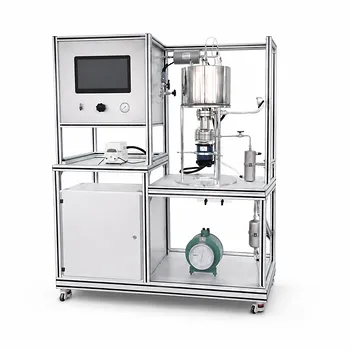
pH and DO: The Beating Heart of Bioreactor Control. In educational and research pilot plant bioreactors, real-time pH control is achieved by a potentiometric probe wired into a PLC or DCS that triggers precise dosing of CO₂ gas to lower pH or a base such as sodium carbonate to raise it, typically using a deadband to stop rapid cycling. Dissolved oxygen (DO) is managed by a polarimetric or optical sensor whose signal drives a cascade control loop that first increases impeller agitation speed and then adjusts sparge gas flow or oxygen enrichment to maintain the setpoint. These automated feedback systems ensure that pH stays within the microorganism’s optimal window and DO stays above critical thresholds—preserving enzyme structure, preventing oxygen shock, and delivering reproducible results.
The real objective of pH and DO control is not simply hitting a number. It is the constant, silent negotiation between the bioreactor’s automation and the fragile biological reality inside—protecting three‑dimensional protein structures, averting plasmid instability, and giving researchers a trustworthy platform to study what actually happens when these parameters drift.
How Real-Time pH Control Works
The Electrochemical Eye: pH Measurement
A sterile, steam‑sterilizable potentiometric pH probe sits immersed in the culture, delivering a millivolt signal proportional to hydrogen ion activity.
This raw signal is amplified and fed into the bioreactor’s control unit (PLC or DCS), where it is compared against the user‑defined setpoint.
The measurement is continuous; even a drift of a few hundredths of a pH unit triggers a corrective response.
The Duel of Gases and Liquids: CO₂ and Base Dosing
When the culture pH rises above the setpoint—often during early growth phases when cells consume acids—the controller opens a valve to sparge pure carbon dioxide gas.
CO₂ dissolves, forms carbonic acid, and gently pulls the pH back down without a sudden ionic shock.
If the pH falls below the setpoint, a peristaltic pump injects a sterile basic solution, frequently sodium carbonate, to neutralize the excess acidity.
The Art of the Deadband: Preventing the Control Loop from Chasing Its Tail
A simple on‑off control would oscillate endlessly around the setpoint, exhausting the dosing lines and stressing the cells.
Engineers introduce a deadband—a narrow, intentional no‑action zone (e.g., ±0.03 pH units) around the setpoint—where no corrective action is taken.
This hysteresis stabilizes the culture environment and protects the delicate biochemical machinery from constant acid/base swings.
How Real-Time Dissolved Oxygen Control Works
Sensing Oxygen: Polarographic vs. Optical Technology
Polarographic (Clark‑type) DO sensors measure a current produced by oxygen reduction at a cathode, while optical sensors measure the quenching of a fluorescent dye.
Both technologies are robust, sterilisable, and deliver a signal proportional to the oxygen partial pressure in the liquid.
The controller converts this signal into a percentage of air saturation, with a typical mammalian‑cell setpoint kept above 30%.
A Tale of Two Knobs: Aeration and Agitation
The simplest control lever is the sparge gas flow rate: increasing sterile air flow forces more oxygen into the liquid.
However, high sparge rates create excessive foaming that can clog exhaust filters and strip product from the headspace.
The second, more efficient lever is impeller agitation speed. Faster mixing smashes gas bubbles, multiplies the gas‑liquid interfacial area, and drastically reduces the liquid‑film resistance that limits oxygen transfer.
The Cascade Control Loop: An Intelligent Hierarchy
Modern educational and research systems deploy a cascade architecture: a master DO controller sends a setpoint to a slave agitation controller and a slave gas‑flow controller.
The typical sequence starts by ramping up the stirrer speed because it enhances oxygen transfer without altering the gas composition.
If agitation reaches a shear‑stress limit or fails to meet demand, the system then increases the sparge rate or enriches the inlet air with pure oxygen through a mass flow controller, always respecting the biological tolerance of the cells.
The Deep Need: Why These Parameters Matter to the Biologist
pH: The Guardian of Enzyme Structure
Proteins and enzymes function only when their complex three‑dimensional folds are intact; extremes of acid or alkali break hydrogen bonds and ionic interactions, causing irreversible denaturation.
Every bacterium, yeast, or mammalian cell has a narrow optimal pH range—straying outside it causes growth rates to plummet as metabolic enzymes lose activity.
Real‑time pH control is therefore not about comfort; it is the direct defense of catalysis and product formation.
DO: The Oxygen Shock and Plasmid Stability
Recombinant E. coli carrying foreign plasmids place an enormous oxygen demand on the culture; even brief periods of oxygen depletion trigger an “oxygen shock.”
This shock induces plasmid instability—cells jettison their engineered DNA to ease the metabolic burden—and shifts carbon flux away from product toward mixed‑acid fermentation by‑products.
Maintaining DO above the critical level (usually above 20‑30% saturation) via the cascade loop preserves both cell fitness and product titer.
Understanding the Trade-offs and Common Pitfalls
Foaming: The Double-Edged Sword of High Aeration
Boosting sparge rate is a fast way to raise DO, but protein‑rich culture broths froth vigorously, filling the headspace and risking filter wetting.
Antifoam agents can suppress the foam, yet they alter surface tension and can foul optical sensors, creating a new control problem.
The cascade’s preference for agitation over gas flow is, in part, a strategy to stay below the foaming threshold.
Shear Stress: When Mixing Becomes Destructive
Animal cells lack a rigid cell wall; the same impeller tip speeds that accelerate oxygen transfer can rip membrane‑bound organelles apart.
Even robust microbial cells can suffer sub‑lethal shear damage that reduces yield.
A well‑tuned cascade loop places an upper limit on stirrer speed and only then calls for oxygen enrichment, respecting the delicate balance between oxygen delivery and mechanical integrity.
Deadband Dilemmas: Precision vs. Stability
A pH deadband set too wide allows slow, unnoticed drift that stresses the culture before the next correction.
A deadband set too narrow triggers incessant base/CO₂ pulses that waste reagents and create ionic oscillations.
The optimal width is a function of the biological system’s tolerance and the buffer capacity of the medium—a classic engineering trade‑off taught in every pilot‑plant course.
Making the Right Choice for Your Research or Education Goal
Each bioreactor run can be configured to emphasize different aspects of control. Your focus determines how you tune the loops.
- If your primary focus is teaching fundamental bioprocess control: Emphasize a simple deadband pH loop with visible dosing events, and a classical stirrer‑first cascade for DO, so students can manually observe the relationship between agitation and oxygen concentration.
- If your primary focus is maximizing recombinant protein yield: Tighten the DO cascade with aggressive agitation limits and early oxygen enrichment, and add a narrow pH deadband to avoid metabolic shifts that trigger plasmid loss.
- If your primary focus is studying metabolic responses to environmental stress: Intentionally widen the deadband or introduce a delay in the DO cascade to simulate industrial transfer lines, then track the transcriptomic or metabolomic footprint of those sub‑optimal windows.
Ultimately, the real power of an educational or research bioreactor lies not in the stainless steel, but in the logic that translates a tiny voltage from a probe into the precise drop of base, the calculated stirrer notch, or the whisper of oxygen that keeps a billion cells alive and productive—transforming a glass vessel into a true instrument of discovery.
Summary Table:
| Parameter | Sensor Technology | Control Mechanism | Biological Importance |
|---|---|---|---|
| pH | Potentiometric probe | Acid (CO₂ gas) / Base (Na₂CO₃) dosing with deadband | Prevents enzyme denaturation & growth rate drop |
| Dissolved Oxygen (DO) | Polarographic or Optical | Cascade loop: Agitation speed first, then gas flow/O₂ enrichment | Prevents oxygen shock & plasmid instability |
Optimize Your Bioprocess Education and Research with LABPARK
Looking to equip your laboratory with advanced, reliable pilot plants? LABPARK provides state-of-the-art Educational and Vocational Unit Operations Pilot Plants in chemical engineering, bioprocess & biotech, and environmental & water treatment.
Designed specifically for universities, research institutes, and enterprises, our bioreactors feature robust, real-time control systems for pH, DO, and other critical parameters to ensure reproducible research results and hands-on vocational learning.
Contact LABPARK Today to Request a Quote or Product Consultation
Related Products
- Bio-fermentation Ethanol Production Practical Training Unit Operations Pilot Plant
- Fixed-Bed Chemical Reaction and Gas Dust Tar Removal Unit Operations Pilot Plant
- Multi-Reactor Educational Pilot Plant for Reaction Engineering Unit Operations
- Internal Circulation Gradient Free Catalytic Reaction Educational Pilot Plant
- Tubular Reactor Flow Characteristics Determination Educational Unit Operations Pilot Plant
People Also Ask
- Why Use PTFE & Hastelloy in Chemical Pilot Plants? Prevent Corrosion & Ensure Safety
- Why Compare Predicted and Experimental Excess Enthalpy? Key to Accurate Pilot Plant Scale-up
- Why is the chemical plant startup schedule crucial? De-risk scale-up with pilot plants.
- When to transition from PID to adaptive control in pilot plants? Key process indicators.
- Why must batch and fed-batch fermentation pilot plants be designed to accommodate changing rheological conditions?