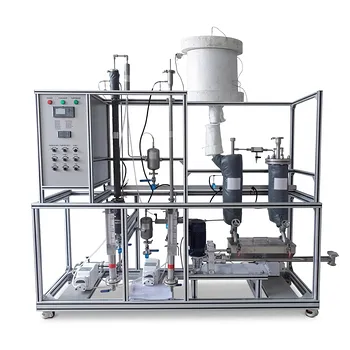
Cold spots are the enemy of efficient steam reforming—especially in compact pilot plants designed for teaching. In such units, there are three primary heat sinks that must be meticulously balanced: the strongly endothermic reforming reaction itself, the latent heat of vaporization needed to convert a premixed liquid feed (like a methanol/water mixture) into gas, and heat losses to the ambient environment through convection and conduction. Ignoring any one of them creates local temperature drops that slash reaction rates, forcing operation at higher temperatures or longer residence times to reach target conversions.
In teaching-scale catalytic steam reformers, three relentless heat drains—reaction enthalpy, feed vaporization, and ambient losses—must be balanced simultaneously. Failing to do so spawns cold spots that degrade reaction efficiency, increase carbon monoxide by-products, and obscure the very thermal integration principles students are meant to learn.
The Three Thermal Drains in a Pilot Reformer
Understand each heat sink in isolation to see how they collectively shape the reactor’s thermal landscape.
The Endothermic Reaction: The Core Consumer
The steam reforming reaction—converting methanol and water to hydrogen and carbon dioxide (or methane and water to syngas)—absorbs a substantial amount of energy. This endothermic demand is not constant; it intensifies at higher conversion where reactant concentrations are lower, making the downstream end of the catalyst bed especially prone to chilling if heat supply wavers.
Feed Vaporization: The Hidden Heat Thief
In many teaching-scale units, liquid methanol/water mixture is injected directly into the center of the reactor. Before reforming can start, that liquid must be fully vaporized. The latent heat of vaporization extracts a massive, localized energy dose right where the catalyst begins, creating a powerful cold spot at the reactor inlet if not preheated or integrated with upstream heat sources.
Ambient Losses: The Relentless Background Drain
Small pilot reactors have a high surface-area-to-volume ratio, making them exceptionally vulnerable to convective and conductive heat loss to the surroundings. Even with insulation, thermal radiation and air currents steadily siphon energy from the reactor wall, cooling the outer catalyst layers and creating radial temperature gradients.
Why These Heat Sinks Are Magnified in Teaching Pilot Plants
Teaching units amplify every thermal challenge, turning routine operation into a careful balancing act.
Low Thermal Mass and High Surface Exposure
Unlike industrial adiabatic reformers, bench-scale units often use small tubular reactors with limited insulation. This exaggerates the impact of ambient losses relative to the reaction heat, making steady-state temperature profiles harder to maintain and demonstrating to students how scale influences thermal behavior.
Integrated Vaporization Without Dedicated Preheat Trains
Cost and simplicity often eliminate separate vaporizers and superheaters. The liquid feed vaporizes inside the reactor itself, competing with the catalyst for heat. Students see firsthand that if the wall temperature isn’t high enough, the front portion of the bed becomes a glorified evaporator rather than a reformer.
Demonstrating the “Cold Spot” Cascade
Cold spots aren’t just academic; they trigger a self-reinforcing decline. A local temperature drop slows reaction kinetics, reducing the endothermic consumption and cooling that zone further. In a teaching context, this vividly illustrates the coupling between heat transfer and kinetics, but only if the sinks are deliberately managed to avoid uncontrolled quenching.
The Direct Consequence: Lost Efficiency and Misleading Data
When any heat sink outpaces the heat supply, the reactor’s output tells a distorted story.
Forced Operation at Higher Temperatures
To compensate for a chronically cold inlet zone, operators often raise the furnace temperature. This punishes the catalyst at the hot end (accelerating sintering) while still failing to fully eliminate the cold spot, leading to residual unconverted feed and increased CO formation via reverse water-gas shift at the hot tail.
Increased Carbon Monoxide Production
Steam reformers aim for high hydrogen and low CO. However, uneven temperature profiles push the water-gas shift equilibrium in warmer zones toward CO. In a teaching plant, students might obsessively adjust steam-to-carbon ratios without realizing the root cause is a thermal imbalance—exactly the lesson the cold spot should teach.
Masking the True Residence Time Requirement
Cold regions artificially inflate the apparent residence time needed for full conversion. Students might wrongly conclude that intrinsic kinetics are slow, when in reality the issue is inadequate heat delivery to the reaction zone, a classic diagnostic pitfall in reactor engineering.
Understanding the Trade-offs in Thermal Management
Pursuing perfect isothermal operation introduces its own downsides that must be weighed.
- Insulation versus inspectability: Heavy lagging reduces ambient losses but hides the reactor during visual demonstration runs. For teaching, a balance might involve transparent insulation or strategically placed viewing ports.
- Preheating versus complexity: Installing an external superheater for the feed eliminates vaporization’s cold spot, but adds capital cost, extra temperature controllers, and potential for coking in preheater lines—a different failure mode that muddies the core reforming lesson.
- Dilution as a thermal buffer: Co-feeding inert gas (e.g., nitrogen) with the liquid feed can cushion temperature drops by adding thermal mass and reducing reactant partial pressure, but it lowers effective productivity and confuses the material balance exercises students perform.
- Oversizing the furnace: A larger, more powerful heater can overwhelm all three heat sinks, but then the reactor operates under a much steeper thermal gradient that masks the delicate balancing act that real industrial reformers must achieve.
Making the Right Choice for Your Teaching Goals
The way you manage these three heat sinks should match what you want students to absorb. Tailor the design and operation accordingly.
- If your primary focus is demonstrating thermal integration: Keep the vaporizer and reforming zones intentionally coupled. Deliberately run the reactor with moderate insulation so students can map cold spots with thermocouples and see how preheating the wall or increasing furnace temperature changes the profile.
- If your primary focus is clean kinetic data collection: Install a dedicated, well-controlled superheater before the catalyst zone and use heavy insulation and guard heaters to minimize ambient losses. This eliminates vaporization and ambient drains as confounding variables, but be transparent with students about the artificial simplification.
- If your primary focus is minimizing cold spots while preserving simplicity: Increase the reactor wall temperature modestly near the feed inlet and wrap the entire unit in removable insulation blankets. Use a pre-mixed liquid feed that can be atomized to accelerate vaporization without oversaturating the catalyst front.
- If your primary focus is exploring CO mitigation strategies: Ensure heat sinks are balanced to prevent hot zones. A uniform temperature profile keeps the water-gas shift equilibrium favorable, so emphasize thermal uniformity over raw heat input.
Effective steam reforming pilot plants are not just chemical reactors—they are thermal orchestras. When you manage the endothermic reaction, the evaporation demand, and the environmental losses in concert, the cold spots vanish, the kinetics sing, and the principles of reactor thermal integration become permanently etched in your students’ minds.
Summary Table:
| Heat Sink | Mechanism & Impact | Management Strategy |
|---|---|---|
| Endothermic Reaction | Absorbs high energy, cooling the downstream catalyst bed. | Balance feed rates and optimize furnace temperature zones. |
| Feed Vaporization | Extracts massive latent heat, causing inlet cold spots. | Install preheaters/superheaters or atomize the liquid feed. |
| Ambient Losses | High surface-to-volume ratio siphons heat to surroundings. | Use high-quality removable insulation blankets. |
Enhance Practical Engineering Education with LABPARK
To help your students and researchers master thermal integration and kinetics, you need highly precise, reliable equipment. LABPARK provides state-of-the-art Educational and Vocational Unit Operations Pilot Plants in chemical engineering, bioprocess & biotech, and environmental & water treatment.
Designed specifically for universities, research institutes, and enterprises, our pilot plants deliver the control and visibility required to study complex reactions without confounding variables.
Contact LABPARK today to request a quote or customize your pilot plant!
Related Products
- Steam Methane Reforming Hydrogen Production and Purification Educational Pilot Plant
- Fixed Bed Gas Solid Catalytic Reaction Educational Pilot Plant
- Fluidized Bed Gas Solid Catalytic Reaction Educational Pilot Plant
- Multi Functional Catalytic Reaction and Reactor Evaluation Educational Unit Operations Pilot Plant
- Methane Cracking Educational Unit Operations Pilot Plant
People Also Ask
- How does integrating unit operations impact pilot plant thermal efficiency & CO management? Key design insights.
- How Do Temp, Pressure & S:C Ratio Affect Methane Reforming? Optimize Your Pilot Reactor
- In educational chemical engineering pilot plants, why use absorption and adsorption before reforming?
- SMR, POX, or ATR? Trade-offs in Hydrogen Production Educational Pilot Plants
- What are steam reforming pilot plant challenges? Master Feedstock Selection & Design