For operators in pilot plants, the choice of a conductivity electrode and its cell constant is a precise, range-driven decision. You select the electrode material and its cell constant by matching them to the expected conductivity range of the process fluid. For ultrapure water, you use a low cell constant (0.01–0.1 cm⁻¹) and inert materials like titanium or bright platinum. For high-salinity brines or concentrated chemical streams, you switch to a high cell constant (1–10 cm⁻¹) and electrodes built to resist polarization, such as platinum black or four-ring graphite.
The central principle is simple: the cell constant ($K = d/A$) must position the measured resistance in the linear, accurate range of the transmitter. A mismatch between the expected conductivity range and the cell constant is the fastest path to erratic readings and wasted pilot batches. The electrode material then acts as the guardian against chemical attack, contamination, and polarization, ensuring the constant remains stable.
Mapping the Fluid to the Cell Constant
The cell constant physically defines the resistance your instrument will see. A low cell constant creates a high cell resistance, which is perfect for measuring tiny ionic populations. A high cell constant lowers the resistance, making it possible to measure highly conductive solutions without saturating the electronics.
The Low-End Sweet Spot: Ultrapure and Condensate
For ultrapure water, demineralized product, or pure steam condensate with a conductivity below 2 μS/cm, you need a cell constant of 0.01 cm⁻¹ or 0.1 cm⁻¹.
The 0.1 cm⁻¹ cell is frequently chosen for boiler feed water and pure condensate return lines because it covers the 1–500 μmho (μS/cm) range with excellent sensitivity. It produces a strong, stable signal that allows you to detect the subtle conductivity swings caused by trace contamination or air in-leakage.
The High-End Reality: Brines and Concentrated Streams
When your pilot plant handles reverse osmosis reject, spent scrubber liquor, or a 20% caustic stream, the conductivity easily lands in the 20 to 2×10⁶ μS/cm range. Here, you must use a cell constant of 1.0 cm⁻¹ or higher, typically up to 10 cm⁻¹.
A larger cell constant brings the measurement resistance down to a manageable level. For general high-salinity applications (20–20,000 μmho), a constant of 2.0 cm⁻¹ is a reliable standard. For extreme conditions like concentrated acids, you select constants of 5 or 10 cm⁻¹ to keep the reading on scale.
Choosing the Right Electrode Material
The electrode material is not just a piece of metal; it controls chemical compatibility, measurement stability, and susceptibility to fouling. Your choice depends on the same conductivity bracket.
Bright Platinum and Titanium for Purity
In low-conductivity (0–2 μS/cm) streams, the electrode surface must be chemically inert and non-leaching.
Bright platinum is the classic choice for a 0.1 cm⁻¹ cell in pure water loops. Its smooth surface resists contamination build-up and provides a stable, repeatable cell constant. Titanium alloy electrodes, often used with an even lower 0.01 cm⁻¹ cell constant, offer exceptional durability in ultrapure systems where trace metal ions from a corroding electrode would ruin the process.
Platinum Black and Graphite for High Ionic Loads
For mid-range to high-conductivity (20 μS/cm to 2,000,000 μS/cm) fluids, the primary enemy is polarization resistance. When ions pile up at a smooth electrode surface, they create a false resistance layer that strangles the signal.
Platinized platinum (platinum black) electrodes, with cell constants from 1.0 to 10 cm⁻¹, solve this. The spongy platinum coating multiplies the effective surface area by hundreds of times, drastically reducing the current density and virtually eliminating polarization error. For the most aggressive high-conductivity chemicals or heavily salinated streams, four-ring graphite electrodes provide a superior alternative. The graphite resists chemical attack, and the four-electrode design physically separates the current-injection pair from the voltage-sensing pair, making the reading immune to fouling and polarization on the current electrodes.
Common Pitfalls and Essential Controls
Selecting the right probe is step one. Step two is not sabotaging that selection through poor handling or ignoring process dynamics.
The Platinized Platinum Rule
The fragile platinum black coating on a high-cell-constant probe is its entire reason for existing. It must never be wiped, scrubbed, or mechanically cleaned. Doing so removes the high-surface-area layer, instantly increasing its polarization error and shifting its cell constant. When not in service, soak the probe in deionized water to keep the platinized layer hydrated and intact.
Temperature Is Never a Side Note
Conductivity is ruthlessly sensitive to temperature, rising by roughly 1.9% per Kelvin in many aqueous solutions. In a pilot plant, a 5°C temperature fluctuation can look like a 10% change in concentration. Every meaningful measurement must use a temperature-compensated sensor or a precisely controlled thermostatic sample loop. Without this, you are reading a thermal artifact, not a concentration trend.
When the Water Itself Is the Limiting Factor
A calibrated probe with a low cell constant will still give you a false reading if your “pure” reference water contains dissolved CO₂ or NH₃. Standard deionized water is often a weak acid with a background conductivity of 1–2 μS/cm. When verifying the instrument or flushing out an ultrapure sample line, use high-purity conductivity water—typically made by redistillation with permanganate—to avoid chasing phantom conductivity spikes.
Understanding the Trade-offs
No single electrode serves every pilot plant well. There is an inherent trade space you must navigate:
- Low cell constant (0.01, 0.1): Maximum sensitivity at ultralow conductivity, but will saturate and read over-range if accidentally exposed to a high-salinity stream. The cell acts like an antenna for electrical noise in dry environments.
- High cell constant (1, 5, 10): Robust against range overload, but loses resolution below ~20 μS/cm. The reading will be noisy and unreliable in pure water because the raw resistance is too low for the instrument to resolve accurately.
- Platinized platinum: The gold standard for polarization resistance, but extremely fragile. It is chemically compatible with mild streams but can be poisoned by sulfides or certain heavy metals, and the coating is mechanically delicate.
- Graphite four-ring: Chemically resistant and durable, but physically larger and often more expensive. It may be overkill for a clean, moderate-salinity pilot line.
Making the Right Selection for Your Pilot Plant
You choose by identifying the bulk chemical environment, not the dilution point. Match the probe to the most concentrated stable state expected.
- If your fluid is ultrapure water, condensate, or demineralized product targeting <2 μS/cm: Select a 0.01 cm⁻¹ titanium alloy or a 0.1 cm⁻¹ bright platinum electrode. Rigorously control temperature and use high-purity water for any line rinses.
- If your process is a typical industrial water, cooling tower blowdown, or brackish wastewater in the 2–20,000 μS/cm range: A 1.0 cm⁻¹ bright platinum electrode provides a solid balance, though for the higher end, switch to a 1.0 cm⁻¹ platinized platinum to suppress polarization error.
- If your pilot plant handles concentrated caustic, heavy brine, or an aggressive chemical stream above 20,000 μS/cm: Choose a platinized platinum electrode with a constant of 2.0 to 10 cm⁻¹, or a four-ring graphite electrode for maximum chemical tolerance and freedom from polarization drift. Never mechanically clean the platinum black coating.
By grounding your selection in the expected ionic load and respecting the material constraints, you turn a simple conductivity probe into a trustworthy process-development tool rather than a source of constant troubleshooting.
Summary Table:
| Conductivity Range | Cell Constant ($K$) | Recommended Material | Typical Application |
|---|---|---|---|
| Low (< 2 μS/cm) | 0.01 – 0.1 cm⁻¹ | Titanium, Bright Platinum | Ultrapure water, steam condensate |
| Medium (2 – 20,000 μS/cm) | 1.0 – 2.0 cm⁻¹ | Bright/Platinized Platinum | Industrial wastewater, cooling towers |
| High (> 20,000 μS/cm) | 2.0 – 10.0 cm⁻¹ | Platinized Platinum, 4-Ring Graphite | Heavy brines, concentrated acids/caustics |
Scale Up Your Process Control with LABPARK
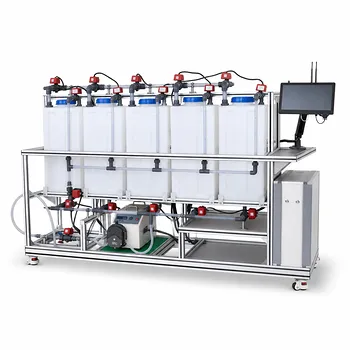
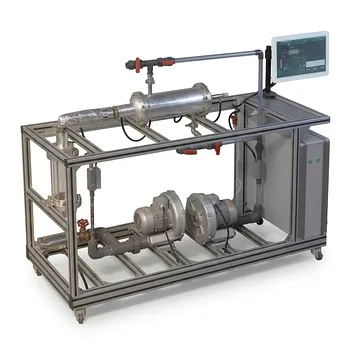
Are you looking to optimize your research or training setup? LABPARK provides state-of-the-art Educational and Vocational Unit Operations Pilot Plants in chemical engineering, bioprocess & biotech, and environmental & water treatment.
We help universities, research institutes, and enterprises build reliable, industry-grade systems equipped with precise control instrumentation to bridge the gap between classroom theory and real-world industrial practice.
Contact LABPARK today to discover the perfect pilot plant solution for your facility!
Related Products
- Electrolyte Distillation Purification and Formulation Educational Pilot Plant
- Electrochemical Water Treatment Educational Unit Operations Pilot Plant
- Electrolytic Hydrogen Production Educational Unit Operations Pilot Plant
- Water Electrolysis Hydrogen Production and Storage Educational Pilot Plant
- Alkaline Membrane Water Electrolysis Educational Pilot Plant Unit Operations Training System
People Also Ask
- Why does simple distillation yield higher efficiency than flash distillation? Key thermodynamic differences.
- How to Integrate Spectroscopy in Distillation Pilot Plants for Advanced Process Control
- How do batch and continuous distillation pilot plants differ? Master their dynamic behavior
- How does operating pressure influence Methylal/Methanol VLE? Discover its impact on distillation
- How to Estimate Distillation Pilot Plant Tray Efficiency? O'Connell's Correlation Guide