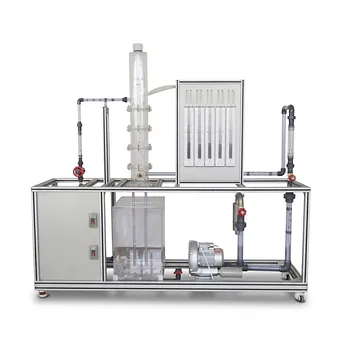
The extraction efficiency in a pulsed sieve plate column is primarily controlled by the intensity of energy input, which is a function of both pulse frequency and amplitude. Typically, an amplitude of 9 to 50 mm combined with a frequency of 30 to 200 min⁻¹ yields an optimal operating window. However, the most efficient mass transfer is usually achieved by pairing higher frequencies with lower amplitudes, as this configuration maximizes interfacial area while keeping harmful axial mixing in check.
The central insight is that pulsation improves extraction by repeatedly dispersing one phase into fine droplets to increase the contact area, but a balanced combination of frequency and amplitude is critical. An overly intense pulsation, regardless of whether it comes from excessive frequency or amplitude, pushes the column beyond its optimal point, leading to flooding and severe back-mixing that destroys efficiency and throughput.
The Mechanics of Pulsed Sieve Plate Extraction
To understand how frequency and amplitude affect efficiency, you must first grasp how this column overcomes the limitations of a simple sieve plate.
How Pulsation Enhances Mass Transfer
In a standard sieve plate column, the lighter phase rises through the perforations and forms droplets, but the mass transfer area is limited. Pulsation adds external mechanical energy to force a reciprocating liquid movement through the plates.
This reciprocating motion repeatedly shears, disperses, and coalesces the liquid droplets. Instead of a single dispersion, the droplets are formed, broken, and reformed dozens of times as they travel up the column. This process dramatically increases the total interfacial surface area available for mass transfer and continuously refreshes the concentration gradient, making the column far more efficient per unit height.
The Role of Sieve Plates vs. Other Internals
The sieve plates themselves are essential for directing this energy. Without internals, like in a spray column, the dispersed phase would flow freely and suffer from severe back-mixing, drastically reducing efficiency.
Sieve plates force the dispersed phase to coalesce and re-disperse at each tray, creating discrete stages. Pulsation then supercharges this stage-wise contact. Understanding this interaction is fundamental in pilot-plant teaching labs, where students compare the performance of different internals to see how physical configurations affect the Height Equivalent to a Theoretical Plate (HETP).
The Impact of Pulse Frequency and Amplitude on Efficiency
Frequency and amplitude are the two knobs you turn to control the energy of the reciprocating motion. They influence droplet behavior and column hydrodynamics in distinct ways.
Frequency: The Driver of Droplet Breakup
Frequency (measured in strokes per minute) primarily governs the rate at which droplets are sheared and re-dispersed. A higher frequency means the liquid reverses direction through the plate holes more often, creating more frequent breakup events.
This produces smaller droplets and a larger specific surface area for mass transfer. However, increasing frequency too much also increases turbulence in the continuous phase. Beyond a critical point, this leads to severe axial back-mixing, where segments of both phases are carried backward, destroying the counter-current concentration gradient.
Amplitude: Controlling Travel Distance and Shear
Amplitude (the vertical displacement in millimeters) controls the stroke length and, thus, the distance a slug of liquid travels on each pulse. A higher amplitude imparts greater kinetic energy, creating larger zones of intense mixing above and below the plate.
While this can increase holdup and interfacial renewal, excessive amplitude is a common cause of column flooding. If the pulses are too long, the downcomers or the plate free area cannot handle the hydraulic load, and one phase will entrain the other, causing the column to choke and halt normal operation.
The Synergistic "High Frequency, Low Amplitude" Strategy
For maximum extraction efficiency, pilot plant studies consistently show that a combination of higher frequency and lower amplitude yields the best results. This strategy achieves the dual goals of interfacial area generation and column stability.
The high frequency provides the numerous, rapid shearing events needed for fine droplet formation. The low amplitude keeps the overall displacement small. This localizes the turbulence right at the sieve plate, generating excellent droplet breakup while minimizing large-scale circulation patterns that cause back-mixing and entrainment further down the column.
Understanding the Trade-offs
Pushing any parameter beyond its practical limit will quickly degrade performance. The key operational pitfall is confusing more energy with better efficiency.
The Flooding Threshold
If the pulsation is too intense, it directly leads to column flooding. Whether through excessive frequency or excessive amplitude, the high fluid velocity prevents the desired phase from flowing counter-currently. The dispersed phase backs up, is carried out with the continuous phase, or vice-versa, reducing the net throughput capacity to zero and making operation impossible.
Severe Axial Back-Mixing
Before outright flooding, excessive pulsation first increases axial dispersion. This back-mixing smooths out the concentration profile along the column's length.
Mass transfer is driven by a concentration difference, and back-mixing reduces this driving force. You end up injecting a lot of mechanical energy to create a large interfacial area, but then immediately squander that advantage because the liquid phases are no longer moving in a true plug-flow, counter-current manner. The extraction efficiency plummets, even if the column is not visibly flooded.
Typical Operating Ranges as a Starting Point
In pilot-plant and educational settings, the operating parameters provide a safe starting envelope for experimentation. The typical pulse amplitude ranges from 9 to 50 mm, and the frequency ranges from 30 to 200 min⁻¹.
A key learning outcome for students is to systematically map this envelope. They start at a low intensity, gradually increase pulsation while monitoring for the onset of flooding and the point of diminishing returns in extraction efficiency, thereby identifying the true optimum for a given liquid-liquid system.
How to Apply This to Your Pilot Plant
Realizing the full benefit of a pulsed column requires a methodical approach. The optimum settings are not universal; they depend on the interfacial tension, density difference, and viscosity of your specific chemical system.
- If your primary focus is maximizing throughput: Start with a moderate frequency and a low amplitude to find a stable operating point with high phase flow rates. The high-frequency, low-amplitude strategy is often ideal here, as it provides efficiency without the hydraulic instability that chokes the column prematurely.
- If your primary focus is achieving the highest possible stage efficiency: You must conduct a parametric sweep by fixing amplitude at a low value and incrementally increasing frequency. Measure the concentration profile; stop increasing pulsation immediately when you see evidence of back-mixing flattening the profile, as this signals you have passed the optimum.
- If your primary focus is a key teaching demonstration: Intentionally run the column up to the flood point by increasing both amplitude and frequency. This provides the clearest visual lesson on why "more is not always better" and allows students to directly correlate the operational limits with the fundamental theory of back-mixing and column hydraulics.
By treating frequency and amplitude not as independent dials but as an interconnected energy-intensity system, you unlock the power of the pulsed sieve plate column as both a highly efficient extraction tool and a vital instrument for teaching process scale-up.
Summary Table:
| Parameter | Typical Range | Key Effect on Efficiency | Risk of Excess |
|---|---|---|---|
| Frequency | 30 to 200 min⁻¹ | Drives droplet breakup; increases mass transfer surface area. | Causes axial back-mixing, flattening concentration gradient. |
| Amplitude | 9 to 50 mm | Controls stroke length & kinetic energy; increases holdup. | Leads to column flooding and phase entrainment. |
| Combination | High Freq / Low Amp | Maximizes interfacial area while keeping column stable. | Avoid over-pulsing to prevent flooding. |
Optimize Your Chemical Engineering Lab with LABPARK
Looking to enhance your students' practical understanding of liquid-liquid extraction and process scale-up? LABPARK provides state-of-the-art Educational and Vocational Unit Operations Pilot Plants in chemical engineering, bioprocess & biotech, and environmental & water treatment for universities, research institutes, and enterprises.
Our advanced pulsed sieve plate columns allow hands-on study of HETP, flooding thresholds, and mass transfer optimization. Contact us today to find the ideal pilot plant solution for your institution.
Related Products
- Continuous Sieve-Plate Distillation Pilot Plant for Unit Operations Laboratory Education
- Dual-Mode Rectification Pilot Plant for Practical Training Unit Operations
- Plate Column Hydrodynamics Tray Demonstration Educational Pilot Plant
- Natural Product Extraction Unit Operations Training Pilot Plant
- Constant Pressure Filtration Educational Unit Operations Pilot Plant
People Also Ask
- How do distillation pilot plants validate VLE data? Achieve reliable solvent separation scale-up.
- Why is experimental validation on a distillation unit operations pilot plant essential? Reduce azeotropic scale-up risk
- What are the primary reflux ratio control strategies? Master Distillation Unit Operations
- Why is the column performance diagram critical? Optimize distillation pilot plant safety & efficiency.
- How does catalyst water concentration affect distillation pilot plant design? Key separation train choices.