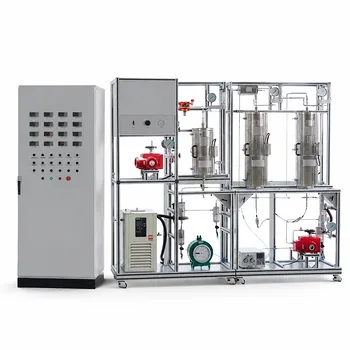
The direct answer is this: In a pilot plant demonstrating Fischer-Tropsch syngas-to-liquid processes, iron catalysts readily accept a feed gas with a low H₂/CO ratio (0.7–1.0), while cobalt catalysts demand a feed gas pre-adjusted to a much higher H₂/CO ratio (ideally near 2.0 or above). This difference stems from iron’s strong water-gas shift (WGS) activity, which internally generates the hydrogen needed for the synthesis, versus cobalt’s negligible shift activity, which forces you to supply that hydrogen upfront.
The choice between iron and cobalt determines whether your pilot plant’s syngas feed can be used “as-is” from a coal or biomass gasifier, or whether it must first undergo substantial compositional adjustment, such as adding hydrogen or integrating a shift reactor. Understanding this catalyst-specific requirement is critical for matching your upstream gas generation unit to your downstream synthesis reactor.
Why the H₂/CO Ratio is a Pivotal Pilot Plant Parameter
The stoichiometry of Fischer-Tropsch synthesis consumes H₂ and CO in a ratio that depends on the product chain length, generally close to 2:1. If the feed gas deviates from what the catalyst can handle, reaction rates plummet, carbon deposition fouls the reactor, and the product spectrum shifts unpredictably.
The Role of the Water-Gas Shift Reaction
Some catalysts have the ability to perform the WGS reaction: H₂O + CO ⇌ H₂ + CO₂.
This allows them to convert CO and water into additional H₂ inside the reactor, effectively boosting the local H₂/CO ratio.
A catalyst that lacks this ability must receive an almost ideal syngas mixture from the start.
Iron Catalysts: Leveraging Internal Shift for Low-Ratio Feeds
Iron catalysts are highly active for the WGS reaction. This is why they are historically linked to coal and biomass-derived syngas sources.
Feed Flexibility as a Core Advantage
Because iron catalyses the shift reaction, it can process a feed H₂/CO ratio as low as 0.7 and still sustain hydrocarbon chain growth.
The catalyst creates its own hydrogen in-situ, bridging the gap between the inlet composition and the local requirement at the active sites.
In a pilot plant, this means you can connect an iron-based reactor directly to a gasifier without an expensive, energy-intensive syngas conditioning unit.
Operational Consequences
While the feed requirement is relaxed, the WGS activity produces significant CO₂.
This dilutes the syngas and must be managed in recycle loops or downstream separation.
Moreover, the reaction water generated participates in the shift, creating a delicate balance between conversion, selectivity, and carbon efficiency.
Cobalt Catalysts: Requiring a Pre-adjusted H₂/CO Ratio
Cobalt catalysts exhibit essentially no WGS activity. They cannot internally increase the H₂/CO ratio; they consume hydrogen and carbon monoxide directly.
The Stringent Feed Requirement
To achieve high activity and prevent catalyst deactivation through carbon formation, a cobalt catalyst requires a feed H₂/CO ratio typically above 2.0.
This makes cobalt an excellent match for syngas produced by steam reforming of natural gas, which inherently yields a hydrogen-rich stream.
If your pilot plant gasifier produces a low-ratio syngas, you must either adopt a different catalyst or install upstream processing—such as a dedicated water-gas shift reactor—to enrich the hydrogen content before the FT unit.
Downstream Product Implications
Though the question focuses on feed composition, it is worth noting in a pilot plant demonstration that cobalt’s higher chain growth probability shifts the product slate toward heavier waxes and diesel.
This means that even if you pre-condition the syngas perfectly, your downstream product separation and distillation train will look different compared to an iron-based run.
Comparing the Operational Impacts on Pilot Plant Setup
When you choose your catalyst, you are also dictating the architecture of the entire feed system.
Integration with Syngas Source
- Iron catalyst: Tolerates syngas from a fixed-bed updraft gasifier, fluidized bed biomass gasifier, or coal entrained flow gasifier without a shift unit.
- Cobalt catalyst: Demands either a natural gas reformer producing a high H₂/CO ratio or a biomass/coal gasifier followed by an additional WGS reactor and CO₂ removal to raise the ratio.
Gas Cleaning and Purity
Though not directly part of the H₂/CO ratio, pilot plant experience shows that cobalt catalysts are extremely sulfur-sensitive—more so than iron.
This means a cobalt-based pilot plant must include extensive desulfurization (often to sub-0.1 ppm), adding to the complexity that begins at the feed gas composition level.
Understanding the Trade-offs
The feed flexibility of iron comes at a cost. While it forgives a low H₂/CO ratio, it sacrifices some product selectivity control because the WGS reaction competes with FT synthesis, leading to more CO₂ formation and lower carbon efficiency.
Conversely, cobalt’s refusal to shift means every molecule of H₂ must be purchased or generated upstream, but it delivers higher conversion per pass and a narrower product distribution, which simplifies downstream separation in a teaching pilot plant.
Selecting iron for its tolerance to poor-quality syngas may mask the need to clean up tars or other contaminants that plague gasifiers. Cobalt’s demand for a perfect ratio often forces better upstream engineering, yielding a more robust, repeatable pilot demonstration.
How to Match the Catalyst to Your Pilot Plant’s Syngas Reality
Your choice should not be made in isolation. It must align the feed gas you can reliably produce with the operational complexity you are prepared to manage.
- If your primary focus is demonstrating a coal/biomass-to-liquids pathway with minimal syngas conditioning: Select an iron catalyst. It will naturally compensate for the low H₂/CO ratio, allowing you to showcase the full chain from gasifier to liquid product without an intermediate shift unit.
- If your primary focus is running a highly controlled, steady-state experiment with a natural gas reformer or a syngas with a pre-adjusted H₂/CO ratio ~2.0: Choose a cobalt catalyst. Its lack of shift activity eliminates the variability caused by the WGS reaction, making conversion and selectivity data more predictable for scale-up.
- If your feed gas source is variable (e.g., biomass gasification with widely fluctuating ratios): Iron’s intrinsic shift capacity offers a buffer against composition swings. Cobalt would likely deactivate rapidly under such conditions unless you invest in advanced ratio control systems.
Ultimately, in a chemical engineering unit operations pilot plant, the catalyst is not just a reaction promoter—it is the central decision that defines the upstream gas preparation requirements. Aligning your syngas generator with your catalyst’s ratio demand is the surest way to run a successful, instructive demonstration.
Summary Table:
| Feature | Iron (Fe) Catalyst | Cobalt (Co) Catalyst |
|---|---|---|
| Optimal H₂/CO Ratio | Low (0.7 – 1.0) | High (Ideally ~2.0 or above) |
| WGS Activity | High (internally generates H₂) | Negligible (cannot shift CO to H₂) |
| Best Syngas Source | Coal or biomass gasification | Steam reforming of natural gas |
| Upstream Needs | Low (tolerates raw syngas) | High (requires shift reactor/enrichment) |
| Sulfide Sensitivity | Moderate | Extremely high (needs deep desulfurization) |
Optimize Your Unit Operations Pilot Plant Setup
Whether demonstrating biomass gasification or natural gas reforming, matching your catalyst to your feed gas is critical. LABPARK designs and manufactures premium Educational and Vocational Unit Operations Pilot Plants in chemical engineering, bioprocess & biotech, and environmental & water treatment. We help universities, research institutes, and enterprises build versatile pilot systems that align upstream gas conditioning with downstream synthesis.
Contact LABPARK today to custom-design your chemical engineering pilot plant and ensure seamless catalytic operations!
Related Products
- Two Phase Flow Pattern Velocity Resistance Measurement Educational Pilot Plant
- Two-Dimensional Fluidization Hydrodynamics Educational Pilot Plant for Unit Operations Training
- Multi Pump Fluid Transport Process Piping Unit Operations Training Pilot Plant
- Chemical Pipeline Assembly and Fluid Transport Practical Training Unit Operations Pilot Plant
- Steam Methane Reforming Hydrogen Production and Purification Educational Pilot Plant
People Also Ask
- How to update chemometric calibration models in pilot plants? Best practices for process engineers.
- How can educational pilot plants be used to teach process safety and risk assessment in chemical engineering curricula?
- How does nuclear yield inefficiency translate to chemical engineering education? Optimize kinetics with pilot plants.
- Why Correct Sig Figs & Rounding Matter in Educational Pilot Plants: Ensure Data Accuracy
- How to identify two-phase gas-liquid flow patterns? Master fluid dynamics with pilot plants