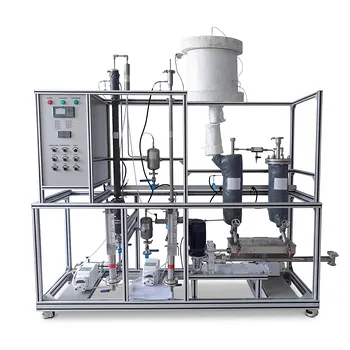
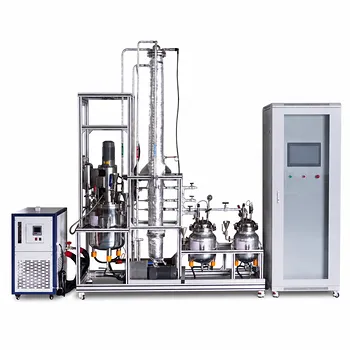
Methane slip isn't a malfunction—it's the percentage of unreacted methane that remains in the syngas after the reforming reaction. In any catalytic steam reforming unit, this residual methane directly eats into hydrogen yield and downstream compression economics. The core process design question isn't if slip occurs, but how pressure and temperature conspire to define its unavoidable minimum and the reactor's physical limits.
Thermodynamics wants high temperature and low pressure to crush methane slip. Industry wants high pressure to shrink equipment and save compression work. The maximum temperature you can actually run is capped by metallurgical creep—so the pilot plant’s safe operating window is a tense balancing act between conversion, pressure, and tube life.
What Methane Slip Really Means for Your Pilot Plant
The Definition and Economic Sting
Methane slip is the mole fraction of CH₄ in the dry reformate leaving the catalyst bed. It is typically expressed as a percentage of the total carbon-containing molecules.
Even a few percent of slip represents lost hydrogen potential. That lost hydrogen translates directly into higher feedstock costs per unit of product, and it forces you to either add a costly methanation or pressure-swing adsorption step downstream to reach pipeline purity.
The Reforming Reaction’s Molar Handicap
The main steam reforming reaction is: CH₄ + H₂O ⇌ CO + 3 H₂
This is a gas-phase reaction where four moles of products are generated from two moles of reactants. According to Le Chatelier’s principle, increasing system pressure shifts the equilibrium back toward the reactants (methane and steam), increasing methane slip.
In an educational pilot plant, comparing equilibrium gas composition at 1 bar versus 30 bar will immediately illustrate this effect. At high pressure, conversion plummets unless you add a much larger driving force.
The Pressure-Temperature Tightrope
Why Pressure Stays High Despite the Thermodynamic Penalty
Industrial reformers and well-designed pilot plants operate at elevated pressure—often 20–30 bar—for a brutally practical reason. Compressing the final hydrogen product is energy-intensive and expensive.
Reforming at pressure means you compress the dense liquid feedstock or natural gas instead of the enormous volume of syngas. It also lets you shrink the reformer tube diameter and the entire convection section, cutting capital cost.
How Temperature Rescues Conversion
The reforming reaction is highly endothermic. Raising temperature pushes equilibrium strongly toward H₂ and CO production, suppressing methane slip.
For example, at a system pressure of 30 bar, achieving near-complete equilibrium methane conversion would require temperatures exceeding 1400 K (over 1127°C). Kinetic data shows that moving from 650°C to 850°C can triple the allowable space velocity while slashing catalyst volume, which is why microchannel heat exchange reactors are so powerful for demonstrating this effect in pilot units.
The Creep Limit: Where Metallurgy Says “Stop”
The maximum operating temperature is not set by thermodynamics. It is set by the creep rupture life of the reformer tube alloy.
Reformer tubes typically run at skin temperatures of 850–1000°C, well below the 1400 K that would fully eliminate slip at high pressure. The metal slowly deforms under the combination of thermal stress and internal pressure. Exceed the alloys’ design creep limit, and tubes can fail catastrophically.
In practice, pilot plants mirror industrial bounds: maximum tube wall temperatures are held to around 1200 K (927°C) for conventional HP-modified austenitic alloys. This metallurgical ceiling locks in an irreducible minimum methane slip for a given pressure.
Designing the Pilot Plant Window
The Steam-to-Carbon Lever
When temperature is pinned against its metallurgical limit and pressure cannot be lowered, the last independent variable is steam. Adding excess steam (high steam-to-carbon ratio) forces the methane equilibrium to the right, reducing slip.
However, this comes at a cost: more steam means larger convection sections, higher energy demand, and bigger cross-flow volumes. In a pilot plant, you can demonstrate this by varying the S/C ratio from 2.5 to 3.5 and watching the dry gas composition shift.
Reactor Architecture and Heat Transfer
Because the reaction is so endothermic, tube wall heat flux limits throughput, not just equilibrium. If heat cannot get into the catalyst fast enough, the actual temperature profile along the tube drops, and slip spikes far above the thermodynamic prediction.
Pilot plants using microchannel architecture or thin-bed annular reactors can achieve heat transfer rates that keep the entire catalyst close to the tube wall temperature. This allows you to run at the kinetic limit, showing the true minimum achievable methane slip for your chosen pressure and temperature.
Understanding the Trade-offs
Tube Life vs. Conversion Chasing
Pushing the exit temperature higher is a direct trade-off against tube longevity. A 20°C increase in maximum tube skin temperature can halve the creep life.
Every pilot plant experiment that explores high-severity operation must weigh the learned kinetic data against the cost of replacing a set of expensive, custom-fabricated tubes. Safety protocols must hard-limit the furnace firing rate based on metallurgical documentation, not just the desire to see sub-1% methane slip.
Carbon Formation Boundaries
Low steam ratios coupled with high temperature and pressure can push the gas composition into the carbon-forming region of the Boudouard or methane cracking reactions. Coking deactivates the nickel catalyst and can physically plug the reactor.
A pilot plant studying slip must also monitor the thermodynamic carbon limit diagram. You can only suppress slip so aggressively before catalyst destruction erases any economic gain.
Model vs. Real Kinetics
Thermodynamic predictions give the equilibrium methane slip floor. But actual slip is kinetically controlled. If your pilot plant has a low-activity catalyst or inadequate residence time, the slip will be higher than the equilibrium curve suggests.
This means pilot plant data must be decoupled into approach-to-equilibrium and pressure-temperature effects before scaling up. Operating at high pressure but low space velocity can still yield misleadingly low slip if the catalyst has not aged realistically.
Making the Right Choice for Your Pilot Plant Goals
The safe design envelope is defined by the intersection of your pressure target, the achievable tube temperature without creep, and the required syngas purity. Your focus dictates the operating point.
- If your primary focus is simulating industrial conditions: Run at 20–25 bar with tube wall temperatures near the alloy’s certified limit (~925°C for common alloys) and a steam-to-carbon ratio of 3.0. Accept the resulting equilibrium methane slip of a few percent as a faithful representation of a commercial unit.
- If your primary focus is teaching thermodynamic principles: Plan experiments that hold temperature constant while stepping pressure from 1 to 30 bar. Plot the rising methane concentration to visually cement Le Chatelier’s principle—then show how a temperature ramp to 850°C recovers the conversion.
- If your primary focus is catalyst research: Decouple the effects by testing at low pressure to remove mass transfer and equilibrium penalties. Once intrinsic kinetics are measured, gradually pressurize to map how pore diffusion and equilibrium drive the actual slip you would see in the field.
- If your primary focus is maximizing safety and tube life: Operate conservatively with tube skin temperatures at least 30–50°C below the documented creep limit. Use an on-line gas analyzer to instantly shut down the furnace if methane slip unexpectedly rises, which can indicate carbon laydown or catalyst deactivation.
Every pilot plant that reformats methane dances on a thin line: high pressure saves money, high temperature saves conversion, and tube metallurgy saves your lab from catastrophe. Designing experiments that deliberately map this triangle is what turns a unit operations pilot plant into a powerful, industrial-grade learning tool.
Summary Table:
| Operating Parameter | Effect on Methane Slip | Impact on Equipment & Tube Life | Optimization Goal |
|---|---|---|---|
| Higher Temperature | Decreases slip (improves yield) | Speeds up metallurgical creep & shortens tube life | Keep below alloy creep limit (~925°C) |
| Higher Pressure | Increases slip (thermodynamic penalty) | Reduces syngas volume & equipment footprint | Balance compression costs vs. conversion |
| Higher Steam-to-Carbon | Decreases slip (shifts equilibrium) | Increases energy demand & equipment sizing | Optimize utility cost vs. carbon prevention |
Optimize Your Unit Operations Training and Research
Are you looking to safely demonstrate complex thermodynamic and kinetic principles like steam reforming in your lab? LABPARK provides premium Educational and Vocational Unit Operations Pilot Plants in chemical engineering, bioprocess & biotech, and environmental & water treatment.
We help universities, research institutes, and enterprises build robust, highly controllable, and industrially relevant systems to accelerate research and student learning.
Ready to upgrade your laboratory capabilities? Contact LABPARK today to discuss your custom pilot plant requirements!
Related Products
- Steam Methane Reforming Hydrogen Production and Purification Educational Pilot Plant
- Fixed Bed Gas Solid Catalytic Reaction Educational Pilot Plant
- Fluidized Bed Gas Solid Catalytic Reaction Educational Pilot Plant
- Multi Functional Catalytic Reaction and Reactor Evaluation Educational Unit Operations Pilot Plant
- Methane Cracking Educational Unit Operations Pilot Plant
People Also Ask
- How to Minimize Hazardous Inventory in Pilot Plants? Master Inherently Safer Design
- What is the difference between allothermal and autothermal steam reforming in pilot plants?
- How to prevent carbon & hot spots in steam reforming pilot plants? Essential Safe Operation Guide
- Why is the steam reforming of methane hindered at elevated pressures in a chemical engineering unit operations pilot plant?
- Why is thermal runaway hard to observe in lab glassware? Quantify heat loss for safe scale-up