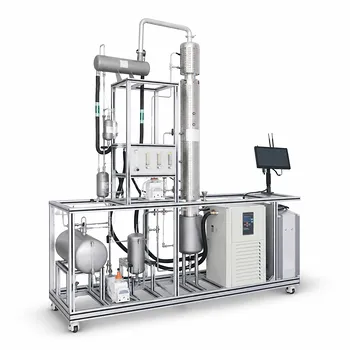
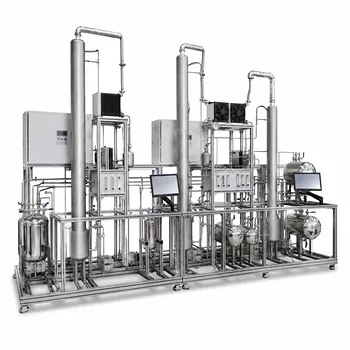
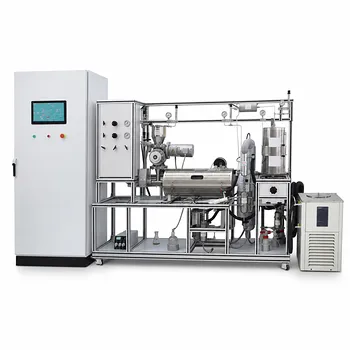
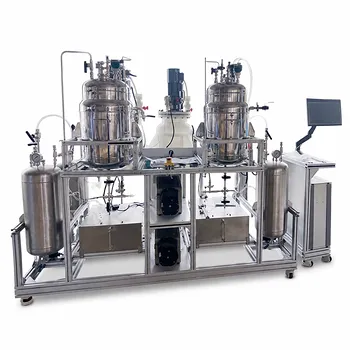
A versatile pilot plant demonstrates different distillation pressures through modular pressure control systems, absolute pressure instrumentation, and columns designed for vacuum or high-pressure operation. To configure a unit ops pilot plant for atmospheric, vacuum, or pressurized distillation, you implement vacuum pumps with knock-out pots and vacuum-rated sealing for reduced‑pressure operation, or install back-pressure regulators and pressure-rated columns for above‑atmospheric studies. The core selection criteria hinge on the boiling points and thermal stability of the feed mixture: go atmospheric when components boil between roughly room temperature and 150 °C without degrading; choose vacuum for heat‑sensitive or high‑boiling streams to prevent thermal damage; and use pressurized distillation for light ends that would vaporize at ambient temperature, raising the boiling point enough to condense with standard cooling water.
Core Takeaway: Operating pressure is not a free parameter—it is dictated by the need to condense the overhead vapor with available cooling water and to avoid exceeding the thermal stability limit of the bottom product. Pilot plant configurations must therefore center on reliable pressure control, precise absolute pressure measurement, and the flexibility to switch between modes while preserving accurate vapor‑liquid equilibrium data.
Configuring a Pilot Plant for Multi‑Pressure Operation
A truly educational or research‑grade distillation pilot plant must be plumbed and instrumented to operate across a wide pressure envelope. This demands both hardware and control‑system flexibility.
Modular Feed and Column Design
Pilot columns should have multiple feed points at different heights, enabling demonstration of both batch and continuous operation. Quick‑connect piping and flexible pump configurations allow reconfiguration without major downtime. The column internals (trays or packing) are selected to accommodate the expected vapor density changes when switching between vacuum and pressure.
Vacuum System Integration
For vacuum distillation, the pilot plant integrates a vacuum pump (often a liquid ring or rotary vane pump), a condensation trap, and a knock‑out pot to protect the pump from process vapors. All flanges, gaskets, and glass‑to‑metal joints must be vacuum‑rated. Pressure sensors tied to a controller maintain the target absolute pressure, often by bleeding in a small amount of inert gas or adjusting the pump speed.
Pressurization and Condensation Control
Pressurized operation requires a back‑pressure regulator or control valve on the vent line to maintain a set head pressure. The column body and reboiler must be designed for the maximum allowable working pressure (MAWP). Overpressure protection through relief valves is mandatory. The overhead condenser must be sized to handle the higher condensation temperature, still using cooling water as the utility.
Instrumentation: Absolute Pressure is Non‑Negotiable
Local atmospheric pressure varies with altitude and weather. Gauge and vacuum pressure readings therefore give irreproducible results across different sites. Vapor‑liquid equilibrium depends strictly on absolute pressure. Every pilot column should be equipped with absolute pressure transmitters at the top and bottom, so that thermodynamic data and operating conditions are transferable.
The Fundamental Criteria for Selecting Operating Pressure
The choice between atmospheric, vacuum, or pressurized distillation follows from two hard constraints and one economic consideration. The primary reference rules—atmospheric for moderate boilers, vacuum for heat‑sensitive, pressurized for low boilers—are practical expressions of these deeper thermodynamic limits.
The Condensation Temperature Constraint (Lower Pressure Limit)
Cooling water is typically available at about 30 °C, and a minimum temperature difference of 10 °C is needed for economic heat transfer. The overhead vapor must therefore condense at a temperature $T_D \ge 40$ °C. The minimum operating pressure ($p_{min}$) is the bubble point pressure of the top product at 40 °C. For very light mixtures, atmospheric pressure would yield a condensation temperature far below 40 °C, preventing condensation with cooling water; the pressure must be raised to push the bubble point above 40 °C.
The Reboiler Temperature Constraint (Upper Pressure Limit)
Most pilot plants use saturated steam as the heating medium, typically available at a temperature that limits the reboiler process temperature to about 180 °C to avoid thermal degradation, coking, or polymerization. The maximum operating pressure ($p_{max}$) is the bubble point pressure of the bottom product at 180 °C. If the bottom stream is heat‑sensitive, the allowable temperature is even lower, forcing the process into the vacuum regime.
Material Heat Sensitivity Overrides Utility Limits
Even if the reboiler temperature would be acceptable under atmospheric pressure, some process streams degrade at far lower temperatures. This is the classic driver for vacuum distillation in bioprocessing and chemical engineering: lowering the column pressure reduces the boiling point of every component, enabling separation at temperatures that preserve molecular integrity. For heavy petroleum fractions, vacuum avoids cracking; for fatty acids, it prevents discoloration and decomposition.
Detailed Pressure Selection Logic
The following framework merges the primary reference’s simple categories with the rigorous utility and stability constraints.
Atmospheric Distillation ($p \approx 0.1$ MPa)
Criterion: The feed mixture’s components boil between roughly ambient temperature and 150–200 °C at 1 atm, and the reboiler liquid remains thermally stable at the bottom temperature required to achieve separation. Atmospheric operation is the default because it avoids the capital and operating cost of vacuum or pressure systems. It is ideal for training students on basic distillation principles with simple alcohol/water or hydrocarbon mixtures.
Vacuum Distillation ($p < 0.1$ MPa)
Criterion: The bottom product’s bubble point at 0.1 MPa would exceed the safe thermal limit (typically < 180 °C, or even lower for sensitive materials). By pulling a vacuum, you reduce the bottom temperature accordingly. Vacuum distillation is mandatory for demonstrating the separation of heat‑sensitive solvents, monomers, or heavy oil fractions. Pilot plants use absolute pressure controllers to hold the column at a stable sub‑atmospheric setpoint, often between 1 and 50 kPa.
Pressurized Distillation ($p > 0.1$ MPa)
Criterion: The overhead product’s bubble point at 0.1 MPa is below 40 °C, making it impossible to condense with normal cooling water. By increasing pressure, the condenser temperature rises above 40 °C. This is common for light hydrocarbons such as ethylene or propylene. Pilot setups must incorporate pressure‑rated glass or metal columns and relief valves. The pressure level is chosen to just exceed the condensation constraint while staying within economic and mechanical limits.
The Economic Sweet Spot
Moderate pressures ($0.1 - 1$ MPa) are most economical. Above 1 MPa, column wall thickness increases significantly, raising material and fabrication costs. Vacuum operation increases column diameter (because vapor density is lower) and can reduce liquid distribution quality in packed columns. These trade‑offs are essential to teach alongside the process physics.
Understanding the Trade‑offs
Every pressure choice comes with design and operational consequences that a well‑configured pilot plant must make visible.
Vacuum: Larger Diameter, Wetting Challenges
Under vacuum, vapor density drops sharply, increasing volumetric flow and therefore required column diameter. In packed columns, low liquid loads can lead to poor wetting and reduced mass‑transfer efficiency. The pilot plant’s instrumentation (differential pressure, temperature profiles) lets students quantify this effect and learn when structured packing or liquid distributors are necessary to compensate.
Pressure: Thicker Walls, Higher Utility Costs
Pressurized columns require thicker walls and more robust sealing, adding expense and safety complexity. The higher condensation temperature can increase cooling tower load. However, the smaller vapor volume can reduce column diameter, offering a capital cost offset. A pilot plant that demonstrates both modes side‑by‑side teaches these economic trade‑offs directly.
Energy and Azeotrope Considerations
Pressure swing distillation exploits the fact that azeotropic compositions shift with pressure. A pilot plant with two columns operating at different pressures can demonstrate breaking an azeotrope without adding an entrainer. This configuration highlights how pressure selection can solve otherwise intractable separation problems, but it also illustrates the energy cost of re‑compressing or condensing at different levels.
Making the Right Choice for Your Pilot Plant Goal
Selecting and configuring a pressure‑flexible distillation pilot plant depends on what you aim to teach or investigate. Use the following decision paths as a starting point.
-
If your primary focus is fundamental thermodynamics training: Build a column that can easily toggle between atmospheric and moderate vacuum, with absolute pressure transmitters everywhere. Use simple binary mixtures to show how pressure shifts vapor‑liquid equilibrium and how to operate within condensation‑reboiler limits.
-
If your primary focus is industrial separation research (heavy oils, specialty chemicals): Invest in a vacuum‑rated system with high‑temperature reboiler options and the ability to hold pressures down to 1 kPa. Include advanced packing and liquid distributors to study wetting effects and scale‑up predictions.
-
If your primary focus is demonstrating light‑end recovery or pressure‑swing processes: Add a second pressure‑rated column and the necessary interstage compressors or control valves. Design for pressures up to 2–3 MPa to cover a range of light hydrocarbons and azeotropic shifts.
-
If your primary focus is process safety and scale‑up: Ensure the pilot plant is instrumented with relief devices, rupture disks, and absolute pressure safety logic. These systems make the inherent hazards of pressure and vacuum operation tangible before pilot‑scale data is translated to production.
The most effective unit operations pilot plant transparently reveals how operating pressure shapes every aspect of distillation—from column diameter and utility consumption to the very possibility of separation. By designing for measurable, reproducible pressure control from the start, you give users the definitive tool to master real‑world separation challenges.
Summary Table:
| Distillation Type | Typical Pressure | Key Selection Criteria | Typical Applications |
|---|---|---|---|
| Atmospheric | $\approx 0.1$ MPa | Components boil between ambient and 150-200 °C; thermally stable. | Basic education, simple solvent separations. |
| Vacuum | $< 0.1$ MPa | Heat-sensitive feeds; bottom bubble point exceeds thermal limits at 1 atm. | Bioprocessing, heavy oils, monomer purification. |
| Pressurized | $> 0.1$ MPa | Overhead bubble point at 1 atm is $< 40$ °C (requires cooling water). | Light hydrocarbon recovery, pressure-swing systems. |
Elevate Your Chemical Engineering Lab with LABPARK
Are you looking to equip your institution with advanced distillation systems? LABPARK provides state-of-the-art Educational and Vocational Unit Operations Pilot Plants in chemical engineering, bioprocess & biotech, and environmental & water treatment for universities, research institutes, and enterprises.
Our custom-engineered pilot plants offer the modularity, advanced instrumentation, and safety features required to demonstrate complex processes like multi-pressure distillation effectively.
Contact LABPARK today to discuss your lab requirements and receive a tailored solution!
Related Products
- Continuous Sieve-Plate Distillation Pilot Plant for Unit Operations Laboratory Education
- Multi-Functional Special Distillation Educational Pilot Plant
- Continuous Batch Extractive Distillation Educational Pilot Plant
- Multi-Modal Distillation Unit Operations Training Pilot Plant
- Electrolyte Distillation Purification and Formulation Educational Pilot Plant
People Also Ask
- How does catalyst water concentration affect distillation pilot plant design? Key separation train choices.
- Why is vacuum operation capability an essential feature for a distillation unit operations pilot plant? Unlock Efficiency
- How can real-time carbon number prediction improve distillation pilot plants? Optimize control.
- What are the primary reflux ratio control strategies? Master Distillation Unit Operations
- How to select the right activity coefficient model (Wilson, NRTL, UNIQUAC) for distillation pilot plants?