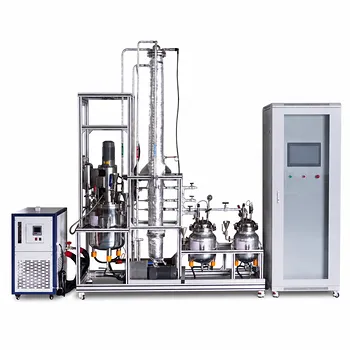
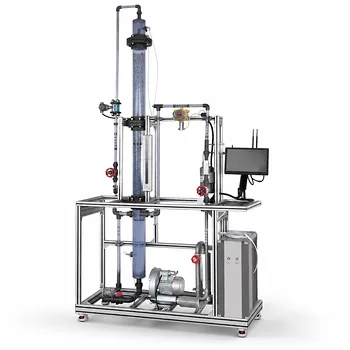
Particle size is the primary filter for selecting gas-solid separation equipment in a pilot plant.
For coarse pre-separation of particles above 75 µm, gravity settling chambers provide a simple, low-pressure-drop option. For medium-sized particles down to 5–10 µm, high-efficiency cyclones offer a robust balance of compactness and moderate pressure drop. When removing submicron dust (≤1 µm), fabric filters, electrostatic precipitators, or venturi wet scrubbers deliver the very high efficiencies required, though each carries distinct pressure-drop, maintenance, or ancillary system demands.
The core selection logic revolves around the target particle size, the required separation efficiency, and the allowable pressure drop. In a pilot-plant environment, the right choice is rarely about the absolute “best” device on paper—it is about the device that faithfully serves the experiment’s purpose while honoring space, energy, cleanability, and instructional constraints.
Mapping Particle Size to Separation Technology
Every gas-solid separation technology has a performance sweet spot defined by the cut diameter it can consistently capture. Understanding these boundaries prevents over-engineering and ensures pilot-plant results scale meaningfully.
Gravity Settling Chambers – The Coarse Dust Gatekeeper
A gravity chamber uses nothing more than a sudden reduction in gas velocity to let heavy particles fall out.
Best particle range: >50–75 µm.
The separation force is 1 g, so only large, dense particles have a settling velocity high enough to exit the gas stream in a reasonable distance.
- Efficiency typically 50–60 %, making these units purely pre-cleaners.
- Pressure drop is negligible (5–15 mm H₂O) because there are no internal resistance elements.
- Downside: They demand a large footprint. In a pilot plant where floor space is at a premium, a simple drop box may need to be impractically long to handle high gas flows.
Cyclone Separators – The Workhorse of the Middle Range
Cyclones amplify the separating force by a factor of 10 to 250 g. Gas is spun into a vortex, and particles are flung outward to the wall while clean gas reverses direction through the central core.
Best particle range: >5 µm for high-efficiency designs; >10–20 µm for standard designs.
A well-designed high-efficiency cyclone can achieve 85–95 % collection on 5–10 µm dust, making it a favorite for teaching centrifugal separation principles.
- Pressure drop is moderate: 10–150 mm H₂O for most pilot-scale units. High-efficiency cyclones push toward the upper end of that range (≈100–150 mm H₂O).
- Compact and robust—cyclones have no moving parts and can be fabricated easily.
- Trade-off: Efficiency plummets below the design cut-point, so a cyclone alone cannot capture submicron mist or fume.
Bag Filters & Electrostatic Precipitators – Conquering the Submicron Realm
Once the particle size drops to ≤1 µm, inertia-based collectors lose their grip. Surface and electrostatic forces take over.
Fabric (bag) filters trap particles on a felt or woven media, building a dust cake that actually improves efficiency with time. They routinely achieve >99 % collection down to 0.2 µm.
Electrostatic precipitators (ESPs) charge particles and collect them on oppositely charged plates. They are equally capable of high efficiency on submicron dust, with the advantage of lower flow resistance.
- Pressure drop of fabric filters is typically 50–150 mm H₂O across the bags, but it rises as the cake builds; periodic cleaning is mandatory.
- ESPs have very low gas-side pressure drop but require high-voltage power supplies and careful grounding, which adds complexity to a small pilot plant.
- In a pilot setting, the cleaning/regeneration requirement is non-trivial: bag blinding, acid dew point corrosion, and disposal of collected dust must be managed.
Venturi (Wet) Scrubbers – High Efficiency at a Pressure Cost
A venturi scrubber shears liquid into a curtain of droplets through which the dirty gas is accelerated to 60–120 m/s. Particles are collected by impaction on the droplets.
Effective for particles down to 0.5 µm with >95–99 % efficiency.
This level of performance, however, demands a very high pressure drop (250–750 mm H₂O).
- The scrubbing liquid creates a slurry handling requirement—pumps, settling tanks, and water treatment may be needed.
- For pilot plants focused on dry product recovery, wet scrubbers introduce a contamination risk.
- They are often selected when simultaneous gas absorption is desirable (e.g., removing acid gases along with particulate).
Process Requirements That Override the Particle-Size Chart
Particle size is the quantitative backbone of selection, but pilot plants introduce qualitative constraints that can tilt the decision. Ignoring them leads to experiments that are functional on paper and frustrating in practice.
The Flexibility-Cleanability Tension
Pilot plants switch between campaigns frequently. A device that is difficult to clean cross-contaminates data.
- Cyclones and simple gravity chambers can be wiped down quickly.
- Baghouses require filter removal, and cake residue analysis.
- Wet scrubbers need system flushes and may trap solids in dead legs.
If the pilot-plant mission involves throughput of many different powders—catalysts, silica sand, fine cohesive Group C Geldart materials—the separator must be easy to disassemble and clean. This often favors cyclones over bag filters.
Pressure Drop and the Energy Budget
Pressure drop is a direct operating cost. In university pilot labs or R&D facilities, available blowers have fixed capacity curves. A 2000 Pa pressure drop from a venturi may require a blower that is physically larger and louder than the rest of the skid, skewing the system design.
On the other hand, an ESP or gravity chamber keeps the blower load light, which is valuable when the experiment’s goal is to measure a fluidized bed’s hydrodynamic behavior, not to fight downstream resistance.
Safety and Material Integrity
- Combustible dust (organic powders, metal fines) demands explosion venting or inerting; fabric filters can accumulate a concentrated dust cloud, while cyclones present a lower volume of suspended dust at any instant.
- Hygroscopic or sticky particles can instantly blind bag filters or ESP plates, making a wet scrubber or a simple cyclone with wall heating a safer choice.
- Toxic compounds push the decision toward systems that can be fully sealed—often a self-contained cyclone with a sealed collection drum.
Understanding the Trade-offs
No single separator dominates across all metrics. It is essential to recognize the compromises inherent in each technology.
- Efficiency vs. Power: Moving from a cyclone to a venturi scrubber buys an extra 5–15 percentage points of collection on submicron dust, but at a 5–10× increase in pressure drop.
- Dry vs. Wet: Wet scrubbers solve the problem of explosive dust and fine particle collection simultaneously, yet they create a liquid effluent stream and can alter the collected product.
- Capital Cost vs. Operational Headache: A simple cyclone is cheap and rugged but cannot meet high-efficiency targets alone. A baghouse meets those targets but demands periodic pulse-jet cleaning, frequent filter inspection, and replacement costs that a teaching lab may dislike.
- Footprint vs. Performance: Gravity chambers are remarkably gentle on pressure drop but physically large; an ESP packs high performance into a smaller volume but requires high-voltage safety protocols.
Making the Right Choice for Your Pilot-Plant Goal
Selecting the appropriate gas-solid separator is not about finding a universal winner. It is about matching the device’s profile to the specific problem you are solving in the pilot plant.
- If your primary focus is coarse pre-cleaning with minimal energy cost: Install a gravity settling chamber ahead of the fan. It will protect downstream equipment and run with zero consumables, as long as your particles are >75 µm.
- If your primary focus is teaching centrifugal separation or handling variable medium-size dust: Choose a high-efficiency cyclone. It will be compact, easy to clean, and give you honest 85–95 % collection on 5–20 µm test dust while illustrating pressure drop/efficiency trade-offs beautifully.
- If your primary focus is protecting a catalyst bed or gas analyzer from fine fugitive dust: Use a bag filter or ESP downstream of a cyclone. The cyclone does the coarse cut; the filter/ESP polishes the submicron fraction, giving you near-total capture with a manageable filter-loading interval.
- If your primary focus is removing submicron mist or sticky ultrafines where dry methods fail: A venturi wet scrubber is your only high-efficiency option, but budget for the high pressure drop and the liquid handling loop. It is worth the complexity when particulate is below 1 µm.
A pilot plant exists to generate reliable data, not to win a design contest. Anchor your selection in the particle size distribution you actually have, then ruthlessly evaluate each candidate against the pressure drop, cleanability, and safety demands your experiment will live with every day.
Summary Table:
| Equipment Type | Target Particle Size | Separation Efficiency | Pressure Drop |
|---|---|---|---|
| Gravity Settling Chamber | >50–75 µm | 50–60% | Negligible (5–15 mm H₂O) |
| Cyclone Separator | >5–10 µm | 85–95% | Moderate (10–150 mm H₂O) |
| Fabric (Bag) Filter / ESP | ≤1 µm | >99% | High (50–150 mm H₂O) |
| Venturi Wet Scrubber | Down to 0.5 µm | >95–99% | Very High (250–750 mm H₂O) |
Optimize Your Unit Operations with LABPARK
Are you looking to equip your laboratory or training facility with reliable separation technology? LABPARK provides premium Educational and Vocational Unit Operations Pilot Plants designed for chemical engineering, bioprocess & biotech, and environmental & water treatment fields. We help universities, research institutes, and enterprises bridge the gap between theory and industrial practice with scalable, safe, and easy-to-clean pilot systems.
Ready to elevate your research and training capabilities? Contact LABPARK today to find the perfect pilot plant solution for your needs!
Related Products
- Gas-Solid Heterogeneous Separation Demonstration Educational Unit Operations Pilot Plant
- Pressure Swing Adsorption Educational Unit Operations Pilot Plant
- Bench Scale Dual Column Gas Separation and Capture Educational Pilot Plant
- Micro-Scale Gas-Solid Catalytic Reaction Educational Pilot Plant
- Fixed-Bed Chemical Reaction and Gas Dust Tar Removal Unit Operations Pilot Plant
People Also Ask
- Why is pressure drop characterization critical in separation pilot plants? Key operational insights.
- What are the key thermodynamic considerations for gas mixture modeling? Expert Guide
- What are the primary operational objectives and physical requirements when running heterogeneous separation pilot plants?
- What are the material limitations of gas separation pilot plants? Key factors to consider.
- What are the trade-offs in olefin-paraffin separation? Optimize Pilot Plant Performance