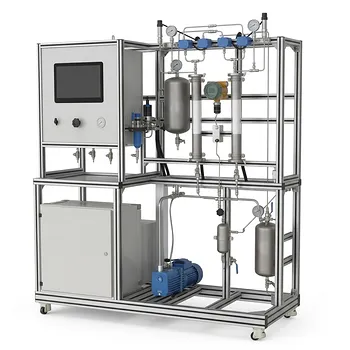
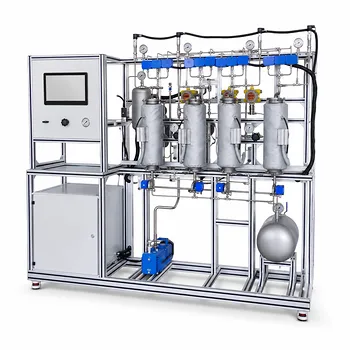
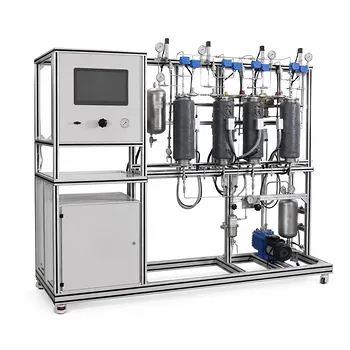
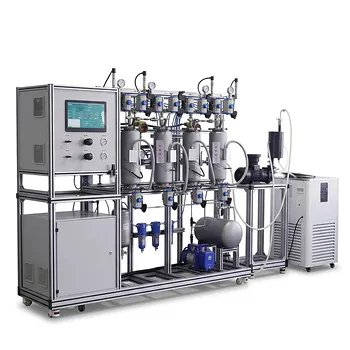
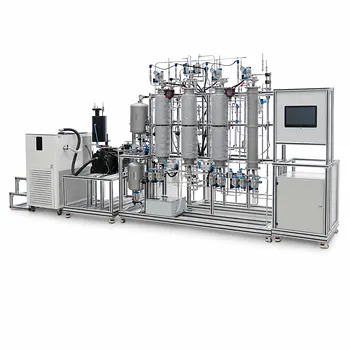
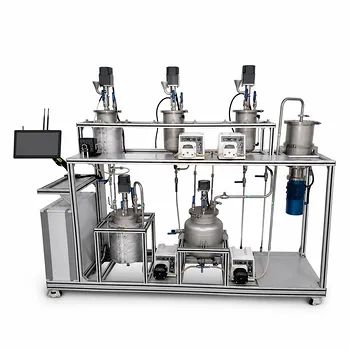
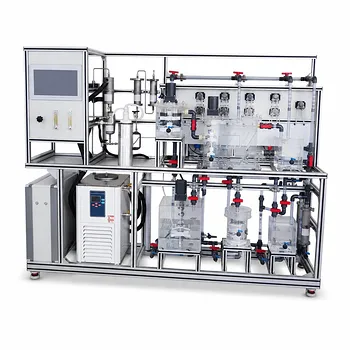
A pilot plant’s adsorber configuration isn’t just plumbing—it’s the physical embodiment of the mass transfer zone.
The correct setup depends directly on the length of the mass transfer zone (MTZ) and the shape of the breakthrough curve. If the MTZ is short and the breakthrough curve is steep, a dual-vessel swing process demonstrates continuous, rapid-cycle adsorption. When the MTZ is long and the curve is flat, a series configuration lets the adsorption wave span multiple vessels, maximizing bed utilization before breakthrough. When fluid flow rates exceed what a single column can handle, a parallel arrangement keeps pilot-scale equipment manageable while preserving the same MTZ behavior per column.
The core educational insight is that the MTZ governs how you connect adsorbers. A long, slow-moving MTZ demands series operation to fully use the adsorbent; a sharp, fast MTZ makes a swing system ideal for showing uninterrupted production. Parallel setups solve a scale problem, not a MTZ problem—yet they still let students see identical breakthrough dynamics in every channel.
Understanding the Mass Transfer Zone and Breakthrough Curve
The Length of the MTZ Drives Design Decisions
The mass transfer zone is the region of the bed where adsorption is actively occurring.
Its length—relative to the total bed length—determines how much unused adsorbent sits beneath the breakthrough point.
A short MTZ means most of the bed is either fully saturated or completely fresh, with only a narrow band doing work.
A long MTZ spreads the adsorption wave over a much larger portion of the column, so a significant fraction of the bed never reaches full saturation before breakthrough occurs.
Breakthrough Curve Shape as a Diagnostic Tool
The breakthrough curve—outlet concentration over time—directly reflects the MTZ.
A steep, almost vertical breakthrough curve signals rapid mass transfer and a compact adsorption wave. A gradual, sloping curve indicates slow kinetics or axial dispersion, stretching the MTZ.
In a well-instrumented pilot plant, students can watch concentration sensors track the wave moving down the bed.
This visual link between the curve shape and the bed’s internal state is what makes configuration choices physically meaningful.
Key Pilot Plant Configurations and Their Demonstrations
Dual-Vessel Swing Process for Steep Breakthroughs
When the system exhibits rapid adsorption rates and a sharp breakthrough profile, a dual-vessel swing arrangement excels.
One vessel performs adsorption while the other is being regenerated, showing students how to achieve continuous product output in a process that would otherwise be batch-wise.
This configuration immediately teaches the cycle time concept—the adsorption step must end before breakthrough, and regeneration must finish before the next cycle starts.
Switching valves and timing become part of the experimental learning, directly tying the MTZ’s speed to the required vessel size and swing frequency.
Series Process for Extended Mass Transfer Zones
If the breakthrough curve is shallow and the MTZ is longer than a single vessel, a series setup is the right pedagogical tool.
Two or more adsorbers plumbed in series let the adsorption wave travel from the first vessel (the lead bed) into the second (the lag bed).
Students can directly observe complete saturation of the lead bed before breakthrough contaminates the effluent.
By the time the outlet concentration from the lead bed begins to rise, the lag bed has already captured the advancing wave, keeping the final product pure. This approach maximizes adsorbent utilization and dramatically reduces waste compared to replacing beds at partial saturation.
Parallel Process for High Flow Rate Scenarios
When the total fluid flow exceeds the design capacity of an individual column, a parallel arrangement keeps pilot-scale hardware manageable.
Identical columns are run side by side, each handling a fraction of the total flow, yet each experiences the same MTZ behavior as a single column at its design rate.
This configuration does not alter the underlying mass transfer physics.
Instead, it teaches scale-up principles: how to maintain identical space velocity and bed geometry across multiple units to achieve identical breakthrough performance. Transport and fabrication constraints that limit column diameter become a tangible engineering lesson.
Integrating Instrumentation to Reveal Process Dynamics
Multi-point Sensors for Visualizing the Adsorption Wave
A gas adsorption pilot plant equipped with axial concentration sensors truly brings the MTZ to life.
Students can track the shifting concentration front in real time and identify the precise moment of breakthrough—the point where the lag bed’s outlet concentration begins to climb.
This data turns an abstract concept into a measurable, plottable phenomenon.
They see why a series configuration can run longer before replacement, because the lead bed’s exit does not immediately cause process failure.
Comparing Series and Parallel Guard Bed Strategies
The same pilot plant can be valved to compare series versus parallel guard-bed operation.
In the series layout, students observe that the lead guard bed can be used to complete exhaustion while the lag bed prevents impurity slippage, reducing adsorbent consumption and operating cost.
In a parallel arrangement, all beds see the same inlet conditions simultaneously, so each must be taken offline before its own breakthrough point.
This direct comparison cements the principle: series operation exploits the length of the MTZ, while parallel operation merely multiplies capacity without changing utilization efficiency.
Understanding the Trade-offs
Complexity vs. Pedagogical Clarity
A highly flexible pilot plant with multi-way valving for dual-vessel, series, and parallel modes can become intimidating.
Too many valves and bypass lines can obscure the core lesson—the relationship between MTZ length and vessel sequencing.
Simplify the configuration for early experiments, using a single column with multi-point probes to establish the MTZ, then add complexity.
This builds from fundamental observation to process design rather than drowning students in hardware.
Flow Distribution and Hidden Dead Volumes
In series and parallel setups, uneven flow distribution can distort the breakthrough curve so it no longer represents the true MTZ.
Even small dead volumes in manifolds or sampling lines can smear the concentration profile, making a steep MTZ look artificially broad.
Design the pilot plant with low-volume, direct connections and provide students with methods to correct for external dispersion.
This ensures the observed data reflects the adsorber’s intrinsic performance, not plumbing artifacts.
Regeneration Mismatch in Dual-Vessel Systems
A dual-vessel swing demonstration fails if regeneration times significantly exceed adsorption times.
The “continuous” operation breaks down because the saturated bed is not ready when the on-stream bed reaches breakthrough.
Before adopting this configuration, measure the MTZ length and shape to size columns so that adsorption and regeneration cycles are balanced.
If the MTZ is too long, the required bed length would be impractically large, and a series configuration becomes a better educational choice.
Making the Right Choice for Your Teaching Objective
Match your pilot plant configuration to the specific process concept you want students to internalize.
- If your primary focus is demonstrating continuous, rapid-cycle adsorption: Use a dual-vessel swing system with a steep breakthrough system and synchronized regeneration, so students can experience uninterrupted product flow and cycle-time optimization.
- If your primary focus is maximizing adsorbent utilization and visualizing a long mass transfer zone: Select a series configuration with multi-point sensors, allowing complete lead-bed saturation before breakthrough and direct observation of the wave’s progression.
- If your primary focus is handling large flows or teaching scale-up through numbering-up: Implement a parallel arrangement of identical columns, emphasizing how constant space velocity preserves the same breakthrough curve in every vessel.
- If your primary focus is comparing guard-bed strategies and reducing waste: Build a flexible manifold that switches between series and parallel modes, so students can quantify the adsorbent savings and purity protection a lag bed provides.
A thoughtfully configured pilot plant turns the abstract concept of a mass transfer zone into a visible, measurable, and unforgettable engineering lesson.
Summary Table:
| Configuration | MTZ Characteristic | Key Teaching Objective | Adsorbent Utilization |
|---|---|---|---|
| Dual-Vessel Swing | Short MTZ, steep curve | Continuous cycle-time control | Moderate |
| Series Setup | Long MTZ, flat curve | Lead/lag bed utilization & wave tracking | High |
| Parallel Setup | Flow exceeds capacity | Scale-up principles & space velocity | Moderate |
Elevate Your Chemical Engineering Lab with LABPARK
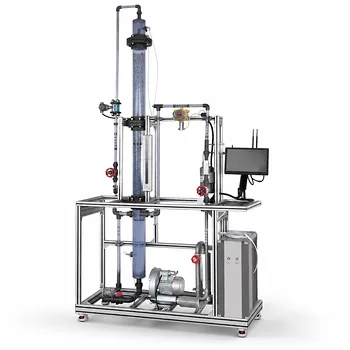
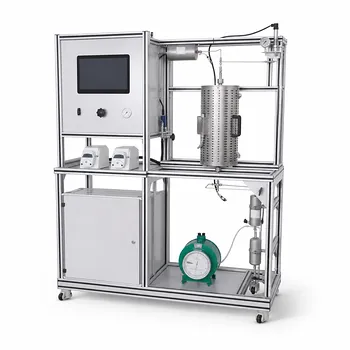
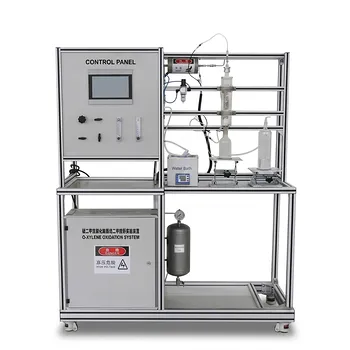
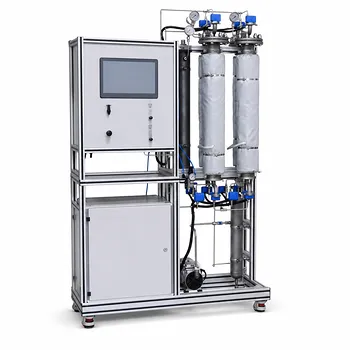
Looking to enhance your students' hands-on learning? LABPARK provides state-of-the-art Educational and Vocational Unit Operations Pilot Plants in chemical engineering, bioprocess & biotech, and environmental & water treatment. Designed specifically for universities, research institutes, and enterprises, our flexible pilot plants make complex concepts like the Mass Transfer Zone (MTZ) visible, measurable, and easy to understand.
Ready to design the ultimate adsorption teaching lab? Contact us today to discuss your customized pilot plant configuration!
Related Products
- Packed Bed Absorption Educational Unit Operations Pilot Plant
- Fixed-Bed Chemical Reaction and Gas Dust Tar Removal Unit Operations Pilot Plant
- Fixed Bed Gas Solid Catalytic Reaction Educational Pilot Plant
- Multi-Reactor Educational Pilot Plant for Reaction Engineering Unit Operations
- Educational Unit Operations Pilot Plant for Intraparticle Diffusion Effective Factor Measurement
People Also Ask
- How Do Flow Regimes Transition in Packed Bed Pilot Plants? Key Scale-up Insights
- How does reactant concentration determine absorption column control? Gas-film vs. dual-film.
- How is the packing height of an absorption column calculated? Master HTU & NTU Concepts
- How does static vs. operating holdup affect pilot plant calibration? Avoid Critical Scale-Up Errors
- Why is counter-current flow selected for gas absorption? Maximize Pilot Plant Efficiency