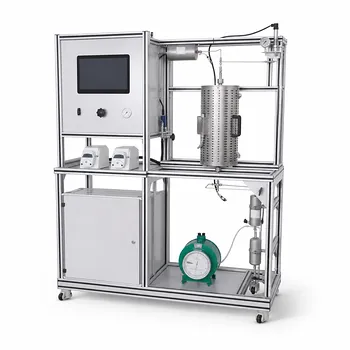
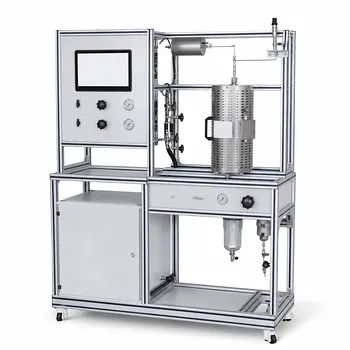
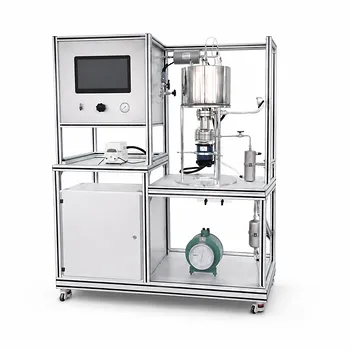
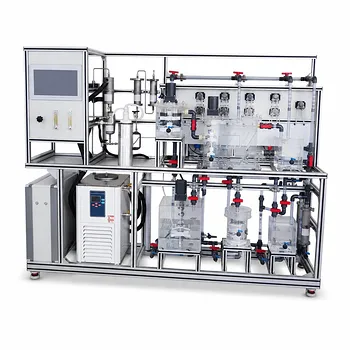
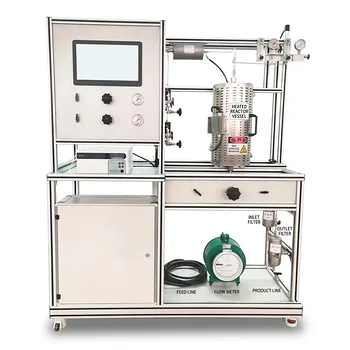
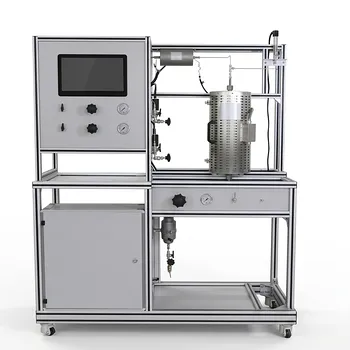
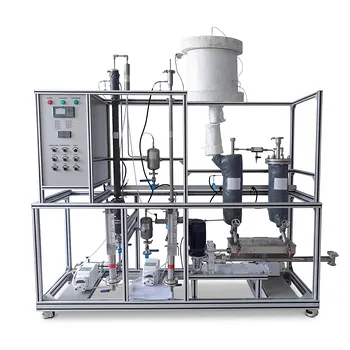
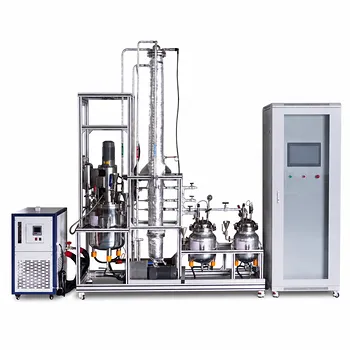
Designing a pilot plant for endothermic dehydrogenation is a battle against falling temperatures and a race to supply heat exactly where it is needed. The plant must be configured around a reactor that can deliver high-temperature heat uniformly to a catalyst bed while accommodating a co-fed diluent—steam—that simultaneously supplies energy, lowers reactant partial pressure, and suppresses coke formation. The configuration typically centers on either an isothermal multi-tubular reactor or a series of adiabatic fixed‑bed reactors, armed with multi‑point temperature sensors and gas chromatography sampling ports. The operational challenges it must address are severe temperature drops, catalyst coking and deactivation, pressure‑drop penalties from high steam‑to‑feed ratios, and the heat‑loss artifacts that come with laboratory‑scale equipment.
The pilot plant must be engineered around three pillars: (1) a heating strategy that counteracts the endothermic ΔrH by feeding heat along the entire catalyst bed, (2) steam injection tuned to balance heat supply, dilution, and coke suppression, and (3) dense instrumentation that reveals temperature profiles and composition evolution. Only then can researchers reliably study kinetics, catalyst stability, and regeneration cycles—because every operational challenge (coke, pressure drop, thermal quenching) originates from the inability to manage these three pillars.
Reactor Architecture: Heat Supply at the Core
Choosing Between Isothermal and Adiabatic Configurations
The fundamental choice dictates how heat reaches the reaction zone.
Isothermal multi-tubular reactors place catalyst inside externally heated tubes, allowing tight temperature control and the study of intrinsic kinetics.
Adiabatic reactors—often connected in series with inter‑stage steam reheat—closely mirror industrial reality at the cost of large temperature drops.
Multi‑Tubular Designs for Kinetic Studies
In education and research, a stainless‑steel or alloy tube filled with catalyst and surrounded by a furnace is the standard isothermal configuration.
This setup lets students and researchers map temperature profiles with multi‑point thermocouples and isolate the effects of temperature, concentration, and steam ratio without the complicating variable of axial temperature fall.
Series‑Connected Adiabatic Beds for Industrial Emulation
When the goal is to replicate commercial ethylbenzene‑to‑styrene processes, a train of adiabatic fixed‑bed reactors with steam injection between stages is used.
Inlet temperatures usually span 580 °C to 600 °C; lower values yield poor conversion, while exceeding 600 °C rapidly degrades selectivity and accelerates coking.
Mastering Temperature Control
The Critical Inlet‑Temperature Window
The endothermic reaction ΔrH (for ethylbenzene dehydrogenation, 125 kJ/mol) means the catalyst bed cools as conversion proceeds.
A pilot plant must hold the inlet temperature in the narrow 580–600 °C range to balance thermodynamic driving force against thermal degradation.
Multi‑Zone Heating and Temperature Sensors
Bare thermocouples placed at multiple axial positions are non‑negotiable.
They reveal the steep temperature drop across the bed—often tens of degrees—and tell the operator when regeneration is required or when steam flow is insufficient.
Minimizing Heat Loss in Small‑Scale Setups
Miniaturization sharply increases the surface‑area‑to‑volume ratio, causing heat loss that can quench the reaction or extinguish the “flame” of activity.
Because the wall’s thermal conductivity is orders of magnitude higher than the fluid’s, heat is primarily conducted upstream through the metal—so pilot reactors must use active insulation and external pre‑heating to preserve an adiabatic‑like profile when needed.
Steam Injection: The Multifunctional Utility
Simultaneous Heat Carrier and Diluent
Steam is co‑fed not just to add heat but to reduce the partial pressure of the reactant, shifting the equilibrium toward the products.
In isothermal operations, a mass ratio of 1–1.5 : 1 steam‑to‑hydrocarbon is typical; in adiabatic trains, molar steam‑to‑ethylbenzene ratios as high as 12–17 : 1 counteract the deep temperature drop.
Coke Suppression
Steam reacts with surface carbon deposits via the water‑gas shift and gasification mechanisms, physically cleaning the catalyst.
The pilot plant must have precise mass flow controllers for steam and hydrocarbon to let researchers map the steam‑to‑feed ratio against coke formation rate, catalyst activity decay, and product selectivity.
Flow Rate and Pressure Drop Trade‑Offs
High steam flows bring a cost: increased bed pressure drop.
A pilot plant must therefore be instrumented with differential pressure transducers to measure ΔP, enabling students to weigh the benefit of higher conversion against the drag force that can crush catalyst pellets and raise pumping energy.
Catalyst and Bed‑Scale Dynamics
Robust Catalysts and Supports
Iron‑based catalysts (e.g., Fe‑K‑Cr formulations) are the workhorse for alkyl‑aromatic dehydrogenation.
For oxygenated feedstocks or alcohol reforming, transition metals on Al₂O₃, CeO₂, or ZrO₂ supports are chosen to resist coking and sintering—so the pilot reactor must be compatible with these materials and allow easy catalyst loading/unloading.
Particle Size Optimization
Pilot‑scale reactors must use catalyst extrudates of 3.2 mm or 4.8 mm diameter—small enough to minimize internal diffusion resistance, yet large enough to avoid excessive pressure drop.
A series configuration permits testing different particle sizes in each bed to decouple diffusion effects from kinetic data.
Regeneration Studies
Dehydrogenation pilot plants are uniquely suited to study catalyst regeneration cycles because the coke lay‑down is rapid and measurable.
The configuration must include a gas‑switching manifold to alternate between reaction and regeneration (air‑or‑steam‑diluted oxygen) while monitoring the bed temperature exotherm and CO₂ evolution.
Instrumentation: Seeing Inside the Bed
Multi‑Point Temperature Sensing
Axially distributed thermocouples are the pilot plant’s “eyes,” detecting hot‑spots, cold‑spots, and the onset of deactivation.
For adiabatic beds, the temperature profile is a direct proxy for conversion and heat balance.
On‑Line Gas Chromatography
Sampling ports after each reactor or at the outlet, tied to an on‑line GC, let researchers track hydrogen, olefin, and by‑product concentrations in real time.
This data feeds kinetic models and validates the steam‑to‑hydrocarbon impact on selectivity.
Wall‑Effect Diagnostics
Laboratory‑scale reactors suffer from channeling and radical quenching at the walls.
The pilot plant should be designed so that the ratio of bed diameter to particle diameter is at least 8–10, and wall‑mounted temperature probes can detect radial gradients that indicate bypassing.
Operational Challenges You Must Address
Coking and Catalyst Deactivation
Carbon lay‑down is the primary failure mode, increasing pressure drop and blanketing active sites.
A robust pilot plant permits regular in‑situ regeneration, monitors ΔP, and allows variation of steam ratio to find the minimum coking threshold for a given feedstock.
Pressure Drop and Bed Integrity
High‑velocity steam can fluidize or crush catalyst pellets, especially at laboratory scale where beds are short.
Using a pellet strength test before loading and installing retaining screens at inlet and outlet mitigates attrition, but research‑grade pilot plants must also record ΔP continuously to flag developing blockages.
Heat Management Artifacts
Axial heat loss through the walls can make the reactor appear more isothermal than it truly is.
To counter this, pilot‑plant designs often use hot‑box enclosures or dynamic insulation that matches the internal temperature gradient, especially when studying adiabatic behavior.
Utility Alignment and Safety
Before powering on, the laboratory must meet the pilot plant’s utility demands: electricity (voltage, phase, and capacity for the furnace), steam (for reactant feed and tracing), cooling water for condensers, and safe ventilation for hydrogen off‑gas.
Ignoring these basics leads to operational failures and safety risks, as highlighted in standard process design bases for educational pilot‑plant installations.
Understanding the Trade‑offs
Isothermal Precision vs. Industrial Realism
An isothermal multi‑tubular reactor gives clean kinetic data but cannot reproduce the temperature‑drop dynamics that dominate commercial adiabatic trains.
Researchers must decide early if their goal is reaction‑model validation or process‑scale de‑risking.
High Steam Ratios: Conversion Gain vs. Hydraulic Penalty
A steam‑to‑ethylbenzene ratio of 15 dramatically boosts conversion and suppresses coke, but it also drives pressure drop through the roof.
Pilot‑plant studies must map the diminishing returns curve to find the economically viable window.
Small‑Scale Artifacts
Data from a 2 cm‑diameter tube may be distorted by wall heat transfer and radial gradients.
Always couple pilot‑plant runs with computational heat‑transfer models to decouple true catalytic activity from thermal lags.
Making the Right Choice for Your Goal
A pilot plant for endothermic dehydrogenation is not a single‑purpose device; its final configuration depends on what you need to learn.
- If your primary focus is intrinsic kinetics and reaction modeling: Choose an isothermal multi‑tubular reactor with tight multi‑zone heating, diluted feeds, and small catalyst particles. This minimizes temperature and concentration gradients, giving you data for rate‑equation derivation.
- If your primary focus is emulating industrial dehydrogenation (e.g., ethylbenzene to styrene): Go for series‑connected adiabatic fixed‑bed reactors with inter‑stage steam injection. Accept the temperature drop and use it as a measurement variable.
- If your primary focus is catalyst development and deactivation studies: Build in frequent on‑line GC sampling, rapid‑cycle regeneration switching, and long‑run capability. Keep the bed geometry scalable so that pellet‑size effects translate to larger units.
- If your primary focus is educational demonstration: Prioritize clear instrumentation, simple configuration (a single heated tube), and full utility alignment. Let students vary steam ratio and temperature to directly observe conversion and coking trends, while keeping safety systems front and center.
Every successful dehydrogenation pilot plant ultimately succeeds because it treats heat not as a boundary condition, but as the central reactant that must be delivered with precision.
Summary Table:
| Configuration | Best Used For | Heat Strategy | Main Challenge |
|---|---|---|---|
| Isothermal Multi-Tubular | Kinetic studies & rate equations | External multi-zone furnace | Wall-effect artifacts & bypass |
| Series Adiabatic Beds | Industrial process emulation | Inter-stage steam reheat | Severe temperature drops & coking |
Scale Up Your Chemical Engineering Labs with LABPARK
Building a reliable pilot plant for complex reactions like endothermic dehydrogenation requires precision engineering. LABPARK provides state-of-the-art Educational and Vocational Unit Operations Pilot Plants tailored for universities, research institutes, and enterprises.
Whether you are teaching kinetics or scaling up chemical engineering, bioprocess & biotech, or environmental & water treatment technologies, our pilot plants ensure precise control, safety, and industrial-grade simulation.
Ready to optimize your research and training setups? Contact LABPARK today to discuss your custom project requirements!
Related Products
- Ethylbenzene Dehydrogenation Educational Unit Operations Pilot Plant
- 100L Continuous Loop Hydrogenation Educational Unit Operations Pilot Plant
- Carbon Dioxide Hydrogenation Methanol Synthesis Educational Unit Operations Pilot Plant
- Multi-Reactor Educational Pilot Plant for Reaction Engineering Unit Operations
- Internal Circulation Gradient Free Catalytic Reaction Educational Pilot Plant
People Also Ask
- What parameters & reactor configurations are needed for ethylbenzene dehydrogenation pilot plants?
- Why is steam dilution critical in dehydrogenation? Pilot Plant Control Guide
- Isothermal vs Adiabatic Reactors: Key Differences in Ethylbenzene Dehydrogenation Pilot Plants
- How do pilot plants help students verify material balances? Bridge Theory with Real-world Data
- Why is the steam-to-feedstock ratio critical in catalytic dehydrogenation? Learn the 3 key roles of steam.