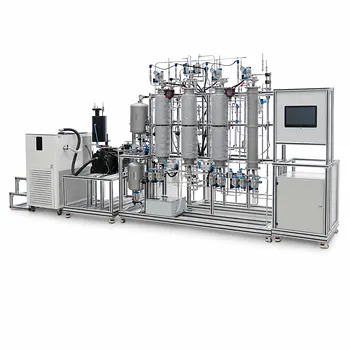
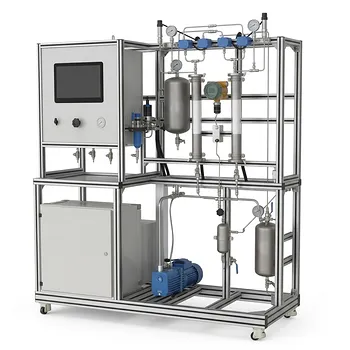
The answer is a definitive, clear-cut split: the method is highly reliable for vapor-liquid equilibria (VLE) but often fails for liquid-liquid equilibria (LLE). For a pilot plant distillation column, you can confidently predict the multicomponent behavior from binary data, saving immense time and resources. However, for a liquid-liquid extraction column, this predictive shortcut is a gamble you will almost certainly lose, making direct experimental verification for your specific three-or-more-component mixture non-negotiable.
The core insight for pilot plant operations is that the reliability of binary-only predictions is not a universal principle but is dictated by the physics of the phase. The vapor phase is a forgiving, ideally-behaved environment where binary interactions serve as robust building blocks. The liquid phase, especially with polar or hydrogen-bonding molecules, is a complex environment of multi-body interactions that binary data simply cannot capture. A successful pilot plant strategy uses this knowledge to invest experimental effort exclusively where it matters: on LLE systems.
The Tale of Two Phases: Why the Reliability Diverges
The stark difference in predictive reliability between VLE and LLE for multicomponent systems isn't a quirk of modeling; it's a consequence of fundamental molecular freedom.
Why Binary Data is a VLE Superpower
In the vapor phase, molecules are distant and disordered. Their interactions are brief, binary collisions. This makes the physics inherently simpler to model.
A ternary vapor mixture's behavior is overwhelmingly defined by the three constituent binary pairs (A-B, B-C, A-C). The chance of a simultaneous, complex A-B-C interaction is negligible. Because of this, thermodynamic models using only binary interaction parameters serve as remarkably accurate building blocks.
The success is quantifiable. For systems like carbon dioxide, ethane, and ethylene, using only binary parameters predicts ternary VLE with a deviation as low as 0.003 mole fraction and 0.16 bar pressure. This level of accuracy allows a pilot plant engineer to safely scale up a fractionation column, optimize its energy use, and predict product purities with minimal experimental runs.
Why LLE Predictions Fail with Binary Data Alone
The liquid phase is a dense, intimate molecular environment. Molecules are in constant, close contact, making the system's behavior a collective property of the entire mixture, not just a sum of pairs.
Adding a third component can fundamentally reorganize the liquid structure. It can enhance or disrupt molecular complexes and alter the local environment. Multi-body interactions dominate. A polar molecule can act as a bridge, causing two previously immiscible components to become miscible, a phenomenon no binary data set could ever predict. This is why, for a pilot plant liquid-liquid extraction unit with three or more components, relying on a simulation built from binary parameters is a primary cause of process failure, and direct experimental verification is the only safe path.
Understanding the Practical Limitations and Pitfalls
Even the highly reliable VLE prediction strategy has boundaries that a trusted advisor must highlight to prevent project-killing mistakes.
The Hidden Risks in the VLE Success Story
The "build-from-binaries" approach works for common, well-studied systems. The reliability falters at the frontier of knowledge.
Thermodynamic literature reveals a critical data gap: consistent experimental VLE data for ternary, quaternary, and larger hydrocarbon systems is scarce, and data for hydrocarbons above C10 is virtually nonexistent. In a research pilot plant, you are likely operating precisely in this uncharted territory, where models haven't been validated. Furthermore, special conditions break standard methods:
- Supercritical Components: When a component goes supercritical, its standard liquid reference state vanishes. Models must rely on extrapolations like the Chao-Seader method or Henry's Law, introducing uncertainty.
- Thermally Unstable Components: For substances like ethylene glycol that decompose before reaching a critical point, critical properties cannot be measured. You must rely on group contribution estimation methods, and an estimated input always produces a less-reliable output for enthalpy and energy balance calculations.
The LLE Challenge is a Validation Challenge
The primary reference is explicit: this predictive method is "often unsuccessful" for LLE. This isn't a warning of minor inaccuracy but of potential qualitative failure—your model may predict a single liquid phase where you physically get two, or vice versa.
Operating an extraction pilot plant without multicomponent LLE data means your designed solvent-to-feed ratio and calculated stage efficiency are, at best, guesses. The only path to a reliable design is to use your pilot plant's precise controls to generate your own experimental tie-line data and validate specialized activity coefficient models like NRTL or UNIQUAC.
Making the Right Choice for Your Pilot Plant Campaign
Your experimental strategy must be aligned with the phase you are separating. Treating all separation processes the same leads to a catastrophic waste of resources.
- If your primary focus is a VLE process (distillation, absorption): Confidently build your simulation from binary parameters, process simulations, and Degradation of CO2 absorption solvents. Your precious pilot plant time is better spent validating energy balances and hydraulic performance than remeasuring the fundamentals of phase behavior.
- If your primary focus is an LLE process (extraction): Dedicate your pilot plant campaign to the essential task of generating rigorous multicomponent LLE data. A simulation without this foundational data is worse than useless; it gives a false sense of security.
- If your system contains supercritical or thermally fragile components: Acknowledge that even your VLE predictions rest on an extrapolated or estimated foundation. Build a safety margin into your equipment sizing and use your pilot plant runs to specifically verify those predicted operating points.
A smart pilot plant strategy is not about applying one method everywhere, but about knowing exactly where you can bank on powerful theoretical shortcuts and where you must pay for experimental certainty.
Summary Table:
| Metric / Feature | Vapor-Liquid Equilibria (VLE) | Liquid-Liquid Equilibria (LLE) |
|---|---|---|
| Predictive Reliability | High (Highly accurate from binary data) | Low (Frequently fails/unreliable) |
| Molecular Physics | Simple binary collisions in vapor phase | Complex multi-body interactions in liquid phase |
| Pilot Plant Strategy | Use binary-based simulation shortcuts | Perform direct experimental verification |
Optimize Your Separation Processes with LABPARK
Are you scaling up distillation or extraction systems? LABPARK provides state-of-the-art Educational and Vocational Unit Operations Pilot Plants in chemical engineering, bioprocess & biotech, and environmental & water treatment. Designed specifically for universities, research institutes, and enterprises, our systems ensure you obtain the precise, real-world experimental data required to validate complex thermodynamic models.
Ready to elevate your research and process scale-up? Contact our experts today to find the perfect pilot plant solution for your facility!
Related Products
- Gas-Solid Heterogeneous Separation Demonstration Educational Unit Operations Pilot Plant
- Carbon Material Thermal Pretreatment Multiphase Separation Educational Pilot Plant
- Potassium Salt Thermal Dissolution and Crystallization Separation Educational Unit Operations Pilot Plant
- Bench Scale Dual Column Gas Separation and Capture Educational Pilot Plant
- Multi-Functional Membrane Separation Educational Pilot Plant for Unit Operations Lab
People Also Ask
- Why is pressure drop characterization critical in separation pilot plants? Key operational insights.
- What are the key thermodynamic considerations for gas mixture modeling? Expert Guide
- What are the primary operational objectives and physical requirements when running heterogeneous separation pilot plants?
- What are the material limitations of gas separation pilot plants? Key factors to consider.
- What are the trade-offs in olefin-paraffin separation? Optimize Pilot Plant Performance