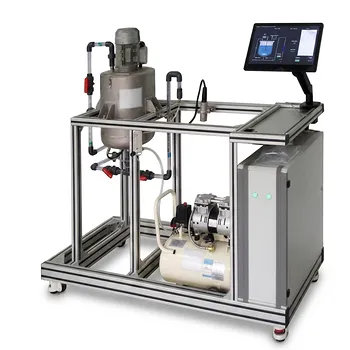
Here’s the core calculation behind comminution power estimates for solid processing pilot plants.
For grinding and milling equipment—such as ball mills or rod mills—power consumption is estimated using Bond’s work index equation: E = 100 * Ei * (1/√d₂ - 1/√d₁). In this relationship, Ei is the material’s work index, d₁ is the inlet feed size, and d₂ is the final product size. This calculation forms the backbone of equipment sizing, energy benchmarking, and student learning in unit operations labs.
The Bond work index equation translates a given size reduction task into a specific energy requirement. By anchoring the estimate in the material’s inherent resistance to breakage (Ei), it gives pilot‑plant teams a defensible, repeatable way to predict motor loads, compare flowsheets, and teach the fundamentals of energy‑efficient processing—long before full‑scale capital is committed.
The Bond Work Index Equation: The Starting Point for Pilot‑Plant Sizing
How the Calculation Works
Bond’s law states that the energy per unit mass to reduce a material from feed size d₁ to product size d₂ is inversely proportional to the square root of those sizes.
In the equation E = 100 * Ei * (1/√d₂ - 1/√d₁):
- E is the specific energy (kWh per ton).
- Ei is the Bond work index—the energy required to reduce one short ton of the material from a theoretically infinite feed size to a product where 80% passes 100 µm.
- d₁ and d₂ are the 80% passing sizes of the feed and product, often in centimeters when using the 100 multiplier. (The more familiar form
W = 10 * Wi * (1/√P₈₀ - 1/√F₈₀)uses microns and a constant of 10.)
The Material’s Fingerprint: The Work Index (Ei)
Ei is a measured, material‑specific value obtained from standardized lab tests—typically the Bond ball mill grindability test.
Harder, more competent ores return higher work indices and therefore demand more energy for the same size reduction.
This single number allows you to shift from vague “horsepower‑per‑ton” rules of thumb to a physics‑grounded estimate that respects the true nature of the solids you are processing.
Why It Matters in a Pilot‑Plant Setting
When you are designing a pilot run, the calculation serves three immediate purposes:
- It sizes the mill drive and motor: The predicted specific energy, multiplied by the desired throughput, gives the absorbed power.
- It benchmarks alternative circuits: You can compare different mill types or closed‑circuit configurations by seeing how they alter the effective size reduction ratio.
- It provides a teaching anchor: In vocational and academic environments, the Bond equation turns an abstract concept of “energy efficiency” into a concrete, measurable target.
What the Equation Teaches Beyond the Numbers
Energy‑Efficiency as a Verifiable Concept
A pilot plant is a learning tool as much as a production test bed.
By measuring actual power draw and comparing it to the Bond prediction, you can quantify mill inefficiencies—losses due to friction, non‑optimal ball charge, or poor material flow.
This verification loop trains operators and engineers to look beyond theoretical equations and consider real‑world factors like mechanical losses and grindability variations.
Scaling Up and Capacity Verification
The Bond equation was originally developed to bridge pilot‑scale and industrial‑scale design.
In a unit operations pilot plant, you run a known mass of material, measure the time and power, and calculate the specific energy.
If the measured work index from your pilot trial matches the lab‑determined Ei, you have strong evidence that the process has been correctly scaled and that the full‑scale equipment can be specified with confidence.
Understanding the Trade‑offs and Pitfalls
The Empirical Limits of Bond’s Law
Bond’s equation is empirical, not a fundamental law of physics.
It works best for intermediate particle sizes (roughly between 100 µm and a few millimeters) and for materials that fracture in a similar way to the rock types Bond originally tested.
Outside this range—ultra‑fine grinding or very coarse crushing—the predictions can deviate significantly, and alternative models (like Rittinger’s or Kick’s) may be more appropriate.
When the Equation Gives a False Sense of Precision
The single Ei value hides the complexity of a material’s breakage behavior.
In a pilot plant, feed size distribution is rarely uniform, and the mill dynamics (e.g., residence time, ball size distribution) alter the actual energy consumption.
Treating the Bond equation as a precise design tool without pilot‑specific efficiency factors can lead to oversized motors or, worse, undersized drives that stall under real loads.
The Hidden Cost of Simplicity
While the Bond equation simplifies the estimation, it does not capture the dynamic responses of the milling circuit—recirculating loads, classifier inefficiencies, or changes in ore hardness over the campaign.
For vocational training, this presents a valuable lesson: the equation gives you a starting point, but only hands‑on pilot‑plant data reveals the full picture of energy consumption.
Applying Bond’s Law to Your Pilot‑Plant Project
Your specific goal determines how you should leverage this energy estimation method.
- If your primary focus is sizing a pilot‑scale mill: Start with the Bond equation to estimate the net power draw, then apply a mechanical efficiency factor (typically 0.9–0.95 for gear and bearing losses) to get the motor rating.
- If your primary focus is benchmarking energy efficiency: Use the equation to set a theoretical minimum and compare it against measured kWh/ton from the pilot run—any excess becomes a driver for circuit optimization.
- If your primary focus is educational or vocational demonstration: Walk students through the lab determination of Ei, then let them commission the pilot unit and discover firsthand how real power demand aligns with (or diverges from) the textbook prediction.
The Bond work index equation transforms rock hardness, feed size, and product specifications into a single, actionable energy number.
It remains the starting point for any credible solid‑processing pilot plant—not because it is perfect, but because it creates a common language for design, verification, and learning.
Summary Table:
| Parameter / Variable | Description in Bond's Equation | Role in Pilot Plant Sizing |
|---|---|---|
| Specific Energy (E) | kWh per ton required for size reduction | Determines motor power and drive sizing |
| Work Index (Ei) | Material resistance to breakage | Serves as the baseline material fingerprint |
| Sizes (d1 & d2) | 80% passing size of feed (d1) and product (d2) | Sets the target size reduction ratio |
| Mechanical Loss Factor | 0.9 - 0.95 efficiency multiplier | Adjusts theoretical energy to actual motor load |
Elevate Your Engineering Programs with LABPARK Pilot Plants
Accurate energy estimation is key to successful process engineering. LABPARK provides state-of-the-art Educational and Vocational Unit Operations Pilot Plants in chemical engineering, bioprocess & biotech, and environmental & water treatment.
We help universities, research institutes, and enterprises bridge academic theory with industrial practice by delivering robust, hands-on learning systems. Whether you are teaching Bond's law or scaling up processing lines, our systems ensure reliability, safety, and deep educational value.
Let us help you build the perfect training environment. Contact LABPARK today to discuss your project requirements!
Related Products
- Agitation and Mixing Educational Unit Operations Pilot Plant
- Bernoulli Equation Demonstration Unit Operations Pilot Plant
- Multi-Stage Stirred Tanks in Series Residence Time Distribution and Mixing Performance Determination Educational Pilot Plant
- Educational Compression Refrigeration Performance Determination Unit Operations Pilot Plant
- Gas-Solid Heterogeneous Separation Demonstration Educational Unit Operations Pilot Plant
People Also Ask
- Why is the Reynolds number ($Re_M$) critical in mixing? Master N_P for pilot plants.
- What are the four guiding principles of process intensification? Educational Equipment Guide
- How do educational unit operations pilot plants support process analysis? Connect theory with real data
- How does the pseudobinary diffusion approximation simplify mass transport equations in educational pilot plants?
- Why is post-implementation performance evaluation and gap analysis critical when deploying educational unit operations pilot plants?