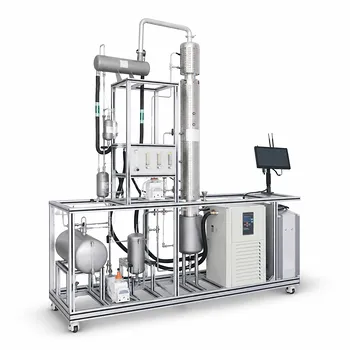
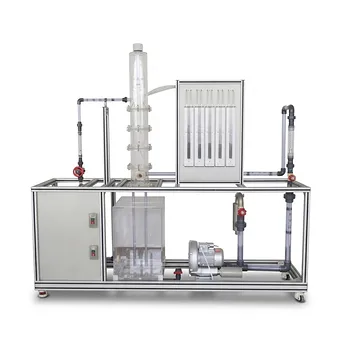
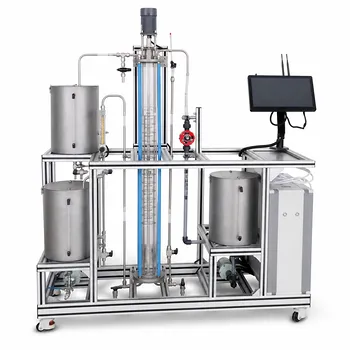
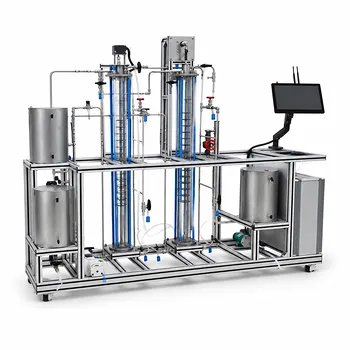
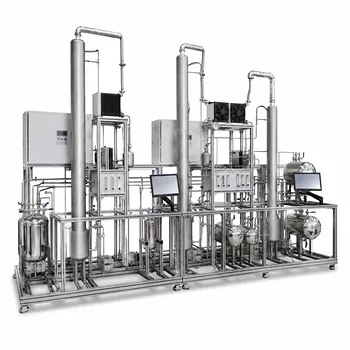
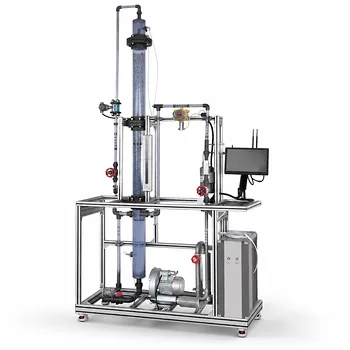
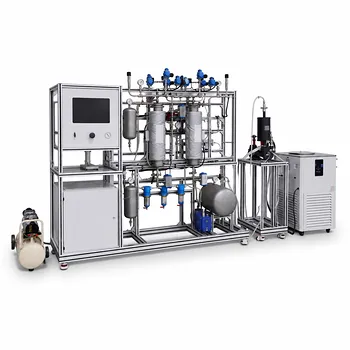
Overall plate efficiency converts the idealized world of chemical equilibrium into the physical reality of equipment design. It is the critical factor that directly translates the number of theoretical stages ($N_T$) from a model into the actual number of physical trays ($N_p$) required in a column, via the relationship $E_T = N_T / N_p$. Once the actual number of plates is known, the effective column height ($Z$) is determined by multiplying the number of plate spacings by the spacing between each tray, using the formula $Z = (N_p - 1)H_T$.
Defining overall plate efficiency is not just an academic exercise in a pilot plant. It is the essential, empirical bridge between thermodynamic predictions and the real-world sizing of a distillation column, accounting for the imperfect mass transfer that idealized models ignore.
Deconstructing Overall Plate Efficiency in a Pilot Plant
The "overall" in overall plate efficiency ($E_T$) is key. A single theoretical stage assumes perfect vapor-liquid equilibrium is achieved. A real physical tray never achieves this. $E_T$ therefore represents the fractional equivalent of a theoretical stage provided by each real tray across an entire section of the column.
The Foundational Formula
The definition is simple: $E_T = N_T / N_p$. The critical work lies in accurately determining $N_T$ for a real separation and using it to solve for $N_p$.
- $N_T$ (Theoretical Stages): This comes from the ideal world of vapor-liquid equilibrium (VLE) calculations. It is the number of perfect contact stages needed to achieve the desired separation at a given reflux ratio.
- $N_p$ (Actual Physical Trays): This is the number of physical, bolted-in trays inside the pilot plant column. This is your measured hardware.
A Practical Determination Method
A common pedagogical exercise in a pilot plant illustrates this process perfectly, allowing you to back-calculate the real-world efficiency of your equipment.
- The Experimental Approach: First, operate the column at steady state and measure the compositions of the feed, distillate, and bottoms streams.
- Calculating the Ideal: Use the Fenske equation to calculate the minimum theoretical stages at total reflux. Then, apply the Gilliland correlation (or a graphical McCabe-Thiele construction for binary systems) to find the total theoretical stages ($N_T$) at the operating reflux ratio.
- Solving for Efficiency: Count the number of physical trays ($N_p$) in the column section. Exclude the reboiler from this count, as it is typically treated as a single theoretical stage. Calculate $E_T$ directly from $E_T = N_T / N_p$. This back-calculated value is the column's real, measured overall efficiency.
Applying Efficiency to Calculate Column Height
Once the overall efficiency is known or reliably estimated, you can design a column or validate an existing one. The purpose of finding $N_p$ is to calculate the physical space the trays will occupy.
The Core Equation: $Z = (N_p - 1)H_T$
The column's effective height ($Z$) is not simply $N_p \times H_T$. It uses ($N_p - 1$) because $H_T$ represents the spacing between trays. For a column with 10 actual trays, there are 9 inter-tray spacings. This is a crucial detail in precise height calculations.
The Importance of Tray Spacing ($H_T$)
Tray spacing is not an arbitrary number. In pilot plant design, it directly impacts three critical factors:
- Column Height: Larger spacing directly increases the column height, affecting structural supports and facility layout.
- Operational Flexibility: Proper spacing prevents entrainment and flooding, defining the column's stable operating window and vapor capacity.
- Maintenance and Observation: In educational pilot plants, a typical spacing of 200–300 mm (8-12 inches) is often specified not just for hydraulics, but to allow for sight glasses and access ports for safe inspection.
Understanding the Trade-offs
No single method for determining $E_T$ is universally superior, and several pitfalls exist in the application.
Empirical Correlations vs. Experiment
Empirical methods are powerful for estimation but have known limitations. They provide a starting point, not an absolute truth.
- The O'Connell Correlation: A classic method where $E_T = 0.49(\alpha \mu_L)^{-0.245}$. This model links efficiency to the liquid-phase physical properties—relative volatility ($\alpha$) and liquid viscosity ($\mu_L$). For multicomponent systems, $\mu_L$ is a mole-fraction-weighted average. The trade-off is clear: it’s a quick estimate primarily suited for hydrocarbons and ignores the specific internal design of the tray.
- Advanced Two-Film Methods: For deeper analysis, methods like the Erwin two-film method stand out. They account for tray geometry and fluid dynamics by calculating gas-phase ($N_G$) and liquid-phase ($N_L$) transfer units. The benefit is higher accuracy (potentially within 3% of industrial norms). The downside is the complexity and detailed input data required, making it more suitable for research than a quick design check.
The Critical Distinction for Packed Columns
A common point of confusion is applying tray efficiency concepts where they don't belong. When working with packed columns, the term $E_T$ is irrelevant.
- The equivalent concept is the HETP (Height Equivalent to a Theoretical Plate).
- The packed bed height is calculated simply as: Packing Height = $N_T \times \text{HETP}$.
- A 1-inch metal Pall ring may have an HETP of roughly 0.4-0.5 meters, but this is an empirical value that varies with system properties and flow rates. Conservative design practice adds a safety margin of at least 6 inches (150 mm) to the calculated minimum HETP.
Making the Right Choice for Your Goal
Your approach to determining and applying overall plate efficiency should directly align with your objective in the pilot plant.
- If your primary focus is education and reinforcing fundamentals: Use the experimental back-calculation method. Have students run the column to steady state, analyze product compositions, calculate $N_T$ via the McCabe-Thiele or Fenske-Underwood-Gilliland methods, and then compute $E_T$ for the installed hardware. This powerfully illustrates the gap between theory and reality.
- If your primary focus is preliminary design or quick validation: Use an empirical correlation like the O'Connell method to estimate $E_T$. This allows you to quickly approximate the required column height ($Z$) from the model results, providing a rapid feasibility check.
- If your primary focus is advanced research or performance optimization: Employ a rigorous two-film model, like the Erwin method. This involves measuring column hydrodynamics and mass transfer parameters to dissect the efficiency losses in each phase and evaluate how specific tray designs or operating points can be improved.
The calculation of column height is a ritual that transforms abstract thermodynamic models into a tangible piece of equipment, grounding theoretical purity in the physical limits of mass transfer.
Summary Table:
| Key Parameter/Method | Formula/Definition | Application & Notes |
|---|---|---|
| Plate Efficiency ($E_T$) | $E_T = N_T / N_p$ | Converts theoretical stages ($N_T$) to actual physical trays ($N_p$). |
| Column Height ($Z$) | $Z = (N_p - 1)H_T$ | Calculates effective column height based on actual trays and spacing ($H_T$). |
| O'Connell Correlation | $E_T = 0.49(\alpha \mu_L)^{-0.245}$ | Quick empirical estimate using relative volatility and liquid viscosity. |
| Erwin Two-Film Method | Rigorous mass transfer model | High accuracy for research; analyzes gas and liquid phase transfer units. |
| Packed Columns (HETP) | Height = $N_T \times \text{HETP}$ | Uses Height Equivalent to a Theoretical Plate instead of plate efficiency. |
Optimize Your Lab with LABPARK Pilot Plants
Bridge the gap between distillation theory and real-world application. LABPARK provides top-tier Educational and Vocational Unit Operations Pilot Plants in chemical engineering, bioprocess & biotech, and environmental & water treatment.
Tailored for universities, research institutes, and enterprises, our systems deliver precise process control, durable construction, and reliable empirical data to elevate your teaching and research. Let us help you design the perfect pilot plant setup—contact LABPARK today!
Related Products
- Continuous Sieve-Plate Distillation Pilot Plant for Unit Operations Laboratory Education
- Multi-Functional Special Distillation Educational Pilot Plant
- Continuous Batch Extractive Distillation Educational Pilot Plant
- Multi-Modal Distillation Unit Operations Training Pilot Plant
- Plate Column Hydrodynamics Tray Demonstration Educational Pilot Plant
People Also Ask
- Why is vacuum operation capability an essential feature for a distillation unit operations pilot plant? Unlock Efficiency
- What are the primary reflux ratio control strategies? Master Distillation Unit Operations
- How to select the right activity coefficient model (Wilson, NRTL, UNIQUAC) for distillation pilot plants?
- How does catalyst water concentration affect distillation pilot plant design? Key separation train choices.
- How can real-time carbon number prediction improve distillation pilot plants? Optimize control.