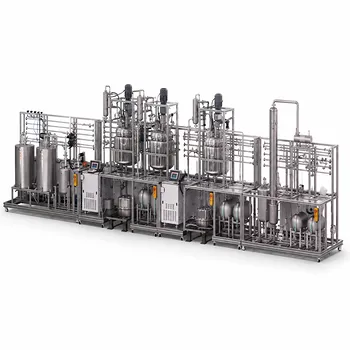
Steady-state material balance verification is the cornerstone of pilot plant operation.
In continuous, steady-state unit operations, material does not accumulate in the system. The conservation of mass forces the material balance to simplify to a single, universal equation: total mass entering the system equals total mass leaving the system. Verification then becomes a practical discipline—operators collect real-time sensor data, select a consistent calculation basis, account for chemical reactions through stoichiometry, and perform component or elemental balances to reconcile inputs and outputs. Any deviation from closure points directly to measurement errors, hidden side reactions, or leaks.
The core challenge in pilot-plant material balance verification is not the equation itself—it is the rigorous translation of theoretical Input = Output into a fault-free reconciliation of measured flows, compositions, and reaction extents. A perfectly balanced pilot line tells you that your instrumentation and understanding of the chemistry align; an imbalance is an invitation to find the unknown loss or unmonitored stream.
The Formulation: Why Input = Output in Steady State
The Law of Conservation of Mass at Work
For any open system operating at steady state, accumulation is zero by definition.
The general material balance—Input + Generation = Output + Accumulation—immediately collapses to Input + Generation = Output.
In mass units, where mass is conserved regardless of chemical transformation, generation and consumption cancel each other. The final equation reduces to the simplest possible form: ∑(mass flow in) = ∑(mass flow out).
Reactions Change Composition, Not Mass
A common point of confusion is the effect of chemical reactions.
Reactions rearrange atoms, but they do not create or destroy mass. Total mass in must equal total mass out, even when the molar flow rates change dramatically.
That is why a mass‑based balance is universally safe, while a molar balance works only when you rigorously track every atom via stoichiometry.
Choosing the Right Basis Makes the Equation Actionable
The simplified equation is only as useful as the basis you attach to it.
For continuous pilot plants, typical bases are per unit of time (e.g., kg/h) or per unit of a key feed stream (e.g., per 1 kmol of fresh ethylbenzene).
A well‑chosen basis turns a generic “Input = Output” into a concrete checklist of streams and measurements you can compare directly.
The Verification Process: From Theory to Trustworthy Data
Step 1: Map the Process Envelope Clearly
Start with a process flow diagram (PFD) that unambiguously defines the system boundary.
Circle every stream crossing that boundary—feeds, products, vents, drains, and sampling points.
Omitting a small condensate drain or a gas purge line is the single most common reason a material balance fails to close.
Step 2: Select a Consistent and Practical Calculation Basis
The basis you choose determines the ease of comparison between theory and measurement.
- If all feed compositions are known, use a molar basis and tie it to a defined time period or a fixed quantity of a key reactant.
- If compositions are uncertain or streams are multiphase, stick to a mass basis—total kilograms per hour.
- For gas streams, convert volumetric readings to mass or moles using equations of state (EOS) that describe real‑gas behavior under process conditions.
Step 3: Write Out the Reaction Stoichiometry
Document every reaction—main and side—that can occur.
In an ethylbenzene dehydrogenation pilot plant, for example, you need the primary reaction (ethylbenzene → styrene + H₂) plus side reactions that form benzene, toluene, and light gases.
Only with a complete stoichiometric map can you predict the expected distribution of atoms and perform elemental balances.
Step 4: Gather Synchronized, Real‑Time Data
Verification demands that input and output measurements represent the same steady‑state time window.
Rely on integrated sensors: mass flow controllers, temperature and pressure transmitters, and analytical tools like online gas chromatography.
For reactions, measure not just total flow but the composition of the outlet stream—hydrogen, CO, unreacted feed, and byproducts—to calculate conversion, selectivity, and yield.
Step 5: Perform Component or Elemental Balances
Once data is collected, close the loop using atomic accounting.
- Elemental balances (carbon, hydrogen, nitrogen, etc.) are powerful because elements are conserved irrespective of reaction pathways.
- Alternatively, run a component balance for every chemical species, checking that the net generation calculated from stoichiometry matches the difference between outlet and inlet molar flows.
Any significant residual indicates an unaccounted loss or an error in the assumed chemistry.
Step 6: Compare Theoretical Predictions with Measured Values
The final verification step is a side‑by‑side reconciliation.
For each stream, the mass flow calculated from reaction stoichiometry (based on feed rates and assumed conversions) is compared to the actual measured outlet mass flow.
When these numbers agree within the instrument error, you have a closed balance. When they don’t, the discrepancy must be explained—it is often the first clue to a physical leak, sensor drift, or an unexpected side reaction.
Why It Matters: Beyond Checking the Math
Validating Sensor Health and Process Integrity
A tight material balance is a de facto calibration check for the entire pilot line.
If the sum of all measured inputs matches the sum of all measured outputs, you can trust your flow meters, thermocouples, and analyzers.
Conversely, a persistent imbalance tells you where to direct your maintenance effort—a malfunctioning mass flow controller or a sampling line that condenses vapors.
Training the Next Generation of Process Thinkers
In an educational pilot plant, closure of the material balance is the “eureka” moment.
Students see firsthand that theoretical conservation laws hold in messy, real‑world equipment—after they properly account for heat loss, venting, residues, and side products.
They learn that the clean equations taught in lecture require persistent detective work when applied to a physical plant.
Generating Scalable Process Data
Accurate material balances are the foundation for commercial scale‑up.
Yield rates, raw material consumption per unit of product, and waste stream quantities—all derived from closed balances—directly feed into cost estimates and environmental permits.
Without a verified balance, scale‑up calculations become guesswork.
Understanding the Trade‑offs: Common Pitfalls in Material Balance Verification
Measurement Precision Versus Systematic Error
High‑resolution sensors give you confidence, but a balance can look perfect while hiding a systematic offset.
For example, a flow meter may read 5 % high on both the feed and the product side, masking a real loss.
Verification is strongest when you periodically challenge the balance with independent check standards, not just internal consistency.
Unaccounted Vents and Sampling Streams
A pilot plant often has manual sample points, inert gas purges, and safety relief lines.
Even a small continuous vent—like a nitrogen sweep—can accumulate into a noticeable mass discrepancy over time.
Every stream crossing the system boundary must be captured in the balance, no matter how minor it seems.
Side Reactions and Trace Byproducts
Assuming a single ideal reaction simplifies the calculation but often breaks the balance.
Trace byproducts (e.g., coke formation on a catalyst or heavy residue in a reboiler) may represent less than 1 % of the mass, but they contain carbon and hydrogen that must appear in the elemental tally.
If you don’t measure them, the balance will show a phantom loss that can be mistaken for a leak.
Phase Separation Uncertainties
In units like condensers and oil‑water separators, accurate sampling of all phases is critical.
A non‑representative liquid sample or an unmeasured dissolved gas in the aqueous phase distorts the gas‑to‑liquid split.
Verification often requires total‑stream condensation and re‑measurement to validate the phase split independently.
Making the Right Choice for Your Verification Approach
The best material balance strategy depends on what you are trying to achieve. Tailor your verification focus accordingly.
- If your primary focus is educating students and operators: Stress the disciplined, step‑by‑step methodology—draw the PFD, write all reactions, choose a basis, and reconcile atom by atom. The learning comes from finding the inevitable initial imbalance and systematically eliminating it.
- If your primary focus is troubleshooting sensor drift and process leaks: Use the material balance as a daily diagnostic. Close the balance on total mass first; if it won’t close, narrow the imbalance to individual streams by performing sequential component checks, starting with the stream you trust least.
- If your primary focus is scaling up to commercial production: Treat every un‑accounted‑for kilogram as a potential cost or emissions liability. Invest the extra effort to quantify all waste streams, side reactions, and vent losses, because those numbers become your raw material cost and waste‑treatment basis for plant design.
- If your primary focus is validating reaction models under realistic conditions: Perform an elemental (C, H, O, N) balance instead of relying solely on component balances. Elemental accounting is immune to incomplete stoichiometric schemes and will reveal side products you haven’t yet identified.
A closed material balance in steady‑state pilot plant operations is both the final proof that your measurements are true and the starting point for every meaningful performance calculation. Get the balance right, and you replace assumption with evidence.
Summary Table:
| Focus Area | Primary Goal | Recommended Strategy |
|---|---|---|
| Education | Train students & operators | Step-by-step elemental reconciliation on PFD |
| Troubleshooting | Detect sensor drift & leaks | Daily total mass closure & sequential component checks |
| Scale-up | Quantify costs & emissions | Strict accounting of trace byproducts and vent losses |
| Model Validation | Validate reaction chemistry | Elemental balances (C, H, O, N) to find unknown species |
Achieve Process Precision with LABPARK Pilot Plants
At LABPARK, we empower universities, research institutes, and enterprises with high-fidelity, reliable equipment. Our advanced Educational and Vocational Unit Operations Pilot Plants cover key disciplines, including:
- Chemical Engineering
- Bioprocess & Biotech
- Environmental & Water Treatment
Whether you are training the next generation of engineers or generating scalable process data, our pilot lines ensure accurate material balances and reliable operations.
Take the next step in process validation—contact LABPARK today to discuss your custom project requirements!
Related Products
- Fixed Bed Gas Solid Catalytic Reaction Educational Pilot Plant
- Multi Pump Fluid Transport Process Piping Unit Operations Training Pilot Plant
- Carbon Dioxide Hydrogen Methanol Synthesis Educational Unit Operations Pilot Plant
- Ethyl Acetate Synthesis Unit Operations Pilot Plant for Practical Training
- Natural Product Extraction Unit Operations Training Pilot Plant
People Also Ask
- How to determine catalyst pore radius & porosity? Optimize your chemical engineering pilot plant.
- How do reactor pilot plants safely study gas-solid reactions? Master kinetics with thermal & flow control.
- How does the Mears criterion evaluate transport resistance? Key Guide to Intrinsic Kinetics
- Why is a multibed configuration necessary for exothermic reactions? Optimize your pilot plant trajectory.
- Fluidized vs. Fixed Bed Reactors: Comparing Heat & Complexity in Pilot Plants