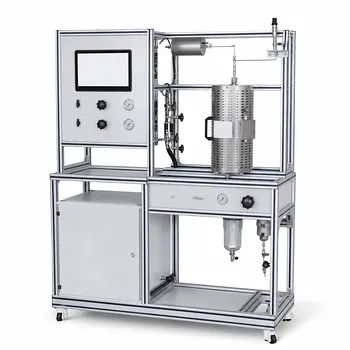
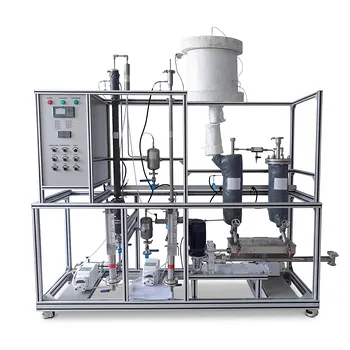
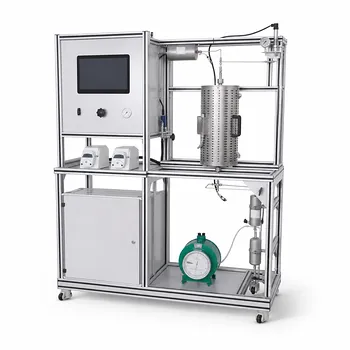
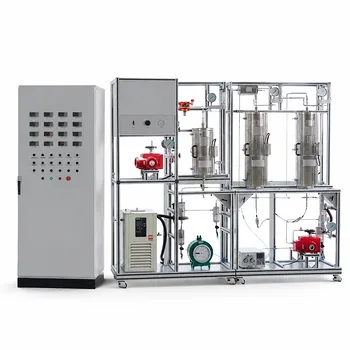
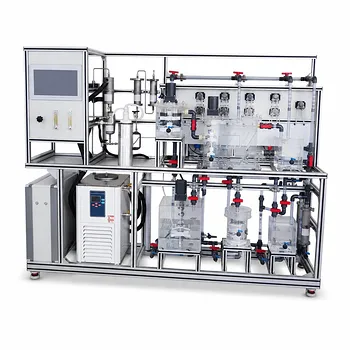
Here’s the straightforward answer:** Methanation’s intense heat release is managed in pilot plants by combining product gas recycle and multi-stage adiabatic reactors with interstage cooling. In the recycle loop, cooled, methane-rich exit gas is blended back into the feed, which dilutes the reactants and absorbs the initial temperature spike. The multi-stage design then splits the remaining conversion across several catalyst beds, with heat exchangers between each bed to remove energy and generate steam or hot water. Together, these two features turn a potentially dangerous thermal runaway scenario into a safe, measurable, and controllable teaching tool.
Methanation’s exothermic nature creates a risk of extreme temperature spikes, but pilot plants tame this through process design—not just add-on safety systems. By using gas recycle to dampen the initial heat release and cascading the reaction through cooled stages, students directly observe how industrial reactors balance conversion, selectivity, and thermal safety. The real lesson isn’t just methanation; it’s how to think about heat management in any highly exothermic process.
Why Thermal Management Is the Core Educational Goal
The surface question is about methanation, but the deep need is to teach—and truly internalize—thermal safety and reactor control. Pilot plants are built to expose students to the same fundamental challenge that appears across the chemical industry: a reaction that wants to run away, but must be kept within a narrow temperature window.
The Runaway Risk Is Universal
Exothermic reactions release energy faster as temperature rises, creating a positive feedback loop. If heat removal can’t keep up, the system self-accelerates. This can lead to catalyst sintering, unwanted byproducts, decomposition, or even pressure vessel failure.
Pilot plants for nitration, oxidation, or metallothermic reductions all share this same DNA. They require real-time temperature monitoring, automated cooling interlocks, and a process design that inherently limits the maximum temperature rise. Methanation is an ideal vehicle for this lesson because its heat release is large (around 206 kJ/mol for CO hydrogenation) and the reaction enters a dangerous runaway regime very quickly without intervention.
The Pilot Plant as a Safe Sandbox
Full-scale industrial reactors leave zero margin for error. A pilot plant shrinks the hazard but preserves the physics. Students can change recycle ratios, adjust interstage cooler setpoints, and even intentionally approach the limits of stability—all while collecting the data needed to fit kinetic models and validate dynamic simulations.
This safe sandbox is what turns abstract concepts like Arrhenius kinetics and heat transfer coefficients into muscle memory. By seeing a temperature spike on a trend plot and correlating it with a control action, students learn that reactor design is fundamentally a thermal problem, not just a chemical one.
The Two-Pronged Strategy in Detail
Recycle: Dampening the Fire with Its Own Cold Ashes
When methanation feed enters a fresh catalyst bed, the reaction rate is at its peak because CO and H₂ concentrations are highest. Without mitigation, the local temperature can jump by hundreds of degrees in seconds.
Recycling cooled product gas dilutes the reactant concentration at the reactor inlet. It’s like lighting a fire with wet kindling—the reaction still proceeds, but the energy release is spread out. This does several things simultaneously:
- It lowers the adiabatic temperature rise across the bed.
- It provides a heat sink, as the returned gas absorbs a portion of the reaction energy.
- It smooths out hotspots, preserving catalyst life and selectivity.
In a teaching pilot plant, students can adjust the recycle ratio through a control valve and instantly see the impact on the reactor’s axial temperature profile. This is a direct demonstration of how process engineering, not just hardware, solves thermal problems.
Multi-Stage Reactors: Stepwise Conversion with Interstage Cooling
The second line of defense is splitting the reaction across multiple fixed-bed reactors in series. Instead of pushing for complete conversion in one brutal thermal step, each stage handles only a fraction of the total reaction.
Between stages, the gas flows through a heat exchanger where it can be cooled to a targeted temperature before entering the next bed. This interstage cooling can generate steam or hot water, turning a safety necessity into an energy recovery opportunity. In a pilot plant, these exchangers are instrumented so students can calculate overall heat transfer coefficients and energy balances, linking thermodynamics directly to equipment design.
The first reactor typically operates with a higher outlet temperature to maximize kinetics while conversion is fast. Later stages can be run at lower temperatures to favor the thermodynamic equilibrium of the methanation reaction, which is exothermic and therefore limited at high temperatures. This is where students see the classic trade-off: you need enough heat to drive the reaction, but not so much that you strangle conversion or damage the catalyst.
Real-Time Data Closes the Loop
All of this hardware is meaningless without measurement. Pilot plants are equipped with thermocouples at multiple axial positions, pressure transmitters, and online analyzers (like gas chromatographs) to track methane formation. This data stream feeds into a distributed control system (DCS) where students can implement feedback loops—for example, a cascade controller that adjusts quench flow based on bed temperature.
By analyzing the dynamic response to setpoint changes or disturbances, students fit reaction rate equations and validate their kinetics against actual plant data. They learn that a model’s prediction is only as good as the temperature measurement it’s built on, and that even a well-designed reactor can fail if control loops aren’t tuned to handle the reaction’s rapid dynamics.
Understanding the Trade-offs
Recycle Dilution Costs Energy
Recycling product gas reduces per-pass conversion and requires a blower or compressor, consuming electricity. It also increases the total gas volume through the reactor, which can raise pressure drop and equipment size. In an educational setting, students can quantify this trade-off by measuring the power consumption of the recycle compressor and comparing it to the thermal energy recovered in the interstage coolers. The lesson: safety isn’t free, but good process integration can turn a cost into a credit.
Staging Adds Complexity
A single reactor is simple. Multiple reactors with interstage heat exchangers multiply the number of valves, sensors, and failure points. Control strategies become more complex because the outlet temperature of stage one determines the inlet condition for stage two. If a cooler fouls or a bypass valve sticks, the entire thermal cascade can drift. Pilot plant exercises often include troubleshooting these very scenarios, reinforcing that industrial reliability demands both robust design and proactive maintenance.
Adiabatic Operation Limits Isothermality
Adiabatic beds, by design, don’t remove heat internally; they let the temperature rise along the bed. This means the catalyst near the exit sees the highest temperature, which can shorten its lifespan. In an educational setting, this demonstrates why real methanation catalysts are often designed with a high nickel loading and thermal stabilizers to survive these gradients. Students learn that materials selection is inseparable from thermal management—a lesson that applies to every exothermic catalytic process, from propylene oxidation to MTO.
How to Apply This to Your Own Learning or Design
- If your primary focus is deeply understanding thermal runaway prevention: Prioritize experiments where you intentionally reduce recycle flow or block interstage cooling (within safe limits) to observe the temperature response. The data you collect will be invaluable for fitting kinetic models and designing emergency relief systems.
- If your primary focus is mastering energy integration and process economics: Use the pilot plant’s interstage coolers to measure recovered energy and compare it against the utility consumption of the recycle compressor and feed preheaters. This turns a safety exercise into a full-scale profitability analysis.
- If your primary focus is control system design: Implement and compare different control strategies—simple PID on a single bed temperature versus a cascade controller that adjusts setpoints across all stages. The methanation reaction’s fast dynamics and strong thermal coupling will expose weaknesses in tuning that don’t appear in gentler systems.
The methanation pilot plant is far more than a methane factory on a small scale. It’s a deliberate, brilliantly packaged lesson in taming one of chemistry’s most aggressive forces—and when you master it, you’re equipped to handle any exothermic process the industry throws at you.
Summary Table:
| Strategy | Mechanism / How it Works | Educational & Safety Benefit |
|---|---|---|
| Product Gas Recycle | Cools and dilutes incoming reactants with product gas. | Lowers adiabatic temperature rise; smooths out hotspots. |
| Multi-Stage Reactors | Splits conversion across series beds with interstage cooling. | Prevents thermodynamic limitations; teaches heat recovery. |
| Real-Time Data & DCS | Tracks axial temperatures using multi-point sensors. | Allows students to fit kinetic models and tune control loops. |
Bring Industrial-Scale Reactor Control to Your Lab
Teaching complex, highly exothermic processes like methanation requires a delicate balance of safety, control, and hands-on realism. LABPARK provides advanced Educational and Vocational Unit Operations Pilot Plants in chemical engineering, bioprocess & biotech, and environmental & water treatment tailored for universities, research institutes, and enterprises.
Our state-of-the-art pilot plants empower your students and researchers to:
- Master Thermal Dynamics: Safely study thermal runaway limits, reactant dilution, and recycle ratio impacts.
- Control Real Processes: Configure DCS software, analyze real-time transient data, and tune cascade loop controls.
- Bridge Theory & Practice: Turn abstract thermodynamics and kinetic modeling into practical, hands-on muscle memory.
Ready to elevate your department's engineering curriculum or research capabilities? Contact LABPARK today to design the ideal custom pilot plant for your facility!
Related Products
- Carbon Dioxide Hydrogenation Methanol Synthesis Educational Unit Operations Pilot Plant
- Methanol Synthesis and Catalyst Performance Evaluation Educational Unit Operations Pilot Plant
- Carbon Dioxide Hydrogen Methanol Synthesis Educational Unit Operations Pilot Plant
- Steam Methane Reforming Hydrogen Production and Purification Educational Pilot Plant
- Methane Cracking Educational Unit Operations Pilot Plant
People Also Ask
- How do temperature variations affect CO2 transport models in pilot plants? Model vs Reality
- Why is a purge system necessary when operating a gas recirculation loop in a methanol synthesis pilot plant? (Guide)
- How do temp & pressure affect methanol synthesis pilot plants? Optimize equilibrium and catalyst performance.
- How do CVD parameters affect stoichiometry and phase purity? Optimize thin film deposition.
- Why do modern methanol pilot plants operate at lower pressures? Catalyst & Feed Requirements Explained