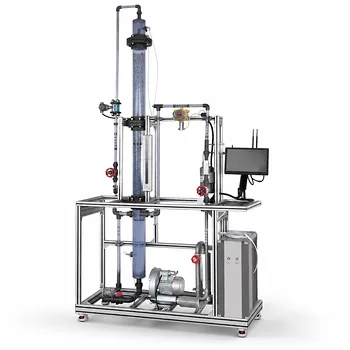
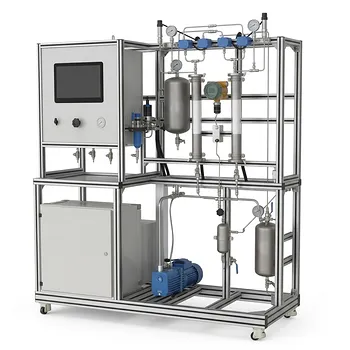
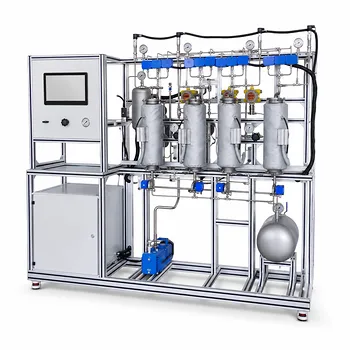
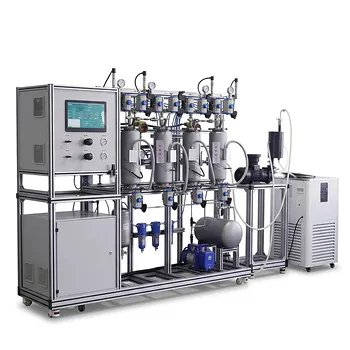
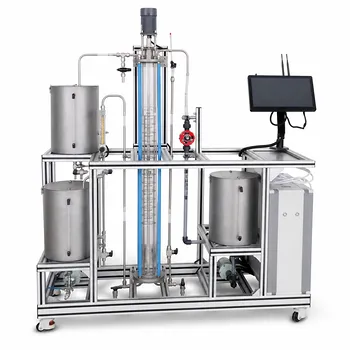
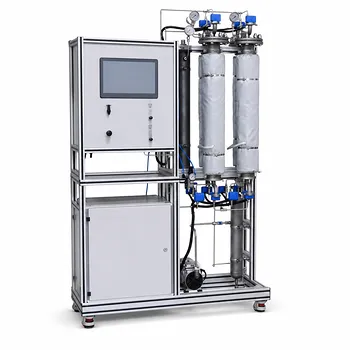
The height of a packed absorption column in a gas absorption pilot plant is determined by multiplying the Height of a Transfer Unit (HTU) by the Number of Transfer Units (NTU). The classic relation ( Z = H_{OG} \times N_{OG} ) (or ( Z = H_{OL} \times N_{OL} )) neatly splits the task into a measure of the packing’s mass transfer efficiency and a measure of the separation’s thermodynamic difficulty. Through straightforward experimental measurement of inlet and outlet concentrations, students and researchers can verify these parameters and directly observe how packing type, flow rates, and chemistry govern column sizing.
The packing height is not a single number but the product of two distinct concepts. The HTU captures “how good the equipment is at moving solute,” while the NTU captures “how much moving needs to happen.” This decomposition is the intellectual backbone of absorption column analysis in both teaching labs and research-scale pilot plants.
The Core Design Equation: Efficiency × Difficulty
The HTU–NTU Relationship
The total packed height ( Z ) is calculated from the overall gas‑phase transfer units as ( Z = H_{OG} \times N_{OG} ).
( H_{OG} ) (the Height of an Overall Transfer Unit, based on gas‑phase driving force) has units of length and represents the depth of packing that performs one theoretical transfer unit’s worth of mass transfer.
( N_{OG} ) (the Number of Overall Transfer Units) is dimensionless and quantifies how many such “units” are required to move from the inlet gas composition to the desired outlet composition.
The same logic applies in the liquid phase, giving ( Z = H_{OL} \times N_{OL} ).
For systems where gas‑phase resistance dominates, the equation simplifies to ( Z = H_G \times N_G ).
What the Height of a Transfer Unit (HTU) Tells You
HTU is inversely proportional to the volumetric mass‑transfer coefficient ( K_Y a ):
[ H_{OG} = \frac{V/\Omega}{K_Y a} ]
where ( V ) is the gas molar flow rate, ( \Omega ) the column cross‑sectional area, and ( a ) the effective interfacial area per unit volume.
A smaller HTU means better mass transfer efficiency — less packing is needed to accomplish the same separation.
HTU depends strongly on the packing type and size, the gas and liquid superficial velocities, and the physical properties of the system.
Empirical correlations for individual‑phase HTUs often take the form:
[ H_G = \alpha , G^{\beta} W^{\gamma} (Sc_G)^{0.5} ]
where ( G ) and ( W ) are the gas and liquid mass velocities and ( Sc_G ) is the Schmidt number; the constants ( \alpha, \beta, \gamma ) vary dramatically between packings like Raschig rings, Berl saddles, or structured packings.
Smaller packing nominal sizes (e.g., 9.5 mm vs. 50 mm) increase the specific surface area and yield lower HTU values — at the cost of higher pressure drop.
In a pilot plant, you can experimentally determine the HTU by running the column at steady state, measuring the composition change, calculating ( N_{OG} ) from the data, and then dividing the known packed height by ( N_{OG} ).
What the Number of Transfer Units (NTU) Represents
The NTU is the integral of the composition change divided by the driving force:
[ N_{OG} = \int_{y_{A2}}^{y_{A1}} \frac{dy_A}{y_A - y_A^*} ]
It is a pure measure of separation difficulty — independent of the column’s physical dimensions or packing details.
A larger NTU means a harder separation (e.g., recovering 99% of a dilute solute instead of 90%, or dealing with a nearly absorbed gas that offers a small driving force).
For low‑concentration absorption with constant gas and liquid flow, the integral can often be solved analytically using an operating line and equilibrium line, giving students a direct link between thermodynamics and equipment sizing.
During a pilot‑plant exercise, students measure the inlet and outlet gas concentrations (and liquid compositions if needed) under steady flow, then use these to calculate ( N_{OG} ) directly. The experimental HTU can then be derived from ( H_{OG} = Z / N_{OG} ) and compared with published correlations for the packing in use.
The HETP Alternative: Thinking in Stages
Theoretical Stages and HETP
An equally common method calculates packed height as:
[ Z = N_T \times \text{HETP} ]
where ( N_T ) is the number of theoretical stages (determined graphically or computationally from the equilibrium and operating lines) and HETP is the Height Equivalent to a Theoretical Plate.
HETP, like HTU, depends on packing geometry and flow conditions. For distillation it is heavily used, but it applies to absorption as well — especially when solutions can be visualized on an x‑y diagram.
Engineers often convert between HTU and HETP using the relationship that depends on the stripping factor, providing a bridge between the mass‑transfer and stage‑wise worlds.
Why Teach Both in a Unit Operations Lab
Contrasting the HTU–NTU and HETP methods reinforces a fundamental learning objective:
- HTU–NTU is rooted in mass‑transfer kinetics, encouraging a deeper analysis of diffusion and contacting efficiency.
- HETP–stages connects absorption design directly to the equilibrium‑stage thinking already familiar from distillation experiments.
Running a pilot column and calculating the packed height via both routes helps students understand that these are not competing theories but complementary tools that must yield the same physical result.
Experimental Determination in a Gas Absorption Pilot Plant
The Direct Measurement Cycle
- Steady‑state operation – Adjust gas and liquid flows, allow the column to reach equilibrium.
- Sampling – Measure gas inlet and outlet concentrations (and liquid outlet if performing an overall balance).
- Compute NTU – Use the appropriate integral form (graphical integration or analytical).
- Determine HTU – Divide the known packing height by the calculated NTU.
- Compare with predictions – Use empirical correlations for the packing to predict HTU, then discuss discrepancies caused by maldistribution, wall effects, or inaccurate equilibrium data.
This hands‑on cycle transforms abstract mass‑transfer equations into a tangible design tool. Researchers can test novel packings or solvents under realistic hydrodynamic conditions and immediately see the impact on the derived HTU.
Using Correlations to Predict Packing Height
When designing a new experiment or scaling up, you can reverse the process:
- Specify the required separation (( N_{OG} )).
- Estimate ( H_{OG} ) from a correlation appropriate for your packing and flow regime.
- Calculate theoretical height ( Z = H_{OG} \times N_{OG} ), then apply a safety factor of 1.2 to 1.5 to account for operational variability.
- Divide the total height into bed sections with liquid redistributors to combat wall‑flow inefficiency. For random packings, the maximum section height is often limited by the column diameter (h/D ratio); for structured packings, a rule of thumb is 15–20 times the HETP.
This process shows that the calculated height is only the starting point — practical hydraulics and liquid distribution govern the final design.
The Crucial Distinction from Tray Columns
It is an essential teaching point that packed columns are sized by height, tray columns by number of actual plates and spacing.
For a tray absorption column, one determines the number of theoretical stages ( N_T ), divides by the overall plate efficiency to get the actual number of trays, and then multiplies by the physical tray spacing to obtain the total column height.
Mixing these two design paths — applying tray‑efficiency logic to packed beds, or vice versa — is a common pitfall that well‑designed pilot‑plant exercises expose and correct.
Understanding the Trade‑offs and Potential Pitfalls
Common Misconceptions in Education
- HTU = HETP: These are not numerically equal; they relate through the stripping factor. Using one in place of the other gives wrong heights.
- Ignoring phase resistance: Assuming all resistance is in the gas phase when liquid‑side resistance is significant leads to an under‑prediction of HTU. Pilot experiments can reveal this by comparing overall HTU with individual‑phase HTU predictions.
- Forgetting safety factors: Many students take the theoretical ( Z ) as the final answer without accounting for operational variability, flooding margins, or liquid maldistribution.
Efficiency vs. Pressure Drop
Smaller packing gives a lower HTU (more efficient), but also a higher gas‑phase pressure drop per meter of packing, which increases operating costs.
In a pilot plant, measuring both HTU and pressure drop across the bed teaches the practical compromise engineers must make between compactness and energy consumption.
Making the Right Choice for Your Goal
After understanding how packing height is determined, how you apply the concept depends on your objective in the lab.
- If your primary focus is teaching mass‑transfer fundamentals: Emphasize the HTU–NTU method with direct measurement of concentrations, so students can calculate both parameters and compare experimental HTU with literature correlations.
- If your primary focus is rapid equipment design and scale‑up: Use the HETP method with known packing data, apply safety factors, and include redistributor‑section calculations to arrive at a realistic design height.
- If your primary focus is comparing packing performance: Run side‑by‑side tests in the pilot plant, calculate ( H_{OG} ) for each packing under identical flow conditions, and directly relate the derived HTU to the packing’s specific surface area and wetting properties.
- If your primary focus is linking thermodynamics and equipment: Have students compute ( N_{OG} ) for multiple inlet/outlet specifications and observe how a more demanding separation (higher NTU) requires proportionally more height — driving home the separation difficulty factor.
By mastering the HTU–NTU decomposition, you gain an interpretable, scalable framework that turns a tower full of packing into a quantitative tool for both education and process research.
Summary Table:
| Method / Parameter | Formula / Relation | Core Representation |
|---|---|---|
| HTU ($H_{OG}$) | $H_{OG} = \frac{V/\Omega}{K_Y a}$ | Equipment Efficiency: Packing performance and mass transfer kinetics. |
| NTU ($N_{OG}$) | $N_{OG} = \int \frac{dy_A}{y_A - y_A^*}$ | Separation Difficulty: Thermodynamic requirement based on concentration targets. |
| HETP | $Z = N_T \times \text{HETP}$ | Stage-wise Equivalent: Links packed column design to theoretical equilibrium stages. |
| Total Height ($Z$) | $Z = HTU \times NTU$ | Total Packed Bed Height: Direct scaling parameter for absorption columns. |
Bring Hands-On Mass Transfer Concepts to Life with LABPARK
Are you looking to equip your laboratory with advanced training systems? LABPARK provides state-of-the-art Educational and Vocational Unit Operations Pilot Plants in chemical engineering, bioprocess & biotech, and environmental & water treatment for universities, research institutes, and enterprises.
Our gas absorption pilot plants allow students and researchers to:
- Directly measure and verify HTU, NTU, and HETP parameters under real operating conditions.
- Gain practical experience with column hydraulics, pressure drops, and different packing efficiencies.
- Bridge the gap between abstract mass transfer theory and industrial scale-up.
Ready to enhance your department's learning and research capabilities? Contact us today to request a quote or customize a pilot plant!
Related Products
- Packed Bed Absorption Educational Unit Operations Pilot Plant
- Absorption and Desorption Educational Unit Operations Pilot Plant
- Bench Scale Dual Column Gas Separation and Capture Educational Pilot Plant
- Multimodal Absorption and Desorption Pilot Plant for Unit Operations Training
- Pressure Swing Adsorption Educational Unit Operations Pilot Plant
People Also Ask
- How Do Flow Regimes Transition in Packed Bed Pilot Plants? Key Scale-up Insights
- How does reactant concentration determine absorption column control? Gas-film vs. dual-film.
- How is the packing height of an absorption column calculated? Master HTU & NTU Concepts
- How does static vs. operating holdup affect pilot plant calibration? Avoid Critical Scale-Up Errors
- Why is counter-current flow selected for gas absorption? Maximize Pilot Plant Efficiency