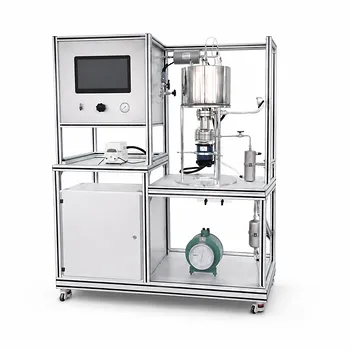
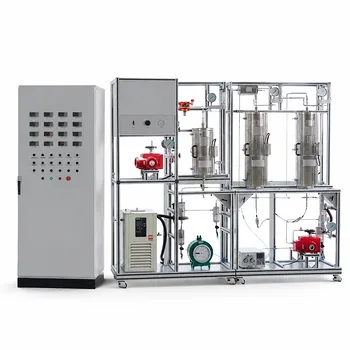
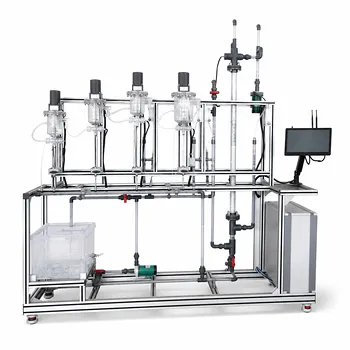
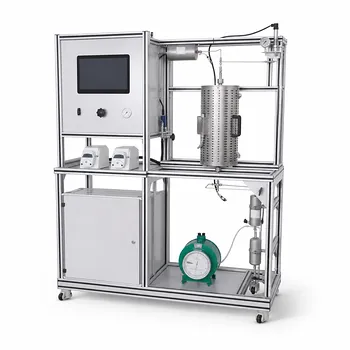
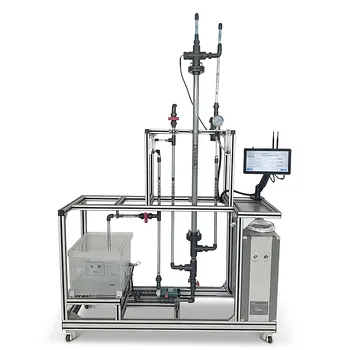
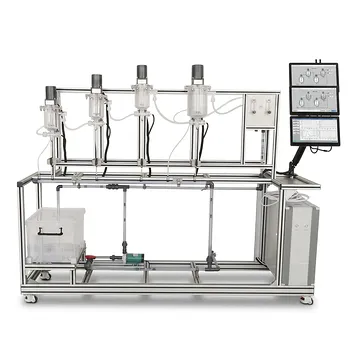
A monofunctional chain stopper is addition’s effect on molecular weight distribution (MWD) is analyzed by operating a batch reactor pilot plant at high conversion and tracking the shift in average molecular weight as a function of stopper concentration. You intentionally add a controlled amount of a monofunctional compound—like acetic acid in nylon-6 synthesis—to cap one end of a growing chain. By then sampling the reactor near full conversion and comparing the measured average molecular weight and MWD curve against a pure bifunctional baseline, you quantify exactly how much the stopper depresses the mean chain length without significantly widening the distribution.
The core insight: In a batch pilot reactor, monofunctional chain stoppers give you independent leverage over molecular weight—completely decoupled from conversion. You probe this effect by fixing high conversion and varying stopper stoichiometry. The result is a predictable downward shift in the average degree of polymerization, leaving the broad shape of the MWD largely unchanged. This is how pilot plants validate industrial recipes that prevent runaway viscosity while hitting a target product grade.
Why Decouple MWD from Conversion?
In a classic linear step‑growth polymerization, high molecular weight only appears when fractional conversion pushes past 0.99. That makes manufacturing delicate and slow. The deep need behind this pilot‑plant analysis is to prove you can lock in a desired molecular weight early, without chasing extreme conversion.
The Limitation of Conversion‑Only Control
Without a chain‑stopper, your only knob is conversion.
Running to near‑completion risks excessively high viscosity, long cycle times, and batch‑to‑batch variability.
Pilot plants must demonstrate a more robust control strategy.
The Stopper as a Molecular Governor
A monofunctional reactant (e.g., acetic acid) competes with the normal bifunctional monomer for an end group.
Once it caps a chain, that end can no longer react, arresting further growth.
The result is a mixed population: a fraction of chains are capped on one side and behave as “dead” length‑limiters.
Quantifying the Analysis in a Batch Reactor
You run a series of isothermal batch polymerizations, all stopped at the same high conversion (e.g., 0.98).
Each run uses a different initial mole ratio of monofunctional stopper to bifunctional monomer.
You then measure the number‑average molecular weight (Mₙ) via titration, GPC, or end‑group analysis.
The analysis plots Mₙ at that fixed conversion against the stopper fraction.
As the stopper concentration rises, Mₙ falls according to the modified Carothers equation, confirming the predicted negative shift.
Crucially, the polydispersity index (PDI) stays near the theoretical step‑growth value (~2). The stopper truncates the entire distribution uniformly, not just one tail.
Pilot Plant Considerations for Reliable Data
Moving this analysis from a textbook calculation to a physical batch pilot reactor introduces real‑world variables. Your interpretation must account for them.
Ensuring True High‑Conversion Conditions
The stopper’s levelling effect is only cleanly observed when the normal polymerization has essentially gone to completion.
If conversion is only 0.90, the bifunctional chains themselves would still be short, masking the stopper’s independent influence.
The pilot plant must hold temperature and mixing precisely to guarantee that the only variable across runs is the stopper level.
Sampling and Characterization Precision
Pilot plant runs typically sample at several time points to confirm conversion plateaus.
The final sample must be quenched immediately to freeze the MWD.
Methods like size‑exclusion chromatography (SEC) are used not only for Mₙ but to overlay the full MWD curves, visually demonstrating that the stopper shifts the peak left while preserving shape.
Modeling the Results
While continuous reactor modeling often uses a mass‑balance framework, a batch reactor analysis is based on transient kinetic equations starting from initial concentrations.
You solve for the MWD moments as a function of time and stopper ratio, then validate against the pilot‑plant data.
This explicit comparison confirms the kinetic model and gives confidence for scaling to production.
Understanding the Trade‑offs
The monofunctional approach is not a free pass. Pilot‑plant analysis must also highlight its limitations.
Loss of Reactive End‑Groups
Each capped chain permanently sacrifices one or both reactive ends.
If post‑polymerization functionalization or reactive blending is planned, dead chains become inert diluents that can hurt final properties.
The analysis report should quantify the fraction of dead chains versus live chains for a given stopper level.
Narrow Window of Effective Control
A monofunctional stopper only gives precise MWD control when the base reaction would naturally produce a high‑molecular‑weight polymer.
At lower conversion, the effect is swamped by the normal growth kinetics.
Thus, the analysis is optimized for near‑complete conversion—exactly where traditional control is hardest, but it means the method cannot be arbitrarily dialed down for very low molecular weights unless stopper loadings become impractically high.
Sensitivity to Stopper Purity and Mixing
Impure or slowly mixing stoppers create local concentration gradients in the batch vessel.
This generates a broader MWD than expected, potentially masking the clean truncation.
Pilot‑plant protocols must include rigorous in‑line mixing and purity checks, or the data will mislead the scale‑up.
Making the Right Choice for Your Goal
How you apply this pilot‑plant analysis depends on what problem you’re solving in your polymer development program.
- If your primary focus is decreasing cycle time while hitting a target melt viscosity: Use a series of batch runs with increasing stopper concentration to find the minimum ratio that keeps viscosity within your equipment limit at full conversion. The analysis will confirm that Mₙ plateaus early, letting you end the batch sooner.
- If your primary focus is validating a kinetic model for process simulation: Run the batch reactor with at least three stopper levels and a no‑stopper baseline. Fit the entire time‑evolution of Mₙ, not just the end point, to distinguish model parameters for propagation versus termination‑equivalent capping.
- If your primary focus is tailoring end‑group functionality for downstream chemistry: The batch analysis must include not just MWD but a measurement of reactive‑end concentration. You’ll likely trade off some molecular weight control to keep a sufficient fraction of bifunctional chains active—the pilot plant data lets you find that sweet spot.
The batch reactor pilot plant, when methodically dosed with monofunctional chain stoppers, transforms MWD control from a side effect of conversion into a direct engineering lever—and a well‑executed analysis turns that lever into a predictable, scalable recipe.
Summary Table:
| Parameter | Conversion-Only Control | Chain-Stopper Control |
|---|---|---|
| Control Mechanism | Adjusting reaction time/conversion ($p > 0.99$) | Varying monofunctional stopper stoichiometry |
| Viscosity Risk | High risk of runaway viscosity and gelation | Predictable viscosity, decoupled from conversion |
| MWD Effect | Shifts right (longer chains) as conversion rises | Shifts left (shorter chains) while preserving shape |
| End-Group Status | Fully active reactive ends | Partially capped (inert "dead" chain ends) |
Optimize Your Chemical Engineering Lab with LABPARK
Are you looking to enhance hands-on training or scale up complex polymerization processes? LABPARK provides state-of-the-art Educational and Vocational Unit Operations Pilot Plants in chemical engineering, bioprocess & biotech, and environmental & water treatment.
We empower universities, research institutes, and enterprises to master advanced process controls like molecular weight distribution and reaction kinetics.
Boost your research and educational outcomes—contact our experts today to find the ideal pilot plant solution!
Related Products
- Continuous Batch Extractive Distillation Educational Pilot Plant
- Multi-Reactor Educational Pilot Plant for Reaction Engineering Unit Operations
- Fixed-Bed Chemical Reaction and Gas Dust Tar Removal Unit Operations Pilot Plant
- Methanol Synthesis and Catalyst Performance Evaluation Educational Unit Operations Pilot Plant
- Fluidized Bed Gas Solid Catalytic Reaction Educational Pilot Plant
People Also Ask
- Wilson vs. UNIQUAC: How to Choose the Right Thermodynamic Model for Your Pilot Plant
- How does the feed thermal state influence distillation pilot plant design and utility consumption?
- Why use non-ideal VLE calculations in distillation pilot plants? Ensure accurate scale-up & purity
- How to Configure a Distillation Pilot Plant? Key Steps for Multi-Mode Setup
- How to Integrate Spectroscopy in Distillation Pilot Plants for Advanced Process Control