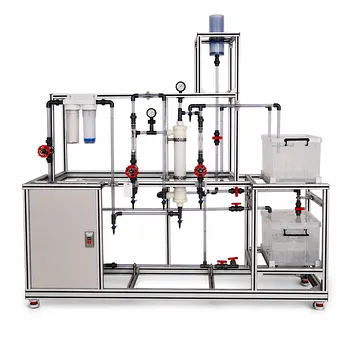
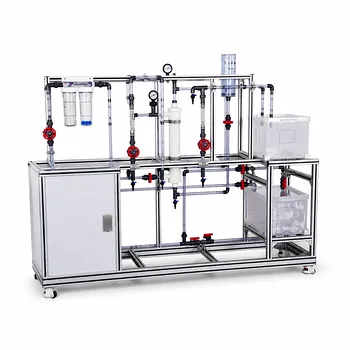
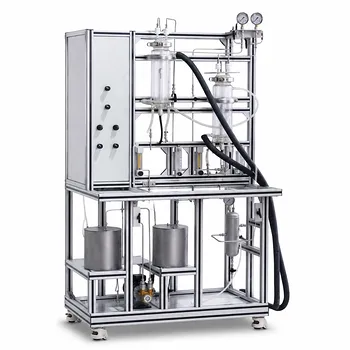
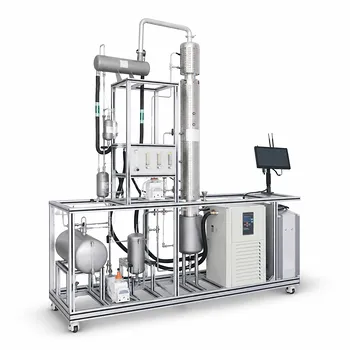
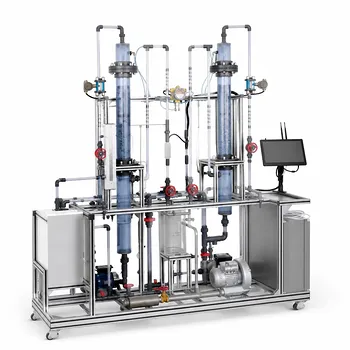
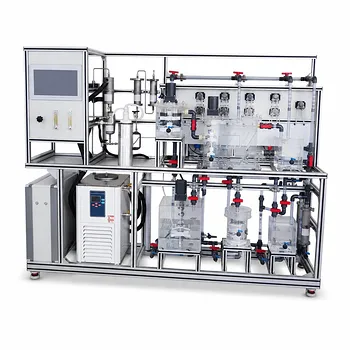
A membrane distillation (MD) pilot plant is a heat-driven, hydrophobic membrane system that makes thermal desalination visible and measurable. In chemical engineering education and research, these pilot units are used to demonstrate how a temperature gradient can drive water vapor through a water-repellent, microporous membrane, effectively separating pure water from salts. The main operational challenges systematically studied on these rigs are membrane wetting and mineral scaling, both of which gradually destroy the membrane’s hydrophobicity and cripple performance. Students and researchers then test mitigation techniques—like feed pre-heating and flow velocity adjustments—to understand how to maintain long-term efficiency.
MD pilot plants provide a hands-on platform to prove that low-grade waste heat can achieve near-perfect salt rejection. Their real-world viability, however, hinges entirely on mastering the twin threats of wetting and fouling through intelligent thermal integration and fluid dynamics.
How an MD Pilot Plant Demonstrates the Process
MD pilot plants turn abstract theory into a tangible experiment by showcasing a thermally driven separation in a controlled loop.
The Thermal Driving Force and Membrane Role
The core demonstration relies on a hydrophobic, microporous membrane that acts as a vapor gate. A hot saline feed flows on one side, and a cold permeate stream flows on the other. The temperature difference creates a vapor pressure gradient that drives only water vapor across the pores. Because the membrane repels liquid water, nonvolatile impurities are left behind. Students observe that the process does not require high pressures or a phase change in the bulk liquid, relying instead on low-grade heat—a key selling point for sustainability.
Configuring the System: Direct Contact MD and Beyond
Pilot plants are typically flexible enough to test different flow configurations, with Direct Contact Membrane Distillation (DCMD) being the workhorse. In DCMD, the hot feed and cold permeate are in direct contact with the membrane, maximizing conductive heat transfer and making the thermal gradient easy to measure and control. More advanced units allow switching to air-gap or vacuum configurations, but DCMD’s simplicity makes it ideal for teaching foundational mass and heat transfer principles while evaluating vapor flux and thermal efficiency.
What You Measure: Flux, Efficiency, and Rejection
Every pilot run generates a rich dataset. Operators track vapor flux (the rate of water production per membrane area), thermal efficiency (how much of the supplied heat actually drives evaporation), and salt rejection (typically exceeding 99.9% for inorganic salts). By varying feed temperature, coolant temperature, flow rates, and feed salinity, students build a direct link between operating conditions and process performance. The pilot plant’s sensors and data acquisition systems let them visualize how a simple parameter change shifts the entire system’s balance.
The Two Headline Operational Challenges
The pilot plant sheds light on why MD, despite its promise, hasn’t conquered the water industry. Two barriers stand out.
Membrane Wetting: When Hydrophobicity Fails
Wetting is the direct failure of the membrane’s cornerstone property. If the liquid feed penetrates the pores—due to a loss of hydrophobicity, excessive transmembrane pressure, or surfactant contamination—the membrane loses its selectivity. Liquid leaks through, causing a catastrophic drop in permeate quality. In pilot plants, wetting is induced deliberately by operating at elevated temperatures, applying pressure surges, or introducing low-surface-tension feed components. Observing the rapid degradation firsthand teaches researchers that pore size distribution, chemical resistance, and thermal stability of the membrane material are make-or-break factors.
Mineral Scaling and Fouling: The Silent Efficiency Killer
Even if wetting is avoided, the concentration of sparingly soluble salts (like calcium carbonate or gypsum) in the hot feed triggers scale formation on the membrane surface. This scale layer blocks the pores, reduces vapor flux, and can even damage the hydrophobic coating. Pilot plants accelerate this fouling by using high-salinity feeds or running at high recovery ratios. The resulting performance degradation forces students to explore countermeasures such as chemical cleaning, feed pre-heating to alter crystallization, or increased flow velocities to sweep away particles. The lesson is clear: MD’s efficiency hinges on managing this slow, relentless buildup.
Understanding the Trade-offs
Running an MD pilot plant teaches a critical engineering truth: every gain comes with a penalty. The real learning happens when students balance these opposing forces.
The Delicate Balance of Heat and Flow
Raising the feed temperature boosts flux enormously. But it also increases the risk of thermal membrane damage, accelerates scaling kinetics, and pushes the system closer to the wetting threshold. Similarly, increasing flow velocity reduces concentration polarization and fouling, yet it ramps up pumping energy and can strip heat from the feed, hurting thermal efficiency. Pilot studies reveal that the optimal point is never at an extreme.
The Pursuit of Absolute Rejection vs. Economic Viability
MD boasts near-total rejection of inorganic salts, making it attractive for high-salinity brines that choke reverse osmosis. However, maintaining that rejection over thousands of hours requires pristine hydrophobicity and aggressive fouling control. The pilot plant shows that chasing absolute purity can demand frequent membrane cleaning or replacement, inflating operating costs. Students learn that practical success means accepting a slightly lower, but stable, flux that can be sustained with available waste heat.
Membrane Materials and Stability
Pilot experiments with different membrane chemistries and pore structures expose a fundamental trade-off. Membranes with larger pores deliver higher flux but are far more prone to wetting. Those with dense, highly hydrophobic coatings resist wetting but may sacrifice permeability. Thermal and chemical stability also compete with cost. Observing how polymer compositions and pore structures behave under repeated thermal cycling helps connect materials science to real-world process economics.
Making the Right Observational Choices
The conclusions you draw from an MD pilot plant depend entirely on what you prioritize. Tailor your experimental plan to your ultimate goal.
- If your primary focus is understanding thermal desalination fundamentals: Run DCMD with clean saline feeds at moderate temperatures. Focus on measuring temperature profiles, heat balances, and the direct link between vapor pressure and flux.
- If your primary focus is solving wetting and scaling for long-term operation: Design experiments with challenging feed chemistries (high salinity, low surface tension) and deliberately push the system toward failure. Then test mitigation strategies like feed pre-heating, flow pulsation, or periodic air-backwashing.
- If your primary focus is energy optimization: Map the system’s thermal efficiency across a wide range of feed and coolant temperatures. Quantify how much heat is lost to conduction and explore the use of simulated waste heat streams to close the gap between theoretical and real-world performance.
The MD pilot plant is more than a demonstration tool; it is a controlled battlefield where the fundamental promise of sustainable thermal separation collides with harsh practical realities. Mastering it means you’ve learned not just how the process works, but why it sometimes doesn't—and that is the most valuable lesson of all.
Summary Table:
| Key Aspect | Operational Focus & Metrics | Mitigation / Actionable Solutions |
|---|---|---|
| DCMD Configuration | Maximizes conductive heat transfer; measures vapor flux & salt rejection | Optimize feed/coolant temperature and balance flow rates |
| Membrane Wetting | Loss of hydrophobicity leads to liquid leakage & drop in permeate quality | Select highly hydrophobic materials; control transmembrane pressure |
| Mineral Scaling | Salt buildup blocks pores, reducing vapor flux and thermal efficiency | Implement feed pre-heating, chemical cleaning, or increase flow velocity |
Bring hands-on chemical engineering concepts to life with LABPARK! We provide state-of-the-art Educational and Vocational Unit Operations Pilot Plants in chemical engineering, bioprocess & biotech, and environmental & water treatment. Specifically designed for universities, research institutes, and enterprises, our pilot plants empower students and researchers to master membrane distillation, fluid dynamics, and fouling mitigation. Ready to upgrade your laboratory? Contact our experts today to find the perfect pilot plant for your curriculum or research goals!
Related Products
- Multi Functional Membrane Crystallization Educational Unit Operations Pilot Plant
- Ultrafiltration Membrane Separation Educational Pilot Plant
- Multifunctional Membrane Separation Educational Pilot Plant with Ultrafiltration, Nanofiltration, Reverse Osmosis
- Hollow Fiber Ultrafiltration Membrane Separation Educational Pilot Plant
- Multi-Functional Special Distillation Educational Pilot Plant
People Also Ask
- Control Crystallization Pilot Plant Secondary Nucleation: 4 Key Adjustments
- Why is precise temperature control critical in crystallization pilot plants? Key to Scale-Up Success
- What key factors should be considered when configuring a crystallization unit operations pilot plant?
- What are the benefits of integrating online PAT tools like ATR-FTIR into crystallization unit operations pilot plants?
- How to use crystallization pilot plant agitation speed to identify diffusion vs reaction growth?