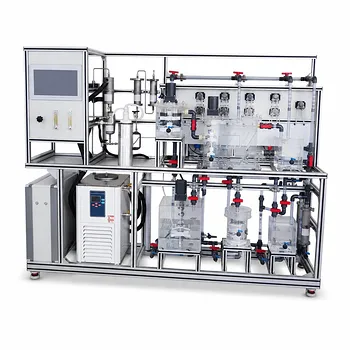
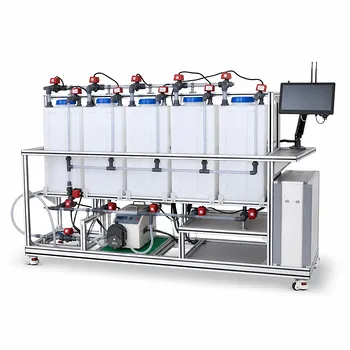
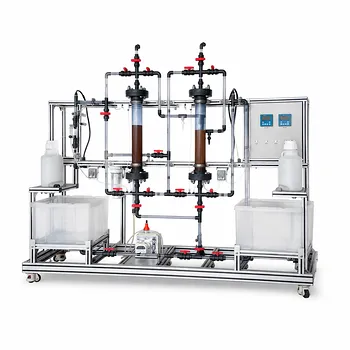
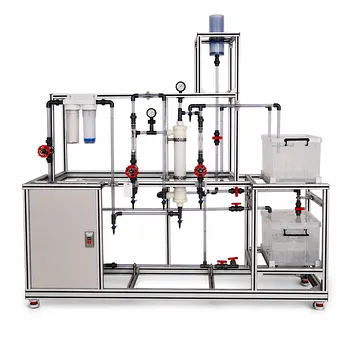
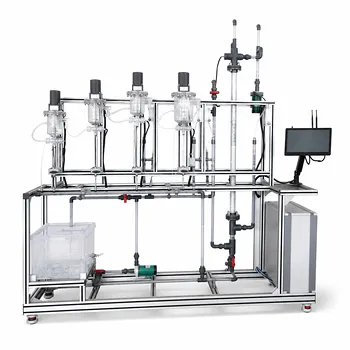
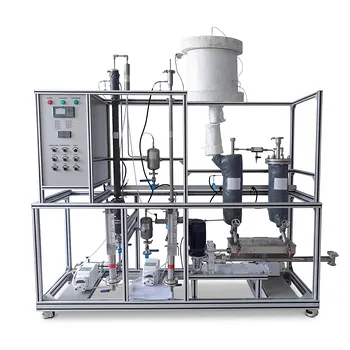
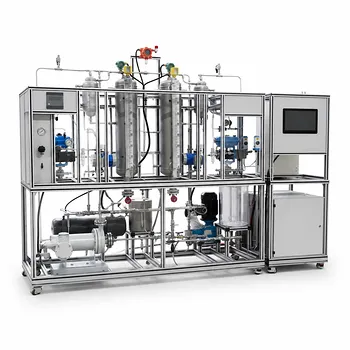
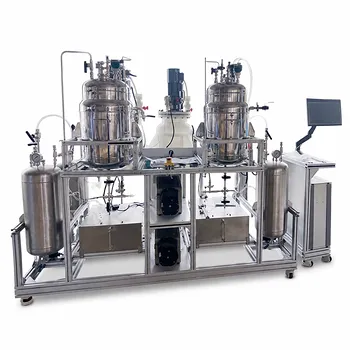
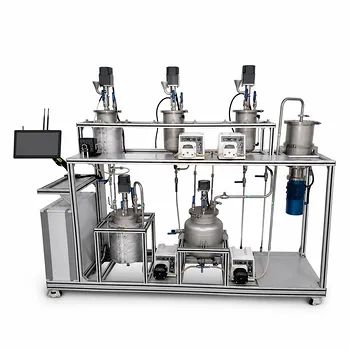
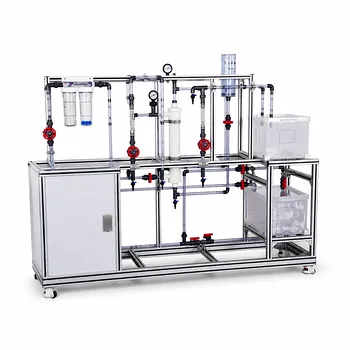
Two-stage reverse osmosis in a pilot plant is a series purification process where the clean water from the first set of membranes is treated again by a second set, while the relatively clean waste stream from that second stage is recycled back to the feed to minimize water loss.
At its core, a two-stage RO pilot plant configuration is an elegant loop: the first stage removes the bulk of contaminants; the second stage polishes the permeate to achieve high purity; and recycling the second stage's reject stream dramatically boosts overall water recovery while still preventing membrane scaling.
How the Two-Stage RO System is Physically Configured
Understanding the physical flow path is the key to grasping both the purification and recovery gains. In a pilot plant, the equipment is arranged to mimic full-scale industrial systems, allowing students and researchers to study every metric in detail.
The Sequential Permeate Path
The raw feed water is first pressurized and sent through the first-stage RO membranes. These membranes reject 96–98% of salts, producing a first-stage permeate that is significantly cleaner but still not pure enough for stringent applications like boiler feed.
This first-stage permeate then becomes the feed for the second-stage RO modules. Instead of returning to the main feed tank, it moves directly into a second, higher-pressure pump and a second bank of membranes. This sequential treatment further reduces salt concentration, bringing the final permeate to a level suitable for high-purity water demands.
What Happens to the Concentrate Streams
Every RO stage produces a concentrated reject (retentate) stream. How these streams are handled is what defines the recovery optimization:
- First-stage reject: This stream has captured the vast majority of the removed salts and is typically sent to drain or further brine treatment. Its salt concentration is high enough that returning it to the feed would rapidly increase scaling risks.
- Second-stage reject: Because the second stage is polishing already-clean water, its reject stream still has a relatively low salt concentration—often around 1%. In a pilot plant configured for high recovery, this stream is recycled back into the feed tank of the first stage, not wasted.
How the Two-Stage Process Achieves High Purity
A single-pass RO system in a pilot plant typically can’t achieve the extreme purity levels required for boiler feed or pharmaceutical processes. The two-stage setup bridges that gap by treating the permeate twice.
From 96% to an Overall Rejection Above 99%
Each membrane stage acts as a separate mass-transfer barrier. The overall salt rejection of the combined system is the product of the individual stage rejections. If the first stage removes 97% of salts and the second stage processes that already-diluted stream, the final permeate can easily fall below 250 ppm total dissolved solids from a brackish feed, and even lower with seawater feeds.
This is critical for pilot plant studies where students calculate mass balances across each stage. They can verify that the salt concentration in the final permeate aligns with the theoretical reduction curve, providing a hands-on lesson in multi-stage separation.
Demonstrating the Non-Linear Purification Curve
The two-stage configuration also illustrates a fundamental membrane principle: the osmotic pressure difference is lower on the second-stage feed, so the required pumping pressure and energy per unit of clean water produced are lower for the polishing step. Researchers can measure this directly, seeing how energy savings are built into the design.
Optimizing Water Recovery: The Role of the Recycle Loop
Water recovery is the ratio of permeate produced to total feed water consumed. Without recycling, a two-stage system would still waste a significant amount of water through the second-stage reject. By redirecting that stream, the pilot plant turns a waste into a resource.
Why Recycling the Second-Stage Reject Makes Sense
The second-stage reject is not a concentrated brine; it’s often only slightly saltier than the original feed water. Returning it to the first-stage feed tank reduces the net freshwater intake required for each liter of final permeate produced. This loop allows overall system recovery rates to climb above 85% or even higher, depending on the feed quality.
At the same time, the first-stage reject is still bled off. This is a critical balancing act: you recycle the cleanest possible waste to maximize recovery while removing the high-salinity stream to keep the system’s average feed salt concentration from creeping up uncontrollably.
Preventing Membrane Scaling While Pushing Recovery
When recovery is pushed too far, sparingly soluble salts can concentrate and precipitate on the membrane surface—a phenomenon called scaling. The pilot plant’s design solves this by segregating the streams. The high-salinity first-stage reject is safely discharged, while only the low-salinity second-stage reject is recirculated. This maintains a stable, manageable salt load in the first-stage feed, allowing researchers to study the upper recovery limits without immediately fouling the membranes.
Understanding the Trade-offs
While this configuration elegantly balances purity and recovery, it is not a one-size-fits-all solution. Every gain comes with a factor you must watch in the pilot plant.
Accumulation of Feed-Side Salts Over Time
Even though the recycled stream has low salinity, returning it to the feed tank means the tank’s average salt concentration will rise over extended run times. This needs to be monitored, as it slightly increases the osmotic pressure the first-stage pump must overcome. The system eventually reaches a steady state, but the time to equilibrium is a valuable teaching point.
Additional Pumping and Energy Demands
Recycling requires repressurizing the second-stage reject to feed pressure. This adds a small parasitic energy load. For pure high-purity production, the extra energy is negligible compared to the value of the recovered water, but in a pilot plant studying energy efficiency, this is a measurable variable.
Not Suitable for Every Feed Water
If the raw feed water already has a high scaling potential (e.g., high silica or calcium sulfate), the buffer offered by the low-salinity recycle may not be enough. The pilot plant operator must still tune antiscalant dosing and monitor the Langelier Saturation Index. The two-stage setup with recycle is a teaching tool for optimization, not a magic bullet.
Making the Right Choice for Your Pilot Plant Goals
The two-stage RO configuration with recycle is versatile, but how you emphasize its parameters should match your learning or research objectives.
- If your primary focus is demonstrating extreme purity achievement: Run detailed chemical analyses on the permeate from each stage. Highlight the 99%+ overall rejection and relate it to the theoretical mass balance across two barriers.
- If your primary focus is maximizing water recovery and sustainability: Focus experiments on the recycle ratio. Measure the system’s recovery rate as a function of the second-stage reject flow rate, and map out the point where scaling indicators begin to rise.
- If your primary focus is energy optimization: Compare the specific energy consumption of the two-stage recycle system to a single-pass system producing equivalent water quality. Use that data to explain why industrial plants invest in multi-stage polishing loops.
- If your primary focus is hands-on process control education: Let students intentionally vary the recycle flow and observe how the first-stage feed conductivity changes over time. This transforms abstract concepts like "concentration polarization" into tangible sensor readings.
A well-instrumented two-stage pilot plant is more than a purification tool—it’s a compact laboratory for understanding the economic and technical heart of industrial water reuse.
Summary Table:
| System Component | Feed Source | Output / Destination | Key Role in System |
|---|---|---|---|
| First-Stage RO | Raw Feed Water | Permeate to Stage 2; Reject to Drain | Removes 96–98% of bulk contaminants |
| Second-Stage RO | Stage 1 Permeate | High-Purity Permeate (Product) | Polishes water to >99% overall rejection |
| Recycle Loop | Stage 2 Reject | Recycled back to Stage 1 Feed | Minimizes water waste; boosts recovery >85% |
Optimize Your Water Treatment Training and Research with LABPARK
Equip your lab with the tools to master complex process engineering. LABPARK provides advanced Educational and Vocational Unit Operations Pilot Plants in chemical engineering, bioprocess & biotech, and environmental & water treatment. Designed specifically for universities, research institutes, and enterprises, our systems offer hands-on training in mass balance, membrane filtration, and energy optimization.
Ready to elevate your educational and research capabilities? Contact LABPARK today to discuss your pilot plant needs!
Related Products
- Multifunctional Membrane Separation Educational Pilot Plant with Ultrafiltration, Nanofiltration, Reverse Osmosis
- Dual-Mode Rectification Pilot Plant for Practical Training Unit Operations
- Multi-Functional Membrane Separation Educational Pilot Plant for Unit Operations Lab
- Thermal Desorption Exhaust Gas and Tail Water Treatment Educational Pilot Plant
- Electrochemical Water Treatment Educational Unit Operations Pilot Plant
People Also Ask
- How do PEI, PVDF, and PSU membranes compare in pilot plants? Find the best fit.
- Pervaporation vs. Vapor Permeation: Handling Suspended Solids in Membrane Pilot Plants
- What are the trade-offs of polymer vs inorganic membranes in teaching pilot plants? Key laboratory comparison.
- What are the advantages of membrane separation in pilot plants? Efficient Organic Vapor Recovery
- How can operators optimize operating conditions and cleaning protocols in membrane separation pilot plants to mitigate fouling?