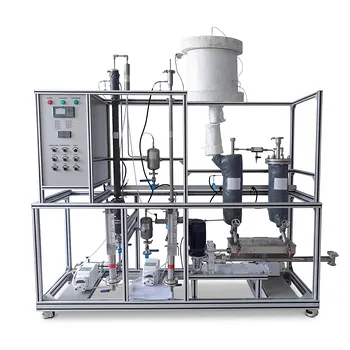
Here is the simple truth: Understanding thermodynamic modeling of non-ideal solutions is not an abstract academic exercise; it is the single most effective way to de-risk your pilot plant program.
The primary benefit of using methods like CALPHAD is that it transforms your pilot plant from a purely exploratory tool into a precision validation instrument. By predicting phase equilibria, precipitation, and reaction equilibrium across wide temperature and composition ranges before you run a single experiment, you eliminate dangerous operating regimes, optimize separation sequences, and drastically reduce the number of costly trial-and-error runs required to scale up a non-ideal process.
Pilot plants are expensive and slow. The core benefit of advanced thermodynamic modeling (CALPHAD, activity coefficient models, etc.) is a strategic shift from "guess-and-check" experimentation to "predict-and-verify" operation, saving time, money, and ensuring safety when scaling up non-ideal mixtures.
Moving from Empirical Guesswork to Predictive Science
When processing non-ideal mixtures—like alloys, molten salts, or azeotropic liquids—linear scaling assumptions fail spectacularly. The deep need here is for a systematic framework to navigate this thermodynamic complexity without breaking the budget on exhaustive testing.
Creating a Predictive Map of Your Process
The most profound shift is the ability to construct a full thermodynamic phase map in silico. A method like CALPHAD doesn't just predict a single boiling point; it calculates phase equilibria over a continuum of compositions and temperatures.
- For high-temperature systems, this predictive power is vital for anticipating and preventing catastrophic solid-state precipitation. For example, it can pinpoint the exact temperature and composition window where brittle carbides will form in an alloy, a failure mode you simply cannot afford to discover by accident in a pilot-scale reactor.
- For separation processes, this map tells you precisely where an azeotrope will form or a second liquid phase will appear. This allows you to design your distillation or absorption column's pressure and thermal profile to either avoid these pitfalls or exploit them.
Virtual Optimization Before Physical Commitment
Once you have this thermodynamic map, your pilot plant's role changes fundamentally. Instead of running dozens of scouting experiments, you can use the model as a hyper-efficient virtual laboratory.
- Solvent Selection: For a liquid-phase reaction, you can use tools like COSMO-RS or UNIFAC to predict the effect of different solvents on the reaction's free energy, equilibrium constant, and even the heat of reaction. You can screen dozens of candidates on a computer in a day, selecting only the top two or three for physical validation in your pilot plant. This process would take months and a fortune to do physically.
- Thermal Safety by Design: A reaction's enthalpy change (
ΔHr) is a direct predictor of your cooling or heating duty. Predicting heat of reaction from first principles, using thermodynamic databanks that define heat capacity as a function of temperature (Cp = A + BT + CT² + DT⁻²), allows you to design a pilot reactor's safety and heating/cooling systems based on a calculated worst-case thermal load, not a dangerous experiment.
The Symbiotic Relationship: How Models and Pilot Plants Perfect Each Other
A common misconception is that models replace pilot plants. The reality is far more powerful: they exist in a mutual feedback loop that neither can fulfill alone.
Models Guide the Experiment
The model makes a specific, highly informed prediction. For a liquid-liquid extraction, a model like NRTL, parameterized with data for polar compounds like acetaldehyde-ethanol mixtures, will generate a precise equilibrium curve. Your pilot plant run is then not a fishing expedition; it's a targeted mission to verify that curve at a specific, critical point with a few highly controlled, steady-state samples.
Pilot Plants Calibrate the Model
This is where the universal truth of "all models are wrong, but some are useful" is addressed directly. Semi-empirical models like NRTL, UNIQUAC, or the Pitzer model for electrolytes are only as good as their binary interaction parameters.
- The Danger of Estimation: Relying on estimated parameters from a group-contribution method like UNIFAC introduces process uncertainty. Your simulation becomes a rough sketch, not a blueprint.
- The Power of Regression: The pilot plant provides the ultimate corrective lens. By operating the unit—be it a distillation column or a crystallization vessel—under strict, steady-state conditions, you generate high-fidelity, real-world composition data. This experimental data is then used to regress and fine-tune the model's binary parameters. You close the gap between a theoretical guess and a high-fidelity, plant-specific simulation that becomes an enduring asset for scale-up.
Understanding the Trade-offs and Pitfalls
The application of these models is not without risk. Blind trust can be more dangerous than no model at all, so objective awareness of the limitations is critical.
The "Garbage In, Garbage Out" Principle
A thermodynamic model is a prediction engine, but it is powerless without accurate fundamental data stored in databanks—standard enthalpy of formation (ΔfH°), standard entropy (S°), and temperature-dependent heat capacity coefficients. If the foundational data for a key component in your mixture is missing or poorly determined, every subsequent calculation of equilibrium constants (K) and heat load will be unreliable, regardless of the model's sophistication.
Validation is Non-Negotiable
All process models, even when operating within their published applicable ranges, can exhibit erratic behavior. The supplementary references correctly warn that models for supercritical components or highly non-ideal systems are notorious for this. The only way to ensure safety and accuracy is through direct physical validation. A pilot plant run is not just a nice-to-have; it's the essential laboratory- and plant-scale reality check that resolves discrepancies between a model's elegant mathematics and real-world physical behavior.
Model Selection is a Specialized Skill
There is no universal model. For a mixture of polar compounds like alcohols, aldehydes, and water, you might need a modified equation of state like Soave-Redlich-Kwong for the vapor phase and an activity coefficient model like Wilson or NRTL for the liquid phase. Selecting the wrong model—for instance, an ideal gas assumption for a highly associating vapor phase—will yield dangerously inaccurate results, a mistake a seasoned thermodynamicist knows how to avoid.
Making the Right Choice for Your Goal
Your strategy for integrating these tools should be dictated by your primary objective in the pilot plant.
- If your primary focus is early-stage process design and hazard elimination: Use predictive methods like CALPHAD for high-temperature alloys, or combine COSMO-RS with quantum chemistry (DFT) for novel organic reactions, to create a thermodynamic map. This map will guide you to the safest, most promising operating window before you commit to hardware.
- If your primary focus is validating a specific unit operation before scale-up: Start with the most rigorous available model (e.g., NRTL, Pitzer) using estimated or literature parameters. Your pilot plant's mission is then singular: to operate at the planned industrial conditions and generate data to regress and perfect those model parameters.
- If your primary focus is educational or on fundamental understanding: Run the pilot plant to deliberately compare real-world behavior against a series of theoretical models. The goal is not optimization, but to make the transition from molecular-level non-ideality to large-scale process behavior tangible and measurable.
The right model enables a philosophy of "predict, then verify," transforming your pilot plant from a cost center into an agile, high-value validation platform.
Summary Table:
| Modeling Method / Tool | Primary Application | Key Benefit for Pilot Plants |
|---|---|---|
| CALPHAD | High-temperature alloys & molten salts | Predicts phase equilibria; prevents solid-state precipitation |
| NRTL / UNIQUAC | Liquid-phase separation (e.g., distillation) | Predicts azeotropes and phase behavior for column design |
| COSMO-RS / UNIFAC | Solvent screening & reaction equilibrium | Screens solvents in silico, reducing physical trial-and-error |
| Thermal Databanks | Heat capacity & enthalpy calculations | Determines worst-case thermal loads for reactor safety design |
Optimize Your Process Scale-Up with LABPARK
Bridging the gap between thermodynamic modeling and real-world validation requires high-precision equipment. LABPARK provides premium Educational and Vocational Unit Operations Pilot Plants in chemical engineering, bioprocess & biotech, and environmental & water treatment.
Specifically engineered for universities, research institutes, and industrial enterprises, our pilot plants deliver the steady-state accuracy you need to calibrate your models, verify phase behavior, and de-risk your scale-up process.
Ready to transform your theoretical models into precise physical operations? Contact LABPARK today to discuss your pilot plant requirements!
Related Products
- Fixed Bed Gas Solid Catalytic Reaction Educational Pilot Plant
- Multi Pump Fluid Transport Process Piping Unit Operations Training Pilot Plant
- Carbon Dioxide Hydrogen Methanol Synthesis Educational Unit Operations Pilot Plant
- Ethyl Acetate Synthesis Unit Operations Pilot Plant for Practical Training
- Natural Product Extraction Unit Operations Training Pilot Plant
People Also Ask
- How do reactor pilot plants safely study gas-solid reactions? Master kinetics with thermal & flow control.
- How does the Mears criterion evaluate transport resistance? Key Guide to Intrinsic Kinetics
- Why is a multibed configuration necessary for exothermic reactions? Optimize your pilot plant trajectory.
- Fluidized vs. Fixed Bed Reactors: Comparing Heat & Complexity in Pilot Plants
- How is the friction factor determined for fixed-bed pilot plants? Select the best pressure drop correlation.