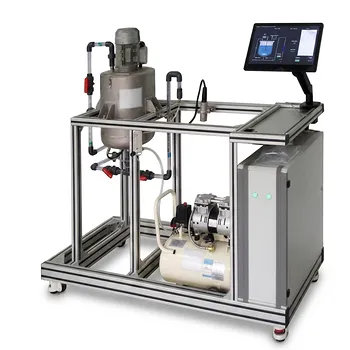
Tracking thermodynamic variables turns abstract equations into observable process behavior. When students measure liquid and vapor mole fractions, partial pressures, and enthalpy changes in a unit operations pilot plant, they can connect mass and energy balances to what is physically happening inside equipment. This immediate comparison between theory, measurement, and plant response strengthens conceptual understanding, analytical reasoning, and troubleshooting ability.
Pilot plants make thermodynamics measurable: students see how composition, phase equilibrium, heat, and energy flows interact in real equipment rather than treating them as isolated symbols in a calculation.
Why Thermodynamic Tracking Improves Learning
It Connects Equations to Physical Behavior
Variables such as liquid mole fraction (x), vapor mole fraction (y), partial pressure, and enthalpy change (\Delta H) are central to chemical engineering analysis. Measuring or calculating them during operation gives students a physical reference for concepts that can otherwise remain abstract.
For example, students can observe how changing reboiler duty or reflux affects vapor composition in a distillation column. The resulting data gives meaning to equilibrium relationships and material-balance equations.
It Reinforces Mass and Energy Balances
Pilot plants operate primarily as open systems, with material continuously entering and leaving equipment. Students must therefore account for both component flows and energy transfers across system boundaries.
Tracking mole fractions supports component balances, while tracking enthalpy changes supports energy balances. Using both sets of variables helps students understand that separation performance depends on the simultaneous conservation of mass and energy.
It Reveals the Relationship Between Phase Equilibrium and Energy
In distillation and absorption, composition and enthalpy are closely connected through vapor-liquid equilibrium. A change in temperature or pressure can alter phase composition, and that phase change also affects the energy required by the process.
Students can compare measured (x)-(y) relationships and enthalpy data with theoretical predictions. This makes it easier to understand why accurate phase-equilibrium calculations are important for reflux-ratio selection, energy-demand estimates, and column design.
How Pilot Plants Build Engineering Judgment
Students Interpret Real-Time Process Response
A pilot plant allows students to change operating variables such as temperature, pressure, flow rate, and heat input. They can then observe how those changes affect composition, phase behavior, and energy consumption.
This creates an active learning cycle: make a change, predict the response, measure the result, and explain the difference. That process develops stronger understanding than memorizing equations without operational context.
Students Compare Models With Measurements
Thermodynamic models can predict vapor pressures, phase compositions, enthalpies, and flash-separation outcomes before an experiment begins. Models may use equations of state, such as Peng-Robinson, or activity-coefficient methods, such as UNIFAC, depending on the system and required assumptions.
Comparing predictions with pilot-plant measurements teaches students to calculate deviations, evaluate model accuracy, and recognize the conditions under which a model becomes unreliable. This is a direct introduction to model validation and data reconciliation.
Students Develop Troubleshooting Skills
Unexpected measurements create useful engineering problems. A measured vapor composition may differ from the predicted value because of heat loss, sensor error, non-ideal mixing, poor insulation, entrainment, or an incorrect equilibrium assumption.
Investigating these discrepancies requires students to distinguish between a faulty measurement, an equipment problem, and a limitation in the thermodynamic model. That diagnostic reasoning is essential in industrial process operation.
Applications Across Unit Operations
Distillation and Absorption
In distillation, liquid and vapor mole fractions help students evaluate separation performance and compare actual column behavior with equilibrium-stage assumptions. Partial pressures also help explain how individual components contribute to total system pressure.
In absorption, students can relate gas-phase composition, liquid loading, pressure, and temperature to the transfer of components between phases. These observations connect thermodynamics with mass transfer and process efficiency.
Heat Exchangers and Open-System Energy Balances
Enthalpy changes help students quantify the energy transferred when streams are heated or cooled. By comparing inlet and outlet conditions, they can evaluate heat duties and identify losses to the surroundings.
This work shows why industrial energy balances must consider equipment heat capacity, imperfect insulation, changing heat capacities, and non-steady operation rather than relying only on idealized assumptions.
Reactors and Reaction Enthalpy
In pilot-scale reactors, students can measure temperature changes during reactions such as neutralization or synthesis. They can compare those observations with theoretical reaction enthalpies calculated using Hess's Law or standard heats of formation.
The difference between theoretical and measured heat release exposes practical effects, including heat loss, reactor-vessel heat capacity, and non-ideal mixing. Students therefore learn how thermodynamic calculations support, but do not replace, experimental analysis.
Understanding the Trade-offs
Measurements Are Not Perfect
Composition, pressure, temperature, and flow sensors have calibration limits, response delays, and measurement uncertainty. Enthalpy is often calculated from measured temperatures, pressures, compositions, and property correlations rather than measured directly.
Students should therefore report uncertainty and perform data-quality checks. Treating every recorded value as exact can lead to incorrect conclusions about process performance.
Real Equipment Does Not Behave Ideally
Pilot plants may have heat losses, pressure drops, incomplete mixing, material holdup, transient behavior, and deviations from equilibrium. These effects can cause experimental results to differ from textbook calculations.
The discrepancy is educationally valuable, but only when students understand its cause. A difference between model and experiment is not automatically evidence that either one is wrong.
Thermodynamic Models Have Boundaries
Equations of state and activity-coefficient models rely on assumptions and parameter quality. Their accuracy can vary with pressure, temperature, mixture composition, and the degree of non-ideal behavior.
Students should learn to select models according to the physical system, document assumptions, and compare predictions against data. Model outputs should be interpreted as engineering estimates, not unquestionable facts.
Too Many Variables Can Overload Beginners
Tracking every available property can distract from the central process question. Instruction is more effective when students begin with a focused set of variables tied to a clear objective, such as explaining a change in distillate composition or closing an energy balance.
Once the basic relationships are understood, additional variables can be introduced for model validation, fault detection, and optimization.
Making the Right Choice for Your Goal
Thermodynamic tracking is most effective when measurements are tied to predictions, balances, and a specific operational decision.
- If your primary focus is conceptual understanding: Use (x), (y), partial pressures, temperature, and (\Delta H) to connect phase-equilibrium and energy-balance equations to visible plant behavior.
- If your primary focus is quantitative problem-solving: Require students to construct component and energy balances from measured flows, compositions, and enthalpy changes.
- If your primary focus is process modeling: Compare pilot-plant data with equation-of-state or activity-coefficient predictions and quantify the deviations.
- If your primary focus is troubleshooting: Have students investigate mismatches between predicted and measured values while considering sensor uncertainty, heat loss, non-ideal behavior, and equipment faults.
- If your primary focus is industrial readiness: Combine real-time measurement, model evaluation, open-system analysis, and operational decisions in case-based experiments.
By tracking thermodynamic variables in context, students learn not only how to calculate process behavior but also how to judge whether the calculation represents reality.
Summary Table:
| Learning focus | Variables and activities | Engineering skills developed |
|---|---|---|
| Conceptual understanding | Mole fractions, partial pressures, temperature, and enthalpy changes | Connect equations with real process behavior |
| Mass and energy balances | Flow rates, compositions, heat duties, and inlet/outlet enthalpies | Analyze open-system conservation laws |
| Phase equilibrium | Liquid-vapor compositions and pressure-temperature effects | Evaluate separation performance and energy demand |
| Process modeling | Pilot-plant data compared with EOS or activity-coefficient models | Validate models and quantify deviations |
| Troubleshooting | Sensor uncertainty, heat loss, pressure drop, and non-ideal behavior | Diagnose measurement and equipment issues |
| Industrial readiness | Real-time measurements linked to operational decisions | Develop practical engineering judgment |
Equip your students and teams to connect thermodynamic theory with measurable process behavior. Contact LABPARK to discuss Educational and Vocational Unit Operations Pilot Plants for chemical engineering, bioprocess and biotech, and environmental and water-treatment training. LABPARK helps universities, research institutes, and enterprises build practical skills in mass and energy balances, phase equilibrium, process modeling, data validation, and troubleshooting through hands-on pilot-scale learning.
Related Products
- Multi-Reactor Educational Pilot Plant for Reaction Engineering Unit Operations
- Multi-Functional Membrane Separation Educational Pilot Plant for Unit Operations Lab
- Electrolytic Hydrogen Production Educational Unit Operations Pilot Plant
- Comprehensive Fluid Mechanics Educational Unit Operations Pilot Plant
- Multi-Functional Drying Educational Unit Operations Pilot Plant
People Also Ask
- How do reactor pilot plants define QbD design space? Master chemical process scale-up.
- When configuring a reactor unit operations pilot plant for highly exothermic reactions, how to prevent thermal runaway?
- How do metal ion-catalyzed reaction mechanisms inform chemical engineering pilot plant design? From kinetics to scale-up
- What are the barriers to process intensification & how do pilot plants help?
- What role do educational pilot plants play in scaling green chemistry? Bridging the Lab-to-Industry Gap