The thermodynamics of leaching are your predictive blueprint. By calculating the standard Gibbs free energy change ($\Delta G^0 = -RT \ln K$), researchers and students can instantly determine if a solid-liquid extraction is even feasible, and how completely it can theoretically proceed. This analysis then guides every critical decision in the pilot plant—from setting the reactor temperature to choosing the solvent concentration—transforming a simple piece of equipment into a powerful tool for rational process optimization.
While a leaching pilot plant excels at teaching mass transfer and unit operations, its true educational and research value is unlocked when students connect the reactor's heater settings and solvent excess directly to the underlying thermodynamic equilibrium. The Van’t Hoff equation and Gibbs free energy are not just classroom abstractions; they are the levers that predict and explain extraction yield in real-time.
The Thermodynamic Foundation of Leaching
Solid-liquid extraction is governed by more than just contact time and agitation. Before a single solute particle dissolves, its release is dictated by chemical potential and the direction a reaction naturally wants to go. Understanding this foundation is the first step toward intelligent pilot plant operation.
Gibbs Free Energy as the Gatekeeper
Any leaching reaction, whether the dissolution of a metal oxide in acid or the extraction of an active compound from a plant, has an associated $\Delta G^0$. A negative $\Delta G^0$ signals that the reaction is thermodynamically spontaneous; a positive one means it will not proceed without additional energy input.
The magnitude of a negative $\Delta G^0$ is even more revealing. A larger absolute value corresponds to a much larger equilibrium constant ($K$). This tells the operator that the reaction will not just start, but will favor products strongly, often pointing toward a higher ultimate recovery.
The Equilibrium Constant and Your Yield Ceiling
The equilibrium constant $K$ sets the theoretical limit of your extraction. In a pilot plant, you can adjust parameters to push the system toward this ceiling, but you cannot exceed it without changing the fundamental chemistry.
By analyzing $K$, students learn why some ores leach completely while others reach a stubborn plateau. They realize that when their yield flattens, the cause might not be poor mixing or a short run time, but simply that they have reached the thermodynamic endpoint for their chosen solvent and temperature.
Translating Theory to Pilot Plant Operation
Once thermodynamic feasibility is confirmed, the pilot plant becomes a living laboratory where theoretical predictions are tested and exploited. Two primary levers allow you to shift an equilibrium position deliberately.
Temperature Control and the Van't Hoff Equation
For many hydrometallurgical leaching reactions, the process is endothermic ( $\Delta H > 0$ ). The Van’t Hoff equation, $\ln(K_{T2}/K_{T1}) = \frac{\Delta H}{R} (\frac{1}{T_1} - \frac{1}{T_2})$, provides a quantitative link between temperature and the equilibrium constant.
Increasing the temperature shifts $K$ to a higher value, directly increasing the product-favored state. When a student operates an agitated batch reactor with an integrated heating system, they can plot yield against temperature, confirming that their data follows the predicted logarithmic trend. This bridges abstract thermodynamic concepts with a tangible, measurable outcome in the pilot plant.
Solvent Concentration as a Lever for Equilibrium Shift
Beyond temperature, the concentration of the leaching agent (solvent) is a direct application of Le Chatelier’s principle. Using an excess of solvent shifts the dissolution equilibrium toward the soluble product side.
Thermodynamic analysis tells you exactly why adding more acid or lixiviant increases recovery. It’s not simply a rule of thumb; it’s a deliberate manipulation of the reaction quotient to drive the system beyond its standard-state equilibrium. In a pilot plant, this allows for methodical variation of reagent dosage to find the optimal, economically justified excess.
Understanding the Trade-Offs Between Thermodynamics and Reality
A purely thermodynamic analysis provides the destination, but not the speed of the journey. Relying on it alone without considering mass transfer and non-ideal behavior is a critical pitfall in pilot plant work.
The Speed Limit of Kinetics and Mass Transfer
A reaction may be highly thermodynamically favorable yet proceed at an imperceptibly slow rate. The shrinking core model describes how a reaction front moves inward on a solid particle, often leaving a product layer that creates diffusion resistance.
In the pilot plant, you might adjust agitation or particle size to overcome these kinetic barriers. Thermodynamics tells you if you can get there; kinetic and mass transfer analysis tells you how long and under what operating conditions. The pilot plant’s value lies in teaching students to decouple these effects, measuring rates to see if the system is equilibrium-limited or diffusion-controlled.
The Pitfall of Ignoring Non-Ideality and Activity
Leaching solutions can be highly non-ideal, especially in concentrated industrial streams. The simple equilibrium constant $K$ based on concentrations may deviate significantly from real behavior if activity coefficients are ignored.
While the primary reference’s thermodynamic framework is sound, students must understand that in a pilot plant, measured yields can diverge from theory because the activity of species is not equal to their concentration. This creates a powerful teaching moment: the need for thermodynamic correlation models (like those tested in liquid-liquid extraction pilot plants with NRTL or UNIQUAC) and the importance of experimental validation to correct for real-world deviations.
Applying Thermodynamic Insight to Your Leaching Pilot Plant
The true power of thermodynamic analysis is in how you translate it into a concrete experimental plan. Your approach should shift depending on your primary objective.
- If your primary focus is maximizing extraction yield: Use Gibbs free energy to screen solvent candidates and use the Van’t Hoff equation to set a target temperature range that dramatically increases $K$, then fine-tune with excess reagent concentration in your pilot plant runs.
- If your primary focus is teaching fundamental thermodynamics: Operate the pilot plant at multiple, precisely controlled temperatures and have students plot $\ln K$ versus $1/T$. The linearity of the resulting Van’t Hoff plot brings the lecture to life and proves that the theoretical model holds in a physical system.
- If your primary focus is scaling up a process: First determine the thermodynamic equilibrium limit in a batch pilot plant. Then, run kinetic experiments to understand how close you can get to that limit under realistic contact times and flow conditions, distinguishing between equilibrium constraints and mass transfer limitations that will dictate column or reactor sizing.
A solid-liquid extraction pilot plant is far more than a vessel with a stirrer. When a researcher or student integrates thermodynamic analysis into every run, the equipment becomes a precise instrument for validating nature’s own rules of chemical equilibrium, turning a lab exercise into a definitive lesson in process design.
Summary Table:
| Thermodynamic Parameter | Core Concept | Pilot Plant Application |
|---|---|---|
| Gibbs Free Energy ($\Delta G^0$) | Feasibility & Spontaneity | Predicts if extraction will proceed and sets the maximum yield ceiling. |
| Van't Hoff Equation | Temperature Dependency | Guides reactor heating settings to shift chemical equilibrium. |
| Solvent Concentration | Le Chatelier's Principle | Directs reagent excess adjustments to drive equilibrium toward products. |
| Kinetics & Mass Transfer | Diffusion & Rate Limits | Determines optimal agitation, particle size, and process run times. |
Bridge the Gap Between Theory and Practice with LABPARK
Turn abstract thermodynamic equations into hands-on experimental success. LABPARK provides state-of-the-art Educational and Vocational Unit Operations Pilot Plants in chemical engineering, bioprocess & biotech, and environmental & water treatment.
Designed specifically for universities, research institutes, and enterprises, our pilot plants offer the precise temperature, flow, and concentration controls needed to help your students and researchers master solid-liquid extraction and chemical equilibrium.
Ready to upgrade your laboratory and training capabilities? Contact us today to discover the ideal pilot plant solution for your institution!
Related Products
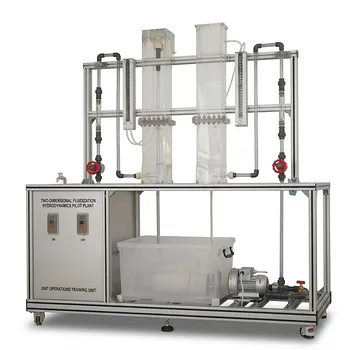
- Two-Dimensional Fluidization Hydrodynamics Educational Pilot Plant for Unit Operations Training
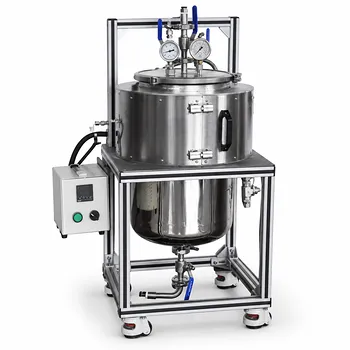
- Hot Filtration Educational Unit Operations Pilot Plant Laboratory System
- Solid Waste Pyrolysis and Refining Educational Pilot Plant for Unit Operations
- Multi-Modal Distillation Unit Operations Training Pilot Plant
- Dual-Mode Rectification Pilot Plant for Practical Training Unit Operations
People Also Ask
- What pressure drop characteristics should students & researchers monitor in a fluidization pilot plant?
- How does active time pulsing mixing enhance fluid homogenization? Configuration Guide for Educational Pilot Plants
- How can acoustic chemometrics prevent reactor clogging in educational fluidized bed pilot plants?
- What is the operational significance of solids feed rate on emulsion phase dynamics in fluidized bed pilot plants?
- Why is UB/Ui critical in fluidized bed pilot plant modeling? Master Gas-Solid Contact