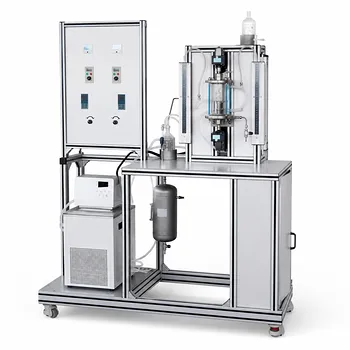
In a pilot-plant bioreactor, kLa determines how effectively oxygen moves from the gas phase into the liquid broth. It directly governs the oxygen transfer rate, commonly expressed as OTR = kLa(C* − CL), where C* is the saturation dissolved-oxygen concentration and CL is the measured liquid concentration. A higher kLa can support greater cell density and productivity, but achieving it usually requires additional agitation power, gas flow, or equipment capacity.
kLa is both a design target and an operating constraint: it connects vessel geometry, agitation, sparging, gas dispersion, and broth properties to the oxygen demand of the process. Reliable pilot-scale kLa measurements help prevent oxygen limitation and establish defensible scale-up criteria.
Why kLa Matters in Pilot-Plant Bioprocessing
It defines oxygen transfer capacity
Aerobic cultures consume oxygen continuously. The required transfer rate must meet or exceed the microorganism or cell-culture oxygen uptake rate.
The relationship is:
[ \text{OTR} = k_La(C^* - C_L) ]
Here, kLa represents the overall volumetric transfer capability, while the concentration difference represents the available driving force.
It connects oxygen supply to process performance
If oxygen demand rises faster than oxygen transfer capacity, dissolved oxygen declines. This can reduce growth, alter metabolism, lower product yield, or create batch-to-batch variability.
Maintaining a suitable dissolved-oxygen setpoint therefore requires more than measuring airflow. The system must provide sufficient kLa and driving force under actual process conditions.
It provides a practical benchmark
The individual liquid-film coefficient, kL, and interfacial area, a, are difficult to measure independently in an operating bioreactor. Their product, kLa, is easier to determine and is therefore widely used as an engineering performance metric.
How kLa Influences Equipment Design
Agitation and impeller selection
Increasing agitation generally improves gas dispersion, reduces bubble size, and increases interfacial area. It often increases kLa, but also raises power consumption and mechanical stress.
Impeller type, diameter, number, and vertical position affect circulation patterns and gas dispersion. Pilot plants are particularly valuable for testing these effects before committing to production-scale equipment.
Sparger and gas-flow design
Gas flow influences bubble formation, gas holdup, and the interfacial area available for transfer. A suitable sparger must distribute gas effectively without causing excessive foaming, flooding, or coalescence.
Superficial gas velocity and gas-flow rate are commonly used in empirical kLa correlations. The relationship is not universal, so pilot measurements should validate predictions for the selected vessel and fluid.
Vessel geometry and internals
Vessel diameter-to-height ratio, liquid fill level, baffles, impeller spacing, and sparger location all influence mixing and gas residence time.
A geometry that performs well in a laboratory vessel may not produce the same kLa at pilot scale. Scale-up must therefore consider the complete hydrodynamic configuration rather than only the nominal volume.
Pressure and gas composition
Operating pressure affects gas solubility and therefore the saturation concentration, C*. Gas composition also matters; oxygen-enriched gas can increase the available driving force even when kLa remains unchanged.
This distinction is important: kLa describes transfer capability, while gas composition and pressure influence the concentration driving force.
How Operating Conditions Change kLa
Power input per unit volume
The ratio P/V is a common scale-up variable because it captures the energy available for mixing and gas dispersion relative to liquid volume.
Higher P/V often increases kLa, but it can also increase heat generation, shear exposure, and operating cost. It should therefore be treated as one design criterion, not a universal scale-up rule.
Gas flow rate
Increasing aeration can increase gas holdup and interfacial area up to a system-dependent limit. Beyond that point, the vessel may experience flooding, excessive foaming, poor dispersion, or diminishing returns in kLa.
Gas flow must also be evaluated against oxygen demand, exhaust-gas handling, pressure limits, and sterilization requirements.
Broth viscosity and composition
Cell concentration, polymers, proteins, solids, and antifoam can substantially change bubble size and gas dispersion. These effects may lower kLa compared with clean water or a simple aqueous test fluid.
For this reason, air–water kLa measurements are useful for equipment characterization but may not represent the production broth accurately.
Temperature and physical properties
Temperature affects oxygen solubility, liquid viscosity, diffusivity, and gas behavior. Solvent properties and dissolved components also influence mass transfer.
Measurements should be made under conditions that are as representative as practical, or corrected using validated property-based methods.
Measuring kLa in a Pilot Plant
Dynamic gassing-out method
The dynamic method is widely used because it can be performed with a dissolved-oxygen probe and does not require chemical oxygen scavengers.
A typical procedure is:
- Fill the vessel with water or a representative medium.
- Remove dissolved oxygen by sparging nitrogen.
- Begin air or oxygen sparging at a defined agitation speed and gas flow.
- Record the rise in dissolved oxygen concentration over time.
- Determine kLa from the slope of the reoxygenation curve.
For constant saturation conditions:
[ \ln\left(\frac{C^* - C_0}{C^* - C_t}\right) = k_La,t ]
The slope of this plot gives kLa, provided the probe response, saturation value, and operating conditions are properly accounted for.
Chemical sulfite oxidation
Sulfite oxidation uses a chemical reaction to consume oxygen and can provide a practical alternative to biological testing.
However, the reaction system may not reproduce the viscosity, surface chemistry, foaming behavior, or oxygen demand of the actual broth. Results should therefore be interpreted as system-specific measurements rather than universal equipment constants.
Probe response and data quality
The dynamic method depends on a calibrated dissolved-oxygen probe with a known response time. A slow probe can distort the measured slope, particularly when reoxygenation is rapid.
Reliable testing also requires stable agitation, gas flow, temperature, liquid volume, and pressure. Measurements should be repeated across the operating range rather than relying on a single kLa value.
Using kLa for Scale-Up and Control
Establishing a scale-up criterion
Pilot plants allow engineers to compare candidate scale-up criteria, including:
- Constant kLa
- Constant P/V
- Constant superficial gas velocity
- Constant oxygen transfer rate
- Constant impeller tip speed, where relevant to shear-sensitive systems
No single criterion is appropriate for every bioprocess. The best choice depends on whether the primary limitation is oxygen supply, mixing time, shear, heat removal, or another process requirement.
Building empirical correlations
Pilot data can be used to relate kLa to variables such as agitation, gas flow, vessel geometry, and liquid properties.
For low-viscosity air–water systems, correlations such as the Van’t Riet relationship are sometimes used in the form:
[ k_La = A\left(\frac{P_g}{V}\right)^\alpha Q^\beta ]
The coefficient and exponents depend on the system and the definitions used for power and gas flow. Such correlations should be calibrated against measurements from the actual pilot configuration.
Predicting production performance
A pilot-scale kLa correlation can help estimate whether a production vessel will meet the expected oxygen demand. It can also identify whether the likely bottleneck is agitation capacity, gas delivery, pressure, heat removal, or exhaust handling.
Prediction is strongest when the pilot and production systems have comparable hydrodynamics and when the broth properties are represented realistically.
Supporting dissolved-oxygen control
A control system may adjust agitation, airflow, backpressure, or oxygen enrichment to maintain the dissolved-oxygen setpoint.
These actions affect different parts of the oxygen-transfer relationship. For example, agitation and airflow commonly affect kLa, while pressure and oxygen enrichment primarily affect C*.
Understanding the Trade-offs
Higher kLa is not automatically better
Increasing kLa can improve oxygen availability, but it may require substantially more power and create greater shear. In sensitive cell cultures, the operating condition that maximizes kLa may damage cells or increase foaming.
The objective is usually to achieve adequate oxygen transfer at acceptable cost and biological stress, not to maximize kLa without limit.
Water-based tests can overestimate performance
Clean water generally offers more predictable gas dispersion than a real broth. Surfactants, proteins, polymers, cells, and antifoam can alter bubble coalescence and interfacial behavior.
Pilot testing with a representative pseudomedium or process broth is therefore important when oxygen transfer is critical.
Correlations have limited transferability
An empirical equation developed for one impeller, sparger, vessel geometry, and fluid should not be treated as a universal law.
Changes in vessel scale, gas distributor design, pressure, viscosity, or surfactant concentration can invalidate the correlation. Experimental calibration is especially important when moving from laboratory to pilot or pilot to production scale.
kLa does not describe mixing by itself
A high kLa does not guarantee adequate bulk mixing. Poor mixing can create local oxygen, pH, nutrient, or substrate gradients even when the average dissolved-oxygen concentration appears acceptable.
kLa should therefore be evaluated together with mixing time, gas holdup, power input, shear, foaming, and process control performance.
Applying kLa to Pilot-Plant Decisions
A useful pilot-plant program combines kLa measurement with oxygen-demand data and equipment operating limits.
- If your primary focus is oxygen-limited microbial fermentation: Determine kLa across the intended agitation and aeration range, then verify that the resulting OTR exceeds the maximum expected oxygen uptake rate.
- If your primary focus is scale-up: Measure kLa using the actual pilot geometry and compare constant-kLa, P/V, and gas-velocity approaches before selecting a production-scale criterion.
- If your primary focus is energy efficiency: Identify the operating point that meets oxygen demand with the lowest acceptable power input per unit volume rather than maximizing agitation alone.
- If your primary focus is shear-sensitive cell culture: Treat kLa, impeller speed, gas rate, and bubble dispersion as a combined design problem, because improving oxygen transfer may increase biological stress.
- If your primary focus is process control: Use kLa data to define the available oxygen-transfer capacity and coordinate agitation, airflow, pressure, and oxygen enrichment strategies.
- If your primary focus is troubleshooting: Compare measured kLa with historical or design values while checking probe calibration, sparger condition, foaming, antifoam concentration, broth viscosity, and gas-flow accuracy.
A well-designed kLa study converts pilot-plant observations into reliable decisions about oxygen supply, scale-up, control, and operating cost.
Summary Table:
| Factor | Effect on k_La or OTR | Pilot-plant consideration |
|---|---|---|
| Agitation and impeller design | Improves gas dispersion and interfacial area | Balance oxygen transfer, power use, and shear |
| Sparger and gas flow | Influences bubble size, gas holdup, and transfer area | Check flooding, foaming, and gas-handling limits |
| Vessel geometry and internals | Changes circulation, residence time, and mixing | Validate scale-up with the actual pilot configuration |
| Pressure and gas composition | Changes oxygen solubility and the driving force, C* | Separate transfer capability from oxygen-enrichment effects |
| Broth properties | Viscosity, cells, proteins, solids, and antifoam can reduce transfer | Test with representative media or process broth |
| k_La measurement | Quantifies volumetric oxygen-transfer capability | Use calibrated probes and stable, repeatable conditions |
| Scale-up criteria | Supports comparison of constant k_La, P/V, gas velocity, and OTR | Select criteria based on oxygen demand, shear, mixing, and heat removal |
| Process control | Guides agitation, airflow, pressure, and oxygen-enrichment strategies | Maintain dissolved oxygen while controlling cost and biological stress |
Design a More Reliable Bioprocess Pilot Plant
Need to verify oxygen-transfer capacity before scale-up? Contact LABPARK to discuss an Educational or Vocational Unit Operations Pilot Plant tailored to your application.
LABPARK provides pilot-plant solutions for chemical engineering, bioprocess and biotechnology, and environmental and water-treatment training, research, and production development. We help universities, research institutes, and enterprises evaluate k_La, agitation, sparging, gas flow, dissolved-oxygen control, mixing, and scale-up performance in a practical system.
Work with LABPARK to select representative equipment, test operating conditions, identify oxygen-transfer limits, and build reliable data for process development, operator training, and production decisions.
Related Products
- Dual-Drive Stirred Gas-Liquid Mass Transfer Coefficient Determination Pilot Plant
- Liquid-Liquid Mass Transfer Coefficient Determination Educational Pilot Plant
- Absorption and Desorption Educational Unit Operations Pilot Plant
- Carbon Dioxide Absorption and Desorption Educational Pilot Plant for Carbon Capture Studies
- Dual-Mode Rectification Pilot Plant for Practical Training Unit Operations
People Also Ask
- How does temperature affect mass transfer rates in chemical engineering educational pilot plants?
- How do pilot plants study gas solubility in polymer melts at high pressures? Key Mass Transfer Insights
- How does column packing affect absorption intensification, and how is it evaluated experimentally?
- Why Compare Membrane-Reservoir Models with Pilot Plant Data? Ensure Successful Process Scale-Up
- How does k_La affect hydrogenation scale-up? Critical insights for pilot reactors.