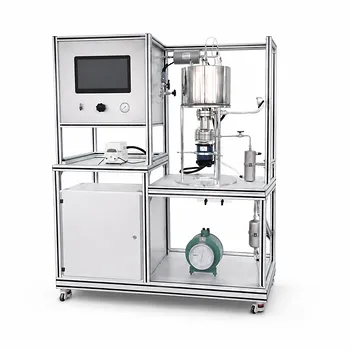
The transition from a lab-scale micro-reactor to a micro-reactor pilot plant is not just an upgrade in size—it's a fundamental shift in design philosophy. The core impact is that pilot plant design must evolve from focusing on a single, isolated device to engineering a fully integrated, automated, and sensor-rich miniature process plant. This holistic system integrates docking platforms, standardized bus interfaces, and advanced process control, making the pilot plant a platform for studying whole-process development rather than just a single reaction.
The key insight is that a modern micro-reactor pilot plant serves as a system integration and process validation platform, not just a scaled-up reactor. It bridges the gap between bench-top chemistry and industrial production by forcing engineers to address the same integration, control, and material challenges encountered in a full-scale factory, all while preserving the superior transport properties of micro-structured devices through smart scaling strategies.
The Shift from Device to System
The fundamental impact on pilot plant design is a philosophical one: the reactor becomes just one component in a complex, interconnected system. The design challenge expands from optimizing a reaction channel to engineering an entire plant.
The Integrated Control Skeleton
A lab micro-reactor is often operated with a syringe pump and a hotplate. A pilot plant, however, is built around a centralized process control backbone. This requires integrating standardized bus interfaces and advanced sensorics for real-time data acquisition. The design must accommodate flow meters, pressure transducers, and temperature probes at multiple points, all feeding into a system that allows for real-time monitoring and automated control loops, transforming the plant into a data-rich validation environment.
Material Selection Becomes a Plant-Level Calculation
In a lab device, you might choose silicon for its precision or a polymer for its low cost. In a pilot plant, the material of construction is a critical process engineering decision. The choice must balance chemical compatibility with the structural demands of a larger, continuous system. 316 stainless steel often becomes the preferred choice because its durability and standard fabrication techniques offer long-term reliability without the fragility of silicon or the sealing and non-standard fabrication challenges of ceramics like LTCC. The design must manage thermal properties—like heat loss through high-conductivity metal—at a system level, not just a chip level.
The New Scale of Experiment: From Chemistry to Process
A lab micro-reactor is used to prove that a reaction works. A micro-reactor pilot plant is designed to prove a process is viable. This means the design must facilitate studies on the adverse effects of scale on mass and heat transfer. It shifts the pilot plant's purpose from analyzing an isolated unit operation to enabling whole-process development. Researchers use it to validate control concepts, optimize process parameters like temperature and concentration, and perform economic evaluations, collecting the crucial data needed for designing commercial equipment.
Mastering the Scale: Numbering-Up vs. Sizing-Up
The method used to increase throughput is the single most impactful technical decision in a micro-reactor pilot plant design, directly determining its performance envelope.
The Failure of Simple Enlargement
The intuitive path—internal scale-up or increasing channel diameter—is often a dead end. This approach simplifies the mechanical design but causes a catastrophic loss of transport performance. The superior heat and mass transfer rates that made the micro-reactor attractive in the first place are directly tied to its small dimensions. A pilot plant designed on this principle will not accurately represent the behavior of a true, production-scale micro-structured unit.
The Promise and Pitfalls of Parallelization
Modern pilot plants are therefore designed around the concept of numbering-up. This strategy maintains the original micro-channel dimensions, preserving the fast mass and heat transfer, and instead multiplies throughput by running identical channels in parallel. For highly exothermic reactions, this is not just an option but a necessity, requiring integrated multi-channel mixer-reactor systems. However, the engineering burden shifts to flow distribution: the pilot plant design must now incorporate specialized headers and manifolds to ensure equal residence time and fluid delivery across every single channel, preventing hot spots or yield loss.
Understanding the Trade-offs
Designing a micro-reactor pilot plant is an exercise in managing competing priorities, where the objective truth is often about choosing the right constraint.
- Capital Cost vs. Operational Knowledge: A robust, stainless-steel pilot plant with full automation is a significant capital investment. This upfront cost must be weighed against the speed and reduced risk it provides in commercializing a process. By combining this hardware with computer modeling, teams can bypass multiple slow and expensive scale-up stages, jumping directly from reliable pilot plant data to an industrial demonstration unit.
- Flexibility vs. Production Rate: A pilot plant designed as a versatile training and R&D platform will sacrifice some throughput for reconfigurability. The use of docking platforms and modular components allows for quick changes but introduces more connections, which are potential leak points. The trade-off is a system that can benchmark continuous processes against batch operations and train personnel on a wide range of workflows, versus a single-product, high-volume machine.
- Technical Mastery vs. Organizational Resistance: The most perfectly designed pilot plant will fail if it doesn't address the human element. The design must incorporate user-friendly control interfaces and serve as a training ground for interdisciplinary plant engineering workflows. The transition from batch to continuous is as much a cultural and organizational challenge as a technical one, and a successful pilot plant design subtly compels this adaptation.
Designing the Pilot Plant for Your Goal
The optimal design of a micro-reactor pilot plant is not universal; it should be a direct reflection of its primary mission. The guiding principle is to design for the data and the decisions you need to make.
- If your primary focus is vocational and educational training: Design a robust, multi-scale toolbox with plug-and-play docking platforms. The system must be safe, flexible, and visually intuitive, with an integrated control system that forces students to think in terms of whole-plant automation, not just unit operations.
- If your primary focus is verifying a sensitive, highly exothermic reaction for scale-up: Build a pilot plant around a numbering-up strategy from day one. The design must prioritize precise flow distribution technology, advanced thermal management, and high-fidelity sensorics to collect the empirical data that theory alone cannot provide, ensuring the system can maintain performance at a commercial channel size.
- If your primary focus is de-risking a process with a direct path to a demo unit: Integrate your pilot plant's control architecture and materials with your modeling and simulation efforts from the start. Use the pilot plant to generate high-quality data that validates your computer models, enabling the hybrid scale-up approach that leapfrogs intermediate stages and gets you to a commercial design with more confidence and less capital.
By understanding that a micro-reactor pilot plant is not a larger version of a lab tool but a smaller version of a factory, you can design a system that doesn't just answer if a reaction works, but definitively shows how a process will succeed.
Summary Table:
| Feature | Lab-Scale Micro-Reactor | Micro-Reactor Pilot Plant |
|---|---|---|
| Design Focus | Single device & reaction feasibility | Integrated, multi-component process system |
| Control & Automation | Manual/basic (e.g., syringe pumps) | Centralized process control with real-time sensors |
| Throughput Scaling | Internal scale-up (enlarging channels) | Numbering-up (parallelization of micro-channels) |
| Primary Goal | Chemistry proof-of-concept | Process validation, optimization, and training |
Scale Up Your Process and Training with LABPARK
Transitioning from lab-scale research to pilot plant engineering requires robust, integrated systems designed for real-world validation. LABPARK provides premium Educational and Vocational Unit Operations Pilot Plants in chemical engineering, bioprocess & biotech, and environmental & water treatment.
Engineered specifically for universities, research institutes, and enterprises, our pilot plants bridge the gap between benchtop discovery and industrial-scale production.
Ready to elevate your R&D or training capabilities? Contact our engineering team today to discuss a customized pilot plant solution for your facility.
Related Products
- Micro-Scale Gas-Solid Catalytic Reaction Educational Pilot Plant
- Fixed-Bed Chemical Reaction and Gas Dust Tar Removal Unit Operations Pilot Plant
- Multi-Reactor Educational Pilot Plant for Reaction Engineering Unit Operations
- Internal Circulation Gradient Free Catalytic Reaction Educational Pilot Plant
- Methanol Synthesis and Catalyst Performance Evaluation Educational Unit Operations Pilot Plant
People Also Ask
- How to determine catalyst pore radius & porosity? Optimize your chemical engineering pilot plant.
- How does identifying the rate-limiting step optimize reaction conditions? Pilot Plant Guide
- Why is a multibed configuration necessary for exothermic reactions? Optimize your pilot plant trajectory.
- Fluidized vs. Fixed Bed Reactors: Comparing Heat & Complexity in Pilot Plants
- How to distinguish Knudsen vs molecular diffusion in catalytic reactor pilot plants?