In a chemical reactor pilot plant, temperature is the single most powerful operational lever you can pull—and the most dangerous one to get wrong. This influence flows directly from the Arrhenius equation, which defines an exponential link between temperature and the reaction rate constant. This relationship forces engineers to design pilot plant control systems with extreme precision. The goal is to walk a tightrope: using heat to drive sluggish reactions forward while simultaneously preventing catastrophic thermal runaway in rapid, heat-generating ones.
The Arrhenius equation turns the reactor control room into a fight against exponential sensitivity. Its direct influence on pilot plants is the absolute mandate for precision thermal management—not just to hit a temperature setpoint, but to actively manage the competing demands of kinetic speed, thermodynamic equilibrium limits, and process safety.
The Exponential Leash of Activation Energy
The behavior of any reactor is fundamentally dictated by a single, exponential term. Mastering a pilot plant means internalizing what this looks like in physical hardware.
The Molecular Hurdle in a Pipe
All reactions have a minimum energy requirement—the activation energy. The Arrhenius equation quantifies how throwing more thermal energy at reactant molecules helps a greater fraction of them surmount this hurdle. In a pilot plant, the rate constant (k) isn't just a number; it's a direct translation into heat generation or consumption.
The Pilot Plant Translation
A high activation energy means the reaction rate is a slave to temperature. A minor, 5-degree temperature excursion in the reactor bed doesn't cause a 5% change in speed—it can cause a doubling. Your pilot plant’s tuning must reflect this reality. Piping, catalyst volumes, and coolant flow rates are all sized around this exponential leash.
The Two-Fold Challenge of Temperature Control
Your primary reference correctly identifies the foundational task: analyze the activation energy to safely manage heating and cooling. This breaks down into two distinct operational battles inside a pilot plant.
Managing Exothermic Runaway
For exothermic reactions, the reaction generates its own heat. When heat generation outpaces your cooling system's ability to remove it, the temperature rises. This increases the rate constant (k), which, in turn, generates even more heat. You are now in a positive feedback loop called thermal runaway, capable of destroying the reactor in seconds. The pilot plant’s jacketed vessel and high-performance chiller serve as a thermal fire extinguisher for this scenario.
Managing Endothermic Heat Input
For endothermic reactions, the opposite occurs. The reaction absorbs heat, causing the temperature to drop if your heater isn’t fast enough. A falling temperature slows the reaction down, which absorbs less heat. The system spirals into a "quenched" state where conversion simply stops. Your heating mantle or steam system must provide a constant, predictable energy flux to keep the activation energy barrier accessible.
The Critical Pitfall: When Kinetics Collides with Thermodynamics
This is where a simple "hotter is faster" mantra leads to profound failure. The supplementary references introduce a conflict that must be resolved in every pilot plant run involving a reversible reaction.
Thermodynamics Sets a Ceiling
Running a reaction hot satisfies the Arrhenius demand for fast kinetics, but for an exothermic reaction, the van't Hoff equation dictates that the equilibrium constant collapses. You are making the reaction faster in a forward direction, but the theoretical maximum product yield is shrinking. You can rapidly and efficiently produce a very small amount of product.
The Ammonia Case Study
The synthesis of ammonia perfectly illustrates this inverse relationship. Low temperatures (thermodynamic control) promise high yields but produce a sluggish, industrially useless rate. High temperatures (kinetic control) make the reaction fleet-footed but so equilibrium-limited that the conversion is nearly zero. As the supplementary references note, the pilot plant becomes a tool to pinpoint the "sweet spot" between 300–500 °C.
The Pilot Plant as a Data Generator
You do not solve the kinetic-thermodynamic conflict by guessing. The pilot plant allows you to run the [ \ln(K_p) \text{ vs } 1/T ] experiment described in your references. By steadying the plant at multiple temperatures and measuring exit concentrations, you directly derive the reaction enthalpy and validate where the Arrhenius advantage is finally consumed by the equilibrium penalty.
Navigating the Trade-offs and Dangers
Operational wisdom requires an honest look at what can go wrong when translating Arrhenius principles into a physical skid.
Trade-off: Rate vs. Total Conversion
The core trade-off is speed versus the final thermodynamic ceiling. A higher temperature shrinks the required reactor volume because of blindingly fast kinetics. However, that smaller reactor will now output a mixture farther from equilibrium. The pilot plant quantifies the cost of that trade-off so you don't pay it at full industrial scale.
Danger: False Activation Energy Measurement
Precise PID controllers are not just for yield. If your temperature control drifts, the linearized [ \lg k = A + B/T ] plots generated by your students will be worthless. Without stable thermal management, you cannot separate the true kinetic constant from the underlying heat transfer resistance of your equipment. You will fake yourself out by measuring the heat transfer coefficient of your jacket, not the reaction's activation energy.
Danger: Ignoring the van't Hoff Equation
If you ignore thermodynamic reversibility and treat every reaction as irreversible, you will optimize the pilot plant for a temperature that is actively thermodynamically disfavored. The supplementary materials highlight that this is a classic educational failure—a reactor that runs perfectly stable but produces almost nothing because the equilibrium (K_p) has dropped to near zero.
How to Apply This to Your Pilot Plant Operations
The Arrhenius equation is not merely a textbook formula; it is the operating logic of your reactor. How you manipulate temperature depends entirely on your operational objective for the run.
- If your primary focus is process safety: Use the activation energy to calculate the Time to Maximum Rate. Design your interlock logic so that cooling failure at the worst-case temperature triggers a shutdown faster than the runaway can accelerate.
- If your primary focus is maximizing reactor throughput: Operate at the highest safe temperature where the Arrhenius rate gain has not yet been negated by a collapsing equilibrium constant. Use the pilot plant to find this exact thermal inflection point.
- If your primary focus is determining kinetic parameters for scale-up: Prioritize isothermal stability above all else. Your PID loops must be tuned aggressively to eliminate temperature oscillations, as even small ripples corrupt the exponential kinetic data used to design a factory-scale reactor.
- If your primary focus is endothermic conversion: Do not just set a high temperature limit. Focus your engineering on maximizing heat transfer surface area to overcome the steep heat demand dictated by the Arrhenius equation, ensuring the feed stream doesn't quench the reaction before it starts.
The goal of operating a pilot plant is not just to run a reaction; it is to understand the thermal character of the molecule so deeply that you can build a model that commands its exponential sensitivity with precision.
Summary Table:
| Reactor Scenario | Core Risk / Challenge | Operational Control Strategy |
|---|---|---|
| Exothermic Reactions | Thermal runaway & positive feedback loops | Jacketed vessel cooling & high-performance chillers |
| Endothermic Reactions | Temperature drop and reaction quenching | High-flux heating mantles or steam systems |
| Reversible Reactions | Lower equilibrium yield at high temperatures | Optimize the "sweet spot" (e.g., 300–500°C for ammonia) |
| Kinetic Parameter Testing | Data corruption from temp fluctuations | Aggressively tune PID loops for isothermal stability |
Optimize Your Reactor Pilot Plant Operations with LABPARK
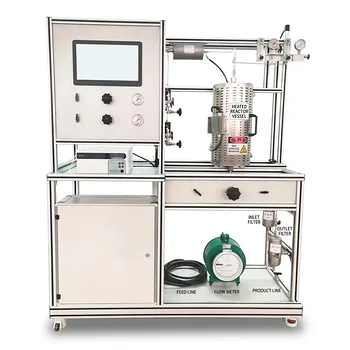
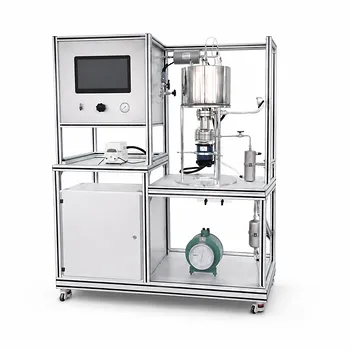
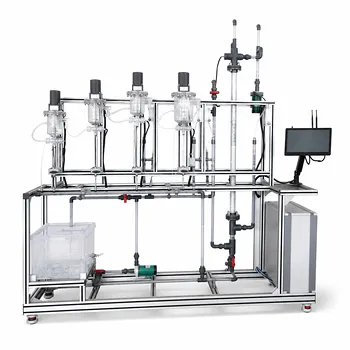
Mastering the exponential nature of chemical kinetics requires precise, reliable, and highly controllable equipment. LABPARK provides state-of-the-art Educational and Vocational Unit Operations Pilot Plants in chemical engineering, bioprocess & biotech, and environmental & water treatment designed specifically for universities, research institutes, and enterprises.
Our systems deliver the isothermal stability and thermal control accuracy needed to prevent thermal runaway, analyze kinetic parameters, and scale up processes safely.
Ready to elevate your research or teaching lab? Contact LABPARK today to find the perfect pilot plant solution for your facility!
Related Products
- Fixed-Bed Chemical Reaction and Gas Dust Tar Removal Unit Operations Pilot Plant
- Multi-Reactor Educational Pilot Plant for Reaction Engineering Unit Operations
- 100L Continuous Loop Hydrogenation Educational Unit Operations Pilot Plant
- Fixed Bed Gas Solid Catalytic Reaction Educational Pilot Plant
- Internal Circulation Gradient Free Catalytic Reaction Educational Pilot Plant
People Also Ask
- When to transition from PID to adaptive control in pilot plants? Key process indicators.
- How do deviations in estimating latent heat impact pilot plant thermal systems? Avoid hardware mis-sizing.
- Why Compare Predicted and Experimental Excess Enthalpy? Key to Accurate Pilot Plant Scale-up
- How to study gasification in pilot plants? Compare exit gas composition & efficiency
- Why Use PTFE & Hastelloy in Chemical Pilot Plants? Prevent Corrosion & Ensure Safety