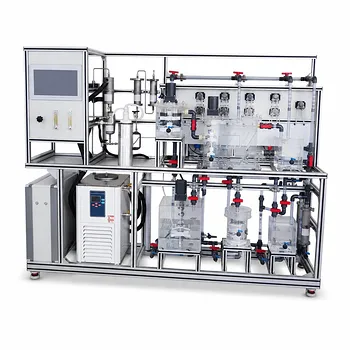
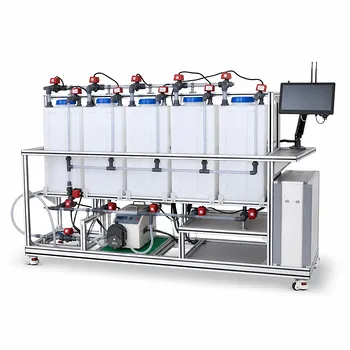
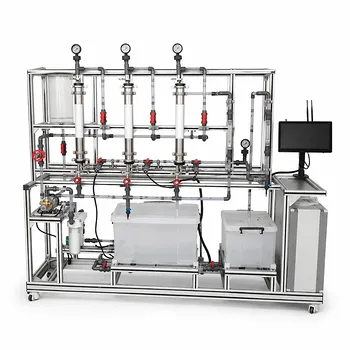
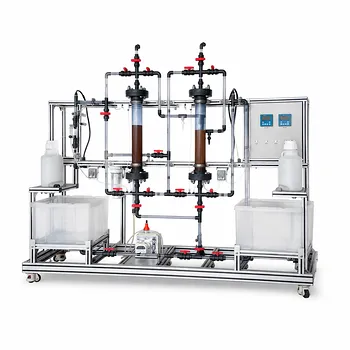
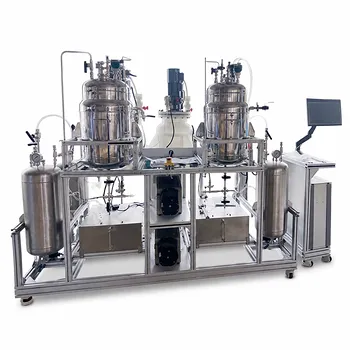
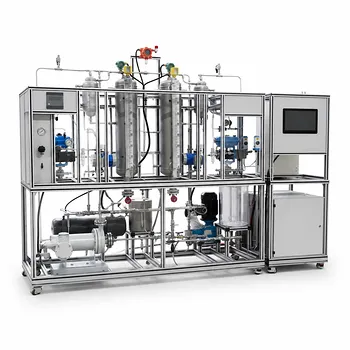
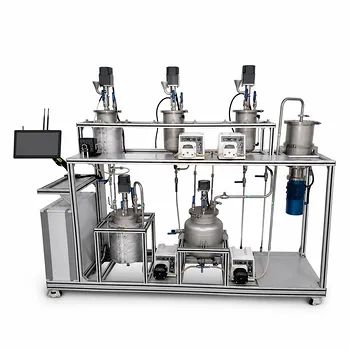
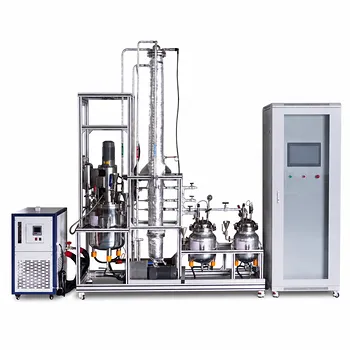
A systematic separation train is not an academic exercise—it’s the operating system your pilot plant must replicate.
The sequential precipitation of aluminum, then nickel and zinc, then calcium and magnesium mirrors the exact logic needed to design and run industrial wastewater and chemical pilot plants. Each step enforces a specific pH window, a chosen precipitant, and a clear filtration stage. At pilot scale, this turns a chemical recipe into a validated, scalable treatment section built around fractional precipitation, selective recovery, and effluent polishing.
A pilot plant that blindly mixes chemicals will fail. The real value of a staged separation is that it forces you to confront the hidden variables—speciation, buffering, and competing reactions—that determine whether your full-scale design will actually meet discharge limits. This sequence is a diagnostic map for turning raw water chemistry into a reliable, controllable process.
The Blueprint of Fractional Precipitation
Why the Sequence Matters: A Staged Separation Logic
A single “bulk precipitation” tank often creates a sludge that is un-settleable, gelatinous, or impossible to reprocess.
Sequencing the separations changes that. Each group of cations is removed under conditions where its solubility is at a minimum, while the others remain safely in solution.
This logic directly dictates how you lay out reactors, dosing points, and filtration units in a pilot plant.
You are building a cascade of thermodynamic selectivity windows—pH shifts, ligand additions, and redox adjustments—that isolate metals one class at a time.
Step 1: Removing Aluminum – The First Cut
In the foundational separation, aluminum is precipitated as a basic succinate and filtered out before anything else.
Why first? Because aluminum hydroxides and basic salts form at relatively low pH and can create gelatinous solids that foul equipment downstream if left behind.
In a pilot plant, this translates to an initial low‑pH precipitation reactor and a robust filtration stage (e.g., a filter press or membrane).
You must choose a reagent—succinate, hydroxide, or another base—that gives a filterable solid, not a colloidal mess. This step trains plant operators to match precipitant chemistry to downstream dewatering performance.
Step 2: Isolating Transition Metals with Sulfide Chemistry
Once aluminum is gone, the filtrate enters a second, tightly controlled zone.
Here, hydrogen sulfide gas (or a soluble sulfide donor) is introduced to drop nickel and zinc as sulfides. This is not a simple dump-and-stir step; it is a master class in pH-dependent sulfide concentration control.
Sulfide precipitation works because the solubility product of metal sulfides is astoundingly low, but the free sulfide ion concentration is governed by a cascade of acid‑base equilibria (H₂S ↔ HS⁻ ↔ S²⁻).
In a pilot plant treating a zinc‑manganese mix, for instance, the pH must stay within a narrow range (theoretically 1.59–4.68, with an optimal laboratory setpoint near 3.0) to force ZnS solid while keeping other sulfides from co‑precipitating. Every mole of ZnS formed releases hydronium ions, so the reactor needs buffer solutions or an automated acid‑base dosing loop to hold that pH steady.
This stage teaches engineers that sulfide precipitation is a real‑time feedback problem, not a batch equilibrium exercise. The pilot plant’s pH controllers, sulfide sensors, and redox probes must be calibrated to respond before the local pH crashes and the reaction stalls.
Step 3: Capturing Alkaline Earths – Softening and Final Polish
After sulfides are filtered, what remains is a solution rich in calcium and magnesium.
These are precipitated in a final polishing step, often as oxalates or oxinates, under alkaline conditions. This is the chemical cousin of industrial lime‑soda softening.
In a pilot plant, this step validates your water softening strategy.
If this unit is not working correctly, the downstream equipment—reverse osmosis membranes, heat exchangers, or boilers—will scale up with calcium carbonate or magnesium silicates. The lesson is clear: the separation sequence doubles as a fouling‑prevention diagnostic. By quantifying how much calcium and magnesium slip through, you can adjust antiscalant dosing or pH setpoints long before they become a full‑scale crisis.
The Hidden Variables That Define Pilot Plant Success
Speciation: Beyond Just Knowing What’s in Solution
Reporting total nickel or total iron is not enough. In an electrolyte solution, cation hydrolysis creates a mixed population of species—Ni²⁺, NiOH⁺, and Ni(OH)₃⁻, for example—each with its own temperature and pH fingerprint.
If your thermodynamic model assumes all nickel exists as free Ni²⁺, you will miscalculate the precipitation window and design a reactor that never hits target.
Running a pilot plant with this separation sequence forces you to confront speciation reality.
You validate, on‑site, whether the equilibrium constants hold in your specific water matrix, and you correct the plant’s pH and temperature setpoints accordingly.
The Coordination Chemistry Toolbox
Sometimes separation is not about precipitation but about selective dissolution.
For instance, a mixed zinc‑magnesium hydroxide sludge can be treated with ammonia. The formation of the soluble tetraamminezinc(II) complex, [Zn(NH₃)₄]²⁺, dissolves zinc while leaving magnesium hydroxide behind.
This principle teaches that a pilot plant isn’t just a precipitation train; it can incorporate complexation‑driven separation stages to recover high‑purity metals.
Designing such a unit requires knowledge of stability constants, ligand concentration, and pH—exactly the skills that this sequential exercise ingrains.
The pH Control Imperative
If there is one operational truth that echoes through every stage, it is this: pH is a process variable, not a batch reading.
Whether you are holding a narrow window for ZnS precipitation or preventing the formation of unwanted chromium species, pH drift destroys separation efficiency.
In a pilot plant, this means integrating dynamic acid‑base dosing systems, buffer tanks, and real‑time monitoring.
The sulfide precipitation example is especially instructive: as the reaction produces acid, the plant’s logic controller must pre‑emptively add base, mimicking an equilibrium shift. Students and operators who run this manually learn, instantly, why buffer chemistry is non‑negotiable.
Understanding the Trade-offs and Pitfalls
The Dangers of Simplified Models
Classroom calculations often assume pure solutions and ideal thermodynamic behavior.
Real wastewater contains complexing agents, organic matter, and competing metals that shift solubility curves and create mixed precipitates. A pilot plant that blindly trusts a simplified Pourbaix diagram will end up with sludges that fail toxicity tests or equipment plugged with unexpected scales.
Scale Formation and Fouling
Pilot plants often fail at the heat exchanger or membrane, not in the reactor itself.
Analytical work on acid‑insoluble deposits—silicates, iron oxides, calcium salts—shows that the scale’s composition is a direct fingerprint of the separation sequence’s weaknesses. If your calcium removal stage is underperforming, you’ll see calcium carbonate scale. If aluminum is bleeding through, you’ll get stubborn aluminosilicate films.
This transforms the separation train into a trouble‑shooting checklist.
Analyze the deposit, trace it back to the under‑performing separation step, and recalibrate.
Redox Sensitivity and Toxic Species
Not all separations are simple acid‑base jobs.
Chromium is the classic warning: trivalent chromium, Cr(III), is benign, but hexavalent Cr(VI) is a potent carcinogen. A pilot plant designed only for precipitation will miss the critical chemical reduction unit needed to convert Cr(VI) to Cr(III) before the pH is raised for precipitation.
The same principle applies to other redox‑active metals.
The sequential separation framework fails if you ignore oxidation state. Your pilot plant must therefore include a redox conditioning stage (e.g., metabisulfite dosing) before the first precipitation reactor, if the influent composition demands it.
Making the Right Choice for Your Pilot Plant Goal
The separation sequence is a template, not a rigid script. Your focus determines how you adapt it.
- If your primary focus is maximum metal recovery and purity: Validate each precipitation window with laboratory speciation tests. Add a complexation‑leaching step (like the ammonia‑zinc separation) to recycle individual metals rather than creating a mixed‑sludge liability.
- If your primary focus is preventing operational failures like scaling: Use the calcium/magnesium removal stage as a live monitor. Sample scale deposits from heat exchangers frequently and correlate their composition with the slip levels from the polishing reactor.
- If your primary focus is cost‑effective, compliant discharge: Prioritize the pH control loops and buffer capacities proven during sulfide and alkaline‑earth precipitation. Robust automation here prevents toxic metal breakthrough and avoids costly re‑treatment.
- If your primary focus is education or R&D: Treat this sequence as a hands‑on lab in speciation, coordination chemistry, and unit operation integration. Use it to calibrate thermodynamic models against empirical data, so that future full‑scale designs are born from proven, not assumed, behavior.
By embedding this sequential thinking into your pilot plant’s controls, reagent selection, and sampling plan, you turn a simple treatment train into a predictive, resilient blueprint—one that anticipates chemical side reactions, avoids catastrophic scaling, and produces effluent that consistently meets environmental goals.
Summary Table:
| Separation Step | Target Cations | Reagent / Method | Process Control Focus | Pilot Plant Application |
|---|---|---|---|---|
| Step 1: Low-pH | Aluminum ($Al^{3+}$) | Succinate / Hydroxide | Low pH, solid dewatering | Fouling prevention & solids handling |
| Step 2: Transition | Nickel, Zinc ($Ni^{2+}, Zn^{2+}$) | Sulfides ($H_2S$ / soluble sulfide) | Tightly buffered pH (~3.0) | Selective metal recovery & automation |
| Step 3: Alkaline | Calcium, Magnesium ($Ca^{2+}, Mg^{2+}$) | Oxalates / Oxinates | Alkaline pH, softening | Scale mitigation & downstream protection |
Ready to translate complex chemical separation theories into a robust, operating system? LABPARK provides premium Educational and Vocational Unit Operations Pilot Plants in chemical engineering, bioprocess & biotech, and environmental & water treatment. Tailored for universities, research institutes, and enterprises, our systems enable hands-on mastery of pH control loops, fractional precipitation, and scale prevention. Contact LABPARK today to design your customized pilot plant solution!
Related Products
- Solid Waste Pyrolysis and Refining Educational Pilot Plant for Unit Operations
- Thermal Desorption Exhaust Gas and Tail Water Treatment Educational Pilot Plant
- Electrochemical Water Treatment Educational Unit Operations Pilot Plant
- Dual-Mode Rectification Pilot Plant for Practical Training Unit Operations
- Continuous Batch Extractive Distillation Educational Pilot Plant
People Also Ask
- How do educational unit operations pilot plants bridge theory and design? Bridge the Engineering Gap
- How do educational unit operations pilot plants address safety and waste management when scaling up?
- When to transition from PID to adaptive control in pilot plants? Key process indicators.
- Why is the chemical plant startup schedule crucial? De-risk scale-up with pilot plants.
- Why Use PTFE & Hastelloy in Chemical Pilot Plants? Prevent Corrosion & Ensure Safety