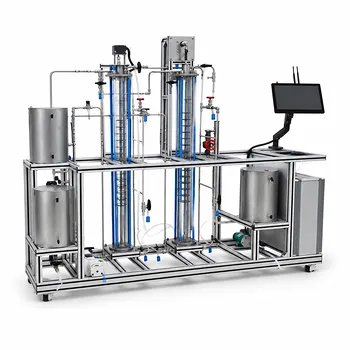
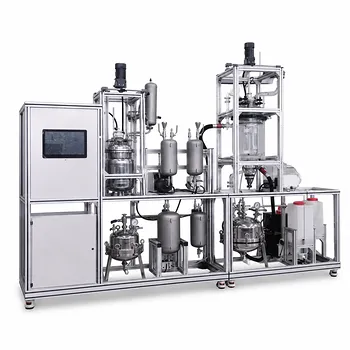
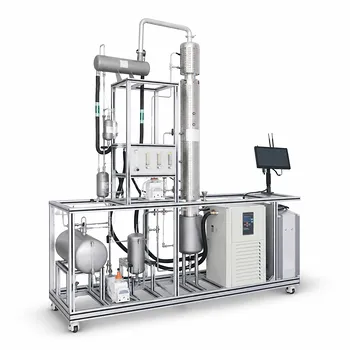
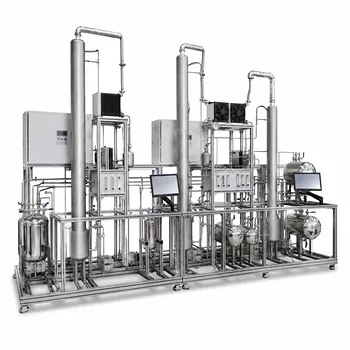
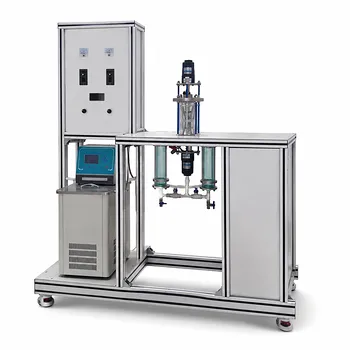
High selectivity is the single most powerful lever for efficiency in a liquid-liquid extraction pilot plant. The selectivity coefficient (β) fundamentally determines a solvent's ability to discriminate between your target solute and everything else. A high β value directly translates to a higher product purity per theoretical stage, sharply reducing the total solvent volume required. This, in turn, slashes the energy bill for the downstream solvent recovery unit.
The selectivity coefficient governs the economic trade-off between capital costs (column height) and operating costs (energy). A high-performing solvent with superior β minimizes both, while a poor β can make a separation economically impossible. The pilot plant is where this critical value is validated before scale-up.
The Fundamental Link Between Selectivity and Purity
The selectivity coefficient is not just another parameter; it is the core metric of a solvent’s economic value.
Quantifying Separation Power
Selectivity is the ratio of the distribution coefficients (K) of two components. It mathematically expresses how much more the solvent favors the solute over the carrier.
- A β value far greater than 1 indicates a strong preference, enabling a clean, high-yield separation.
- As β approaches 1, the solvent shows no preference, and separation becomes theoretically impossible, regardless of how many stages your pilot plant has.
The Viscous Cycle of Low Selectivity
When selectivity is poor, the pilot plant operation enters a forced, cascading inefficiency. Low enrichment per stage forces the operator to increase the number of theoretical stages to hit a purity target. To compensate for poor mass transfer, you must also increase the solvent-to-feed ratio (S/F). This flood of extra solvent might achieve the separation, but it creates a massive downstream problem: the extract phase is now a highly dilute solution of the target product.
Cascading Effects on Operating Costs
The cost of separation does not end at the extractor's outlet. The true financial burden is almost always felt in the solvent recovery system.
The Distillation Penalty
Solvent recovery downstream of an extraction column is typically done via distillation. Energy consumption here is your dominant operating cost. A high-selectivity solvent achieves the target separation with a low solvent flow rate. This produces a more concentrated extract stream entering the distillation column, meaning fewer kilograms of solvent need to be vaporized per kilogram of product. Every incremental improvement in β directly reduces the reboiler steam duty of the recovery column.
The Extraction Factor Trade-off
The extraction factor (Am = K * S / B) captures the dynamic tension in your operation.
- High Am (often forced by low selectivity): Reduces the number of theoretical stages needed, making the column shorter and cheaper to build. However, this floods the system with solvent, massively increasing your recovery energy cost.
- Low Am (enabled by high selectivity): Requires a taller column with more stages to achieve the separation but uses significantly less solvent, drastically reducing the downstream energy penalty.
Understanding the Trade-offs and Design Limits
Selectivity is never selected in isolation. A solvent must also obey practical phase behavior and physical property constraints.
The "Plait Point" Constraint
High selectivity is useless if it triggers a phase collapse. Even if the feed contains 40-50% solute, operators must manage the internal concentration profile in the first extraction stage. A high solvent flow rate, often required for less-selective solvents, is also used to dilute the solute concentration below a critical threshold (e.g., 25%). If the concentration climbs too high and the composition approaches the plait point on a ternary diagram, the two liquid phases will dissolve into each other. This destroys the immiscibility and causes the separation to fail catastrophically.
Physical Properties: Density, Viscosity, and Tension
Selectivity must be paired with operationally sound physical properties. Rapid phase separation within the pilot plant mixer-settlers or column depends on a high density difference between the phases. Meanwhile, interfacial tension must exist in a practical window (e.g., 1 to 47 x 10^-3 N/m for water-solvent systems). Too high a tension prevents proper dispersion, starving you of mass transfer area. Too low a tension leads to stable emulsions and severe carry-over (flooding), ruining both raffinate purity and extract quality.
Making the Right Choice for Your Goal
Selectivity is the starting point, but the final solvent choice is a systems-level decision validated on the pilot plant.
- If your primary focus is minimizing energy costs: Aggressively screen for solvents with the highest β. A 10% increase in selectivity often yields a disproportionate reduction in steam consumption at the recovery tower.
- If your primary focus is debottlenecking an existing column: Evaluate if a higher-selectivity solvent can reduce the required solvent flow rate to alleviate hydraulic flooding, provided the system stays far from the plait point.
- If your primary focus is achieving a new, high-purity specification: A solvent with a β between 1 and 5 may deliver an easy separation, but look for β values an order of magnitude higher (e.g., >50) for difficult, close-boiling mixtures to keep the number of theoretical stages within a practical, buildable height.
A pilot plant is not just for proving a process works; it’s the proving ground for the economic viability that starts with the selectivity coefficient.
Summary Table:
| Parameter / Metric | High Selectivity (High β) | Low Selectivity (Low β) | Operational & Economic Impact |
|---|---|---|---|
| Theoretical Stages | Fewer stages required | More stages (taller column) | High β reduces equipment CAPEX |
| Solvent-to-Feed Ratio | Low S/F ratio | High S/F ratio | High β minimizes solvent inventory |
| Extract Concentration | Highly concentrated | Dilute product stream | High β simplifies downstream recovery |
| Downstream Energy Cost | Minimal steam duty | High distillation energy | High β drastically lowers OPEX |
Optimize Your Extraction Processes with LABPARK
Validating solvent selectivity and phase behavior is critical for scaling up chemical processes efficiently. LABPARK design and provides industry-grade Educational and Vocational Unit Operations Pilot Plants in chemical engineering, bioprocess & biotech, and environmental & water treatment for universities, research institutes, and enterprises. Our robust pilot systems empower researchers and students to accurately model real-world mass transfer, stage efficiency, and solvent recovery dynamics.
Ready to elevate your engineering lab or training curriculum? Contact LABPARK today to find the perfect pilot plant configuration for your needs.
Related Products
- Comprehensive Liquid-Liquid Extraction Pilot Plant for Engineering Education
- Gallium and Indium Selective Extraction Educational Pilot Plant
- Continuous Sieve-Plate Distillation Pilot Plant for Unit Operations Laboratory Education
- Multi-Reactor Educational Pilot Plant for Reaction Engineering Unit Operations
- Multi-Modal Distillation Unit Operations Training Pilot Plant
People Also Ask
- How do pilot plants differentiate physical vs chemical extraction? Enhance Chemical Engineering Training
- How to Validate BIPs for LLE Pilot Plants? Steps to Align Simulations with Reality
- In a liquid-liquid extraction pilot plant, how is a ternary-phase diagram utilized to determine solvent feed requirements?
- How are ternary phase diagrams and LLE data applied in extraction experiments? Optimize Pilot Plant Scale-up
- How Do Selectivity & Distribution Coefficients Influence LLE Pilot Plant Solvent Choice?