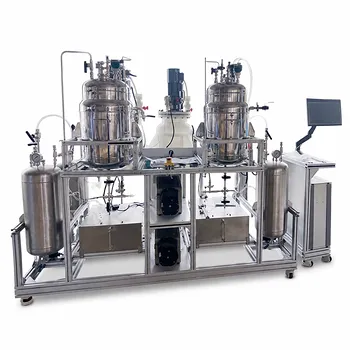
The fundamental difference is stark: in a conventional distillation pilot plant, reflux ratio and theoretical stages are flexible levers that substitute for each other, but in a reactive distillation column, this trade-off collapses into a narrow, rigid optimum.
In a standard pilot column, you can compensate for a short column (fewer stages) by simply increasing the reflux, and vice-versa, across a wide range. In a reactive distillation pilot plant, changing the reflux ratio doesn’t just alter liquid composition; it directly manipulates the reaction residence time and catalyst contact. This introduces kinetic constraints that break the classic compensatory relationship, replacing a broad design curve with a singular point of maximum performance.
While conventional distillation allows for a forgiving economic trade-off between column height and reflux, reactive distillation operates under tight chemical constraints. Altering the reflux ratio changes how long the liquid reacts on each tray, meaning you are simultaneously changing the separation driving force and the reaction rate. This removes the simple, interchangeable relationship between stages and reflux, creating a system with a few practical degree of freedom.
The Conventional Compensatory Relationship
In a classic distillation pilot plant, the relationship between the reflux ratio ( R ) and the number of theoretical stages ( N ) is a cornerstone of chemical engineering education and design. This relationship is defined by flexibility.
The Classic Trade-off
At the extremes, this relationship is mathematically absolute. Operating at minimum reflux ( R_{min} ) demands an infinite number of stages, while total reflux requires the minimum number of stages ( N_{min} ). Between these two limits, you can design for any combination.
The Erbar-Maddox correlation graphically proves this inverse, nonlinear relationship. As you increase the operating reflux ratio, the required number of theoretical stages decreases towards ( N_{min} ). This allows operators to use a lever—more reflux to save on capital cost, or a taller column to save on energy.
A Tool for Education and Economics
Pilot plants let students physically manipulate this knob and observe the effects. They can see how a higher reflux improves product purity on a fixed number of trays, directly visualizing the economic trade-off between utility costs (steam, cooling water) and column height.
The optimum reflux ratio is typically chosen empirically, usually between 1.1 and 2.0 times ( R_{min} ). This range balances the combined cost of energy and equipment depreciation, a calculation that assumes reflux and stages are smoothly interchangeable variables.
The Kinetic Constraint in Reactive Distillation
This entire model breaks down in a reactive distillation pilot plant. The primary reference makes it clear: the compensation between reflux ratio and stages exists only within a very narrow range, if at all.
Reflux as a Kinetic Manipulator
In a reactive column, the reflux ratio is not just a composition controller; it is a reaction time controller. Adjusting the reflux changes the liquid-catalyst contact behavior and the residence time of the liquid in the reaction zone.
For a standard distillation, the liquid’s composition changes, but its time spent on a tray is a purely hydraulic result. In reactive distillation, that residence time determines the extent of reaction. If you lower the reflux to reduce energy costs, you simultaneously reduce how long the reactants are in contact with the catalyst, potentially decimating conversion.
The Loss of Degrees of Freedom
This introduces a chemical constraint that locks down the system's degrees of freedom. For systems controlled by reaction kinetics, a simple "minimum reflux ratio" for separation doesn't strictly exist in the conventional sense.
Instead, there is a specific, optimal reflux ratio that maximizes conversion. You cannot freely trade stages for reflux because the reflux ratio sets the reaction duration. A stage count that works perfectly at one reflux rate will fail completely at another, not because separation failed, but because the reaction didn't have time to finish.
Understanding the Trade-offs and Pitfalls
The unique behavior of reactive distillation introduces specific operational hazards that don’t exist in conventional pilot plants. A traditional "higher-is-better" approach to reflux can destroy column performance.
The Danger of Dilution
In some configurations, like extractive reactive distillation, increasing the reflux at a constant solvent flow rate physically dilutes the catalyst or separating agent on the trays. This is a fatal mistake. A higher reflux ratio can actually hinder separation by reducing the relative volatility between the target components because the effective liquid-phase concentration of the key agent drops.
This is the opposite of what happens in a conventional column. The operator must balance the reflux ratio against the feed ratio to find an optimum, and blindly increasing reflux will backfire.
The Non-Linear Operating Window
The operational limits are much sharper. In a standard column, poor efficiency from a low HETP can be compensated with more reflux. In a reactive column, this compensation can push the system into flooding or entrainment long before the required reaction time is achieved. The hydraulic limit and the kinetic limit become decoupled and unforgiving.
Making the Right Choice for Your Pilot Plant Goals
The operation of your pilot column must be governed by the nature of your system. A standard protocol for a unit operations lab will fail in a reaction system.
- If your primary focus is teaching the economic trade-off between capital and operating costs: A conventional fractional distillation pilot plant is correct. The clear, inverse relationship between the number of stages and the reflux ratio provides a powerful, repeatable visual demonstration of engineering economics.
- If your primary focus is optimizing a reaction-rate-controlled system: A reactive distillation pilot plant is non-negotiable. You must prioritize precise reflux ratio control and multi-point temperature sensors to hunt for the singular, narrow optimal point. Do not assume you can compensate for a short column with more reflux; you must design for a specific kinetic residence time.
The core question isn't about a numerical difference, but a philosophical one: you’ve moved from balancing a flexible equation to finding the single point where separation and reaction can coexist long enough to succeed.
Summary Table:
| Feature | Conventional Distillation Pilot Plant | Reactive Distillation Column |
|---|---|---|
| Reflux vs. Stages Relationship | Flexible, inverse trade-off (Erbar-Maddox curve) | Rigid, narrow optimum (no simple substitution) |
| Primary Role of Reflux | Controls product purity & composition | Controls reaction residence time & catalyst contact |
| Degrees of Freedom | High (forgiving design window) | Low (locked by chemical kinetics) |
| Risk of Excessive Reflux | Increased utility cost (energy waste) | Catalyst dilution & reduced reaction conversion |
Optimize Your Unit Operations Lab with LABPARK
Are you looking to bridge the gap between chemical engineering theory and hands-on practice? LABPARK designs and manufactures high-performance Educational and Vocational Unit Operations Pilot Plants in chemical engineering, bioprocess & biotech, and environmental & water treatment for universities, research institutes, and enterprises.
Whether you need conventional distillation columns to teach classic thermodynamic trade-offs or advanced reactive distillation pilot plants to study complex kinetic constraints, our systems offer the precision control and durability your curriculum or research demands.
Contact LABPARK today to discuss your specific pilot plant requirements and receive a customized quote!
Related Products
- Continuous Sieve-Plate Distillation Pilot Plant for Unit Operations Laboratory Education
- Multi-Functional Special Distillation Educational Pilot Plant
- Continuous Batch Extractive Distillation Educational Pilot Plant
- Multi-Modal Distillation Unit Operations Training Pilot Plant
- Electrolyte Distillation Purification and Formulation Educational Pilot Plant
People Also Ask
- How does catalyst water concentration affect distillation pilot plant design? Key separation train choices.
- What are the primary reflux ratio control strategies? Master Distillation Unit Operations
- Why is vacuum operation capability an essential feature for a distillation unit operations pilot plant? Unlock Efficiency
- How can real-time carbon number prediction improve distillation pilot plants? Optimize control.
- How to select the right activity coefficient model (Wilson, NRTL, UNIQUAC) for distillation pilot plants?