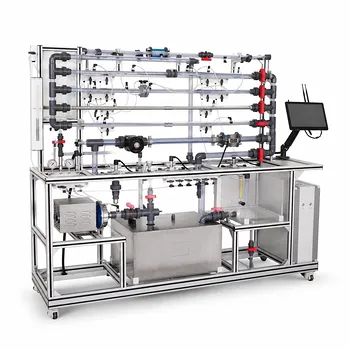
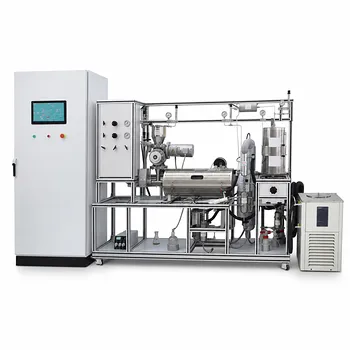
The relationship between alkane chain length and cracking kinetics directly dictates that heavier hydrocarbons react much faster than lighter ones. This fundamental fact forces a radical redesign of how educational pilot plants are built and operated. To safely teach these principles, a pilot plant must be engineered for agility: it requires highly adjustable temperature controls, variable residence time capabilities, and flexible feedstock systems. Without these features, students cannot systematically study how each alkane’s reactivity affects conversion, selectivity, and the risk of reactor plugging or coke formation.
The core design challenge is that a single, fixed reactor cannot effectively crack both ethane and n-pentane. The reaction rate coefficient increases with chain length, making heavier alkanes far more reactive. An educational pilot plant must therefore be a precision instrument that allows students to map the kinetic landscape across different feedstocks and conditions, not just run a single recipe.
Why Chain Length Dictates Reactor Design
The kinetic rule is straightforward: a heavier alkane like n-pentane cracks orders of magnitude faster than ethane at the same temperature. This is due to the greater number of carbon–carbon bonds available for homolytic fission and the formation of more stable radical intermediates. In an educational setting, this creates a practical problem. A reactor tube optimized for ethane’s slow kinetics will instantly over-crack or coke up when fed n-pentane unless its operating parameters can be changed on the fly.
The Need for Highly Granular Temperature Control
Because different feedstocks have such divergent optimal temperature windows—often ranging from 800 K to 1200 K—fixed-temperature furnaces are inadequate. The pilot plant must provide multi-zone heating with rapid thermal response. This lets students safely sweep through the full temperature range, observing how the activation energy barrier for lighter alkanes demands higher temperatures, while heavier feeds require cooler, more controlled conditions to avoid runaway reactions. A single-zone oven would force a compromise, hiding the true kinetic differences and making safe operation difficult.
Residence Time as a Critical Safety and Learning Variable
Variable residence time is the second non-negotiable. For fast-cracking heavy alkanes, short residence times (often fractions of a second) are essential to prevent secondary reactions that lead to coke and plugging. For ethane, longer residence times are needed simply to achieve measurable conversion. An educational plant must therefore allow students to independently change feed flow rate and reactor volume (e.g., by swapping tube lengths or using a coiled-tube design with multiple sample ports). This dual control teaches the core concept of space velocity and its direct link to chain-length kinetics, while physically preventing the safety hazard of coke formation that would occur if you tried to crack pentane at ethane-like residence times.
Accommodating Feedstock Complexity and Product Analysis
The chain-length effect is just the starting point. In reality, students explore not only pure light gases but also complex liquid mixtures like naphtha, which contains a range of n-alkanes, iso-alkanes, and naphthenes. This complexity is a direct extension of the chain-length principle: each component has its own reactivity, leading to a broad product slate. The pilot plant’s design must reflect this.
Flexible Feed Introduction Systems
A plant restricted to a single gaseous feed line cannot teach the full scope of cracking. Educational systems require dual-feeding capability: a mass flow-controlled gas supply for ethane or propane, and a liquid injection system (with preheating) for naphtha or model compounds. This flexibility allows students to perform a clean ethane run yielding mostly ethene, then immediately switch to a naphtha feed and see the severity-dependent distribution of methane, ethene, propene, butenes, and pyrolysis gasoline. The contrast cements the kinetic lesson.
The Indispensable Role of Online Analysis
Because product spectra change so dramatically with chain length, a simple grab sample is insufficient. The plant must integrate online gas chromatography (GC) or similar real-time analytics. When cracking ethane, the GC shows high ethene selectivity. When cracking naphtha, the chromatogram becomes a complex fingerprint that students can correlate back to the reactor’s temperature and residence time settings. This immediate feedback loop turns the pilot plant into a true experimental learning tool, not just a demonstration unit.
Understanding the Trade-offs and Safety Boundaries
The very flexibility that solves the kinetic problem introduces operational risks. The most serious is coke formation. Heavier feeds, if subjected to even slightly excessive temperature or residence time, will rapidly produce carbonaceous deposits that clog the reactor. Educational plants must therefore include:
- Pressure-drop monitoring across the reactor to provide early warning of coking.
- Decoking procedures (steam/air cycles) that can be safely demonstrated.
- Explosion-proof design when working with flammable gases at high temperatures.
There is also an educational trade-off. A plant with too many automated safeguards can obscure the kinetic lesson. The ideal design gives students enough control to cause a small, controlled upset (e.g., a noticeable yield drop from coking) while keeping the system within safe boundaries. This teaches the real-world consequence of ignoring the chain-length/reactivity relationship.
Making the Right Choice for Your Educational Goal
When designing or selecting a pilot plant to teach cracking kinetics, align the specifications with your primary learning objectives.
- If your primary focus is demonstrating fundamental kinetics: Prioritize a reactor with multi-zone temperature control and at least two interchangeable reactor tubes of different volume. This enables precise Arrhenius studies across multiple pure alkanes.
- If your primary focus is industrial product distribution: Invest in a system with both gas and liquid feed modules, and ensure online GC is fully integrated. The key is to let students compare ethane's clean ethene signal with naphtha's multi-component chromatogram.
- If your primary focus is safe process operations: Select a plant with robust pressure-drop monitoring and programmable interlocks for high temperature or low flow, explicitly using the risk of coking as a teachable moment on reactor health.
A pilot plant is not just a piece of equipment; it is a kinetic laboratory that must bend to the will of the molecules being studied. By making the plant as responsive as the alkanes themselves, you empower students to not just memorize that heavier chains crack faster, but to see, measure, and safely control that rate for themselves.
Summary Table:
| Alkane Type | Reactivity & Kinetics | Temp. Window | Residence Time | Pilot Plant Design Requirements |
|---|---|---|---|---|
| Lighter Alkanes (e.g., Ethane) | Slow reaction rate, high activation energy | High (Up to 1200 K) | Longer to achieve conversion | Multi-zone heating, variable flow rates |
| Heavier Alkanes (e.g., Pentane/Naphtha) | Fast reaction rate, lower activation energy | Low to Moderate (800 K+) | Short (fractions of a second) | Rapid cooling, liquid injection, coke monitoring |
Bring Advanced Kinetic Experiments to Your Lab
Teaching complex cracking kinetics requires highly flexible, safe, and precise equipment. LABPARK provides state-of-the-art Educational and Vocational Unit Operations Pilot Plants in chemical engineering, bioprocess & biotech, and environmental & water treatment. Designed specifically for universities, research institutes, and enterprises, our pilot plants feature multi-zone heating, flexible feed systems, and real-time monitoring to ensure safe, hands-on learning and reliable research outcomes.
Ready to upgrade your laboratory capabilities? Contact LABPARK today to find the perfect pilot plant solution for your institution!
Related Products
- Methane Cracking Educational Unit Operations Pilot Plant
- Educational Unit Operations Pilot Plant for Intraparticle Diffusion Effective Factor Measurement
- Multi Functional Catalytic Reaction and Reactor Evaluation Educational Unit Operations Pilot Plant
- High-Gravity Emulsification and Mass Transfer Educational Pilot Plant
- Multi-Reactor Educational Pilot Plant for Reaction Engineering Unit Operations
People Also Ask
- How do ethane vs naphtha cracking influence teaching pilot plant analytical configurations? Key Design Guide
- How can flow-NMR be integrated with pilot plant reactors to monitor kinetics? A Complete Guide
- How do cracking temperature and residence time affect olefin yield? Pilot Plant Guide
- How are utility consumption rates integrated into chemical pilot plant economic evaluations?
- How should OSBL investments be estimated? Key Steps to Avoid Budget Overruns in Pilot Plant Projects