The production of pure nitrogen by fractional distillation of air is the conceptual and thermodynamic template for chemical engineering pilot plants that study gas separation.
These pilot plants replicate the core unit operation—multi-stage vapor-liquid equilibrium—in a controlled, smaller-scale environment. The relationship is direct: industrial air separation defines the separation principles, column design logic, and scale-up challenges, while educational pilot plants translate that physics into observable, measurable experiments that teach reflux ratios, column hydraulics, and mass transfer without requiring cryogenic temperatures.
Industrial nitrogen production via cryogenic distillation provides the essential thermodynamic and operational framework for pilot-scale gas separation units. Educational pilot plants adapt this framework into accessible, safe experiments that demystify multi-stage separation, enabling engineers to internalize the critical relationships between reflux, theoretical stages, and purity before tackling full-scale design.
From Industrial Air Separation to the Pilot Plant Floor
The Thermodynamic Blueprint
Air is separated into pure nitrogen (boiling point: -195.8°C) and oxygen (-183°C) by exploiting their small boiling point difference in a cryogenic distillation column.
The process requires precise pressure control—often operating slightly above atmospheric to raise boiling points for efficiency—and high thermal insulation to minimize heat leak.
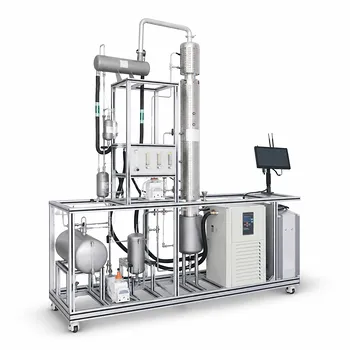
A pilot plant designed for gas separation borrows this exact logic: a vertical column with multiple contact stages, reflux provided by a condenser, and heat input from a reboiler. It studies the same heat and mass transfer phenomena and the impact of column packing efficiency.
Why the Pilot Plant Exists
An industrial air separation unit (ASU) is massive, hazardous, and energy-intensive. No educational or research program can operate one safely or affordably.
The pilot plant shrinks the process to a benchtop or small skid-mounted unit while preserving the essential engineering: vapor-liquid equilibrium stages, temperature profiles, and material balances.
This allows students and researchers to test how changes in reflux ratio, feed location, and pressure affect purity and throughput—knowledge that transfers directly to the design of large-scale nitrogen plants.
How Pilot Plants Simulate the Core Principles Safely
Swapping the Mixture Without Losing the Lesson
To avoid the danger and infrastructure of cryogenic temperatures, most educational gas separation pilot plants use a safer binary mixture—such as ethanol-water—under vacuum or atmospheric pressure.
The separation mechanism remains identical: a more volatile component (like ethanol) concentrates toward the top, while the less volatile component (water) stays in the bottoms.
Students still manipulate reflux ratio, measure column hydraulics (pressure drop, flooding limits), calculate plate efficiencies, and trace the temperature profile along the column height. The physics of stagewise contact is universal, making the learning directly transferable to cryogenic air separation.
Instrumentation and Control Mirrors Industrial Practice
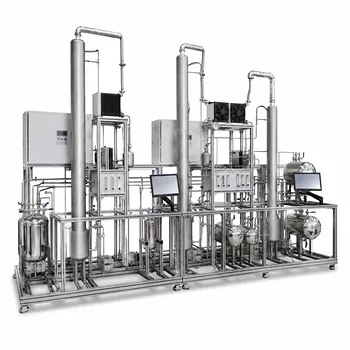
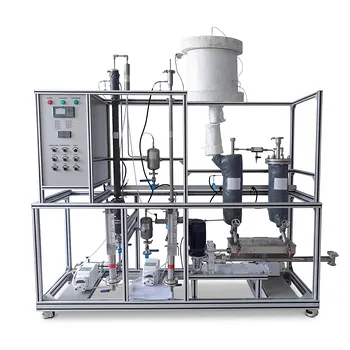
Pilot plants feature industrial-grade components: sieve tray or packed columns, motorized reflux controllers, reboiler heating mantles, and overhead condensers.
Temperature sensors installed at multiple points create a profile that mirrors the composition gradient in a nitrogen-oxygen column.
By comparing this profile to an equilibrium curve, students validate the number of theoretical stages and diagnose operating faults like flooding or weeping—exactly the skills needed to troubleshoot an ASU.
Key Design Parameters Derived from Distillation Theory
Shortcut Models Guide Physical Setup
Before building or running a pilot plant, engineers use a shortcut distillation model (e.g., Fenske-Underwood-Gilliland) to estimate:
- Minimum number of theoretical stages
- Minimum reflux ratio
- Optimal feed stage location
These parameters are the same ones calculated for an industrial nitrogen plant.
In a pilot plant, the shortcut results inform column height, the number of physical trays or packing height, and where to install the feed port. Students establish a theoretical baseline, then compare actual separation performance against it, reinforcing the link between simulation and physical reality.
The Role of Mass and Energy Balances
Fractional distillation is fundamentally a series of interconnected equilibrium stages. For nitrogen production, a high purity (>99%) demands many stages because the relative volatility between oxygen and nitrogen is low.
Pilot plant experiments capture overall and component mass balances around the column, as well as an energy balance over the reboiler and condenser.
This teaches how a small error in reflux ratio or heat duty can drastically reduce purity—a lesson critical for the design of cryogenic plants where energy consumption is a dominant cost.
The Bridge Between Laboratory Glassware and Full-Scale Operations
Moving Beyond Simple Phase Changes
In a basic chemistry lab, nitrogen is often produced by heating a reagent and condensing the vapor, or by chemical removal of other gases. Those setups focus on sample preparation and basic phase-change principles.
In contrast, an educational distillation pilot plant scales up to continuous or batch unit operations with multiple stages, reflux, and real-time data acquisition.
This bridges the gap: students who have only seen a simple distillation flask now encounter reboiler dynamics, condenser duty, and the effect of flooding—all of which are daily concerns in an industrial air separation plant.
Safety as a Design Element
Industrial gas separation integrates multiple safety layers—purge systems, pressure relief, and leak detection.
Pilot plants designed for gas purification incorporate similar logic. Even when handling non-cryogenic mixtures, the process train may include a safety trap, liquid washing bottles, and a drying column to scrub unwanted components, mirroring the sequential purification steps used before cryogenic air intake in an ASU.
This trains engineers to think in terms of containment, sequential purification, and controlled venting—a mindset directly applicable to nitrogen production facilities.
Understanding the Trade-offs in Pilot Plant Design
Simplicity vs. Cryogenic Realism
Using an ethanol-water mixture makes operation safe and affordable, but it eliminates the extreme low-temperature effects that dominate industrial nitrogen plants.
Issues like material embrittlement, cryogenic insulation performance, and oxygen hazard management cannot be studied.
The knowledge gap is addressed through theoretical coursework and specialized cryogenic internships, but the pilot plant alone cannot fully replicate the air separation thermal environment.
Scale-Dependent Phenomena
In a small-diameter pilot column, wall heat transfer, liquid maldistribution, and vapor channeling can be disproportionately large compared to an industrial unit.
Data collected may overestimate plate efficiency or underestimate weeping tendencies.
This is why pilot plant results are used to validate fundamental principles and educate, rather than to provide exact scale-up correlations without empirical correction factors.
Fixed vs. Flexible Configurations
An educational pilot plant is often a multi-purpose unit with interchangeable internals, allowing study of both tray and packed columns.
This flexibility is excellent for learning but means the column geometry may differ significantly from a dedicated, optimized air separation column.
Researchers must treat pilot plant data as indicative of trends, not as a direct miniature version of a nitrogen plant.
Making the Right Choice for Your Learning or Research Goal
The design and operation of a gas separation pilot plant must align with your specific educational or research objective. Use the goals below to guide your approach.
- If your primary focus is grasping fundamental distillation principles: Choose a pilot plant with a safe binary mixture and clear instrumentation. Concentrate on manipulating reflux ratio and drawing equilibrium stages—these skills transfer directly to cryogenic nitrogen production.
- If your primary focus is studying cryogenic separation behavior: Seek a pilot facility that operates at low temperatures (e.g., liquid nitrogen as a coolant) and includes vacuum-insulated columns and oxygen-safe materials. Accept that such units are rare and demand rigorous safety training.
- If your primary focus is scaling up an air separation design: Use a combination of shortcut modeling and pilot plant runs with the actual mixture (or a simulant with similar relative volatility) to probe flooding limits and packing efficiency. Always calibrate your column’s heat loss before drawing conclusions about energy consumption.
- If your primary focus is training operators for an industrial plant: Expose trainees to a pilot plant that simulates startup, shutdown, and abnormal situations (e.g., feed composition drift, loss of reflux). Emphasize the column’s process control logic, not just steady-state separation.
A pilot plant is not a miniature replica of a nitrogen production facility—it is a purpose-built instrument for understanding the separation science that makes that facility work. When designed and operated with this mindset, it becomes the most powerful tool for building the intuition that engineers bring to every cryogenic distillation challenge.
Summary Table:
| Feature | Industrial Air Separation (ASU) | Gas Separation Pilot Plant |
|---|---|---|
| Working Fluid | Cryogenic Air ($O_2 / N_2$) | Safe Binary Mixtures (e.g., Ethanol/Water) |
| Operating Temp | Cryogenic (down to -196°C) | Near-ambient or standard boiling points |
| Primary Objective | High-purity mass production | Educational training, research & scale-up |
| Key Focus Areas | Thermal insulation, power efficiency | Column hydraulics, plate efficiency, reflux ratios |
Bring Industrial Distillation Theory to Life with LABPARK
Bridging the gap between complex cryogenic concepts and hands-on engineering requires precise, reliable equipment. LABPARK provides high-quality Educational and Vocational Unit Operations Pilot Plants in chemical engineering, bioprocess & biotech, and environmental & water treatment for universities, research institutes, and enterprises.
Our custom-engineered pilot plants enable safe, measurable experiments in column hydraulics, mass transfer, and process control. Contact LABPARK today to discover how we can enhance your research and training capabilities!
Related Products
- Multi-Modal Distillation Unit Operations Training Pilot Plant
- Multi-Functional Special Distillation Educational Pilot Plant
- Continuous Sieve-Plate Distillation Pilot Plant for Unit Operations Laboratory Education
- Dual-Mode Rectification Pilot Plant for Practical Training Unit Operations
- Electrolyte Distillation Purification and Formulation Educational Pilot Plant
People Also Ask
- How can energy balance equations for condensers & reboilers be validated experimentally? Guide
- What are the primary reflux ratio control strategies? Master Distillation Unit Operations
- How can real-time carbon number prediction improve distillation pilot plants? Optimize control.
- Why is vacuum operation capability an essential feature for a distillation unit operations pilot plant? Unlock Efficiency
- How does catalyst water concentration affect distillation pilot plant design? Key separation train choices.