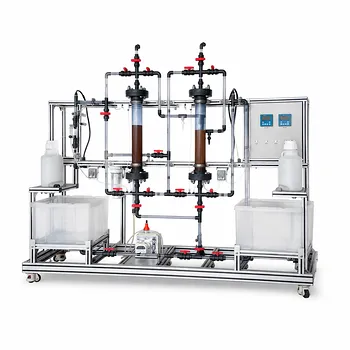
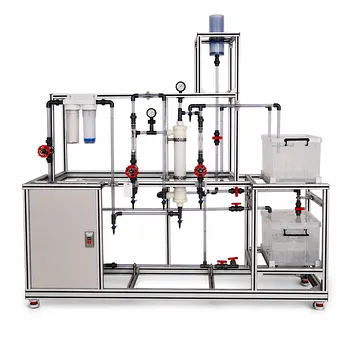
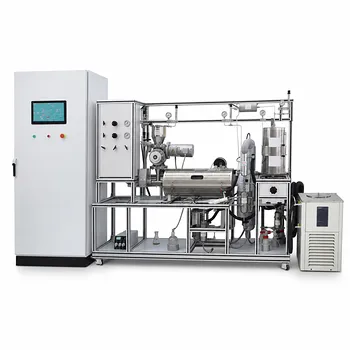
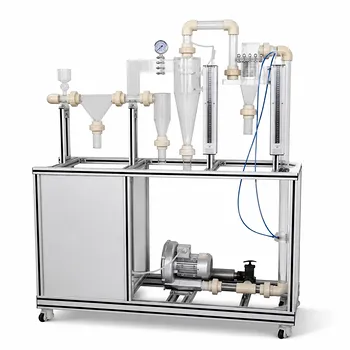
The efficiency gain is exponential, not linear. The principle of "multiple washes in small quantities" applies directly to filtration and washing pilot plants by proving that a fixed total volume of wash liquid removes far more impurity when split into several small cycles rather than used in one large flush. In pilot-plant design and operation, this translates to engineering workflows that intentionally stage wash steps, measure residual impurity after each cycle, and use the mathematical relationship [ \text{Remaining impurity} \propto \left( \frac{V_0}{V + V_0} \right)^n ] to optimize liquid consumption versus product purity.
Pilot plants don’t just demonstrate the “multiple small washes” rule—they provide the controlled environment where the trade-off between washing efficiency, solvent use, and product loss is quantified. The real value lies in using the pilot-scale data to build operational models that balance purity targets with processing time and dissolution risk.
Designing Pilot Plants for Staged Washing
The design of a filtration and washing pilot plant must physically enforce the principle by allowing precise, repeatable cycles.
The Core Mathematical Driver
The formula’s power comes from the exponent ( n ), the number of wash cycles. Pilot plants are equipped to track the residual solution volume ( V_0 ) (the liquid held in the cake after initial filtration) and the per-cycle wash volume ( V ). By collecting and analyzing samples after each wash, the plant becomes a teaching tool for mass transfer fundamentals.
Instrumentation and Control Requirements
To run a true multiple-wash experiment, the pilot plant needs accurate dosing pumps or graduated vessels that can deliver small, measured volumes consistently. Automated sequence controllers are also common, enabling operators to program a series of identical wash-filtrate steps without manual intervention, which reduces human error in cycle timing.
Physical Layout and Selection of Equipment
Plate and frame filter presses are frequently chosen because each plate can be washed individually with a small plug of liquid, mimicking the “small quantity” ideal. The design must also incorporate valves and lines that minimize dead volume, so that the wash liquid contacts the entire cake and doesn’t just bypass it, ensuring ( V ) is fully utilized.
Operating Strategies That Maximize the Benefit
Plant operation translates design potential into measurable purity gains, using data-driven cycle optimization.
Determining Filtration and Washing Constants
During operation, students or engineers first collect filtrate volume versus time data at constant pressure to determine filtration constants like ( K ) and the compressibility index. Then, by applying the known rule that the washing rate in many filter types is roughly one-quarter of the final filtration rate, they accurately predict the washing time needed per cycle, allowing fair comparison of different wash regimes.
Verifying the Exponential Impurity Removal
The pilot plant is run in wash cycles, with impurity concentration measured in each effluent sample. Operators can directly plot the remaining impurity against cycle number to confirm the logarithmic trend predicted by the formula. This empirical verification is impossible in a textbook but becomes visceral on the pilot scale.
Linking to Overall Productivity
The time each wash cycle adds is not free. Operators vary the number of wash cycles and the total wash volume while recording the change in product purity and the increase in total batch time. This data feeds directly into an economic model—more washes boost purity but also extend the cycle, potentially lowering the overall production rate when fixed auxiliary times (unloading, cleaning) are considered.
Understanding the Trade-offs
Blindly maximizing the number of washes without accounting for plant limitations leads to poor outcomes.
Product Dissolution Risk
Every small wash volume contacts the product cake and can dissolve a fraction of the desired solid, especially if the wash liquid is not perfectly saturated. Pilot plants measure this loss by analyzing the wash effluent for the target compound, revealing that beyond a certain purity point, yield loss outweighs the impurity removal benefit.
Time Penalty and Energy Use
Each additional wash step introduces another filtration and displacement phase. In a pilot plant, the increased cycle time is directly recorded, and for heated or cooled operations, additional thermal energy may be needed to maintain the temperature of each small wash dose. The data often shows a diminishing return where the fifth or sixth wash removes negligible impurity but still consumes time and energy.
Measurement and Control Complexity
Running ten 5-mL washes is operationally more demanding than one 50-mL wash. Pilot plants must have high-precision metering and robust automation to deliver this consistently; otherwise, the variability of manual operations can invalidate the mathematical model. The lesson is as much about the limits of instrumentation as it is about chemistry.
Making the Right Choice for Your Goal
How you apply the principle in a pilot plant depends entirely on your primary objective—education, scale-up design, or process optimization.
- If your primary focus is teaching mass transfer fundamentals: Use a plate and frame filter with a transparent filtrate collection system so students can see each cycle’s clarity. Emphasize manual measurements of ( V_0 ) and ( V ) to build an intuitive feel for the exponential relationship.
- If your primary focus is minimizing solvent consumption for an industrial scale-up: Run a statistically designed experiment varying wash cycles and volumes. Use the pilot-plant data to build a predictive model that finds the fewest cycles meeting the purity specification, directly reducing solvent recovery costs at production scale.
- If your primary focus is maximizing product purity without regard for time: Program the pilot plant to run an excessive number of cycles and measure the asymptotic purity limit. This defines the theoretical ceiling, but then use the time-and-loss data to choose a sensible operating point that balances purity with yield.
The “multiple washes in small quantities” principle is not a rigid rule but a lever—the pilot plant reveals exactly how much you can pull it before time, cost, and product loss break the process.
Summary Table:
| Aspect | Key Impact & Design Considerations | Primary Goal |
|---|---|---|
| Mathematical Driver | Exponential impurity removal: $Remaining\ impurity \propto (\frac{V_0}{V + V_0})^n$ | Optimize solvent consumption vs. product purity |
| Equipment Selection | Plate & frame filters, low dead-volume valves, precise dosing | Ensure repeatable, accurate small-volume cycles |
| Operational Trade-offs | Balancing product dissolution risk, cycle time, and energy use | Prevent yield loss while maximizing overall throughput |
| Process Optimization | Staged cycle programming & empirical verification of impurity | Adapt operations for teaching, scale-up, or purity limits |
Optimize Your Process Engineering Lab with LABPARK
Are you looking to demonstrate complex mass transfer concepts like staged washing or optimize industrial scale-up workflows?
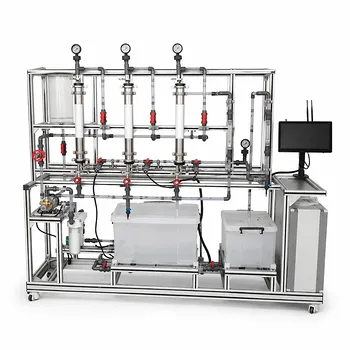
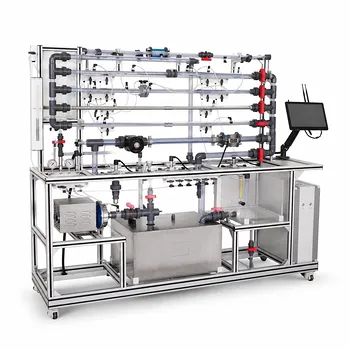
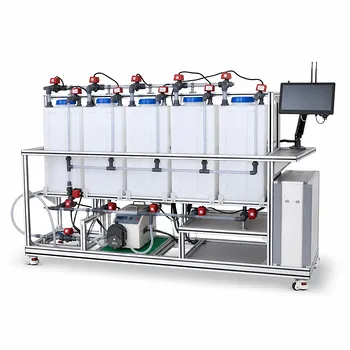
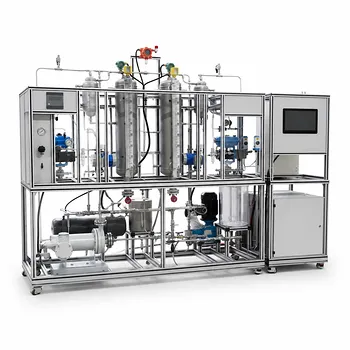
LABPARK provides premium Educational and Vocational Unit Operations Pilot Plants in chemical engineering, bioprocess & biotech, and environmental & water treatment. Specifically designed for universities, research institutes, and enterprises, our pilot plants feature the precise control, automation, and physical layouts required to master filtration and washing operations.
Contact LABPARK today to find the ideal pilot plant solution for your facility!
Related Products
- Hot Filtration Educational Unit Operations Pilot Plant Laboratory System
- Constant Pressure Filtration Educational Unit Operations Pilot Plant
- Multi-Functional Membrane Separation Educational Pilot Plant for Unit Operations Lab
- Multi-Functional Drying Educational Unit Operations Pilot Plant
- Dual-Mode Rectification Pilot Plant for Practical Training Unit Operations
People Also Ask
- How to Determine Specific Cake (r) & Filter Medium (Rm) Resistance Using Filtration Pilot Plant Data
- How to select solid-liquid separation equipment for pilot plants? A Step-by-Step Guide
- How can researchers identify and resolve filter medium blinding? Optimize Your Pilot Plant Runs
- Why Demo Constant-Rate to Constant-Pressure Filtration on a Pilot Plant? Key Practical Insights
- How do Buchner funnels & leaf filters differ in filtration scale-up? Key Differences Explained