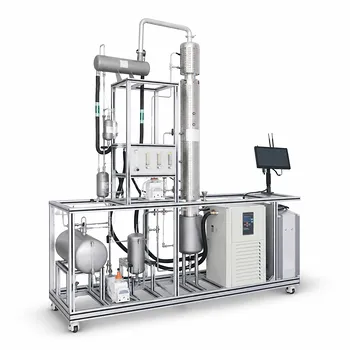
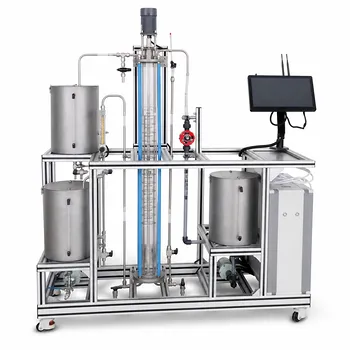
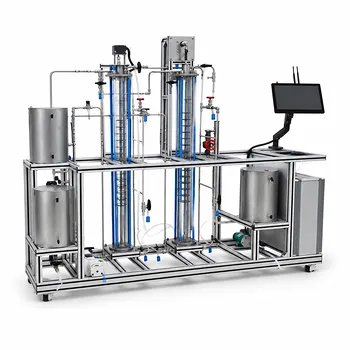
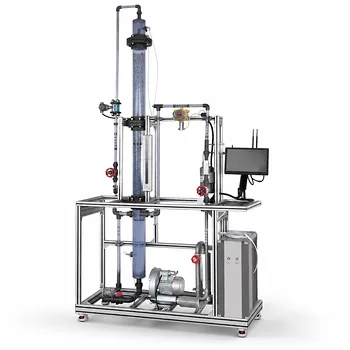
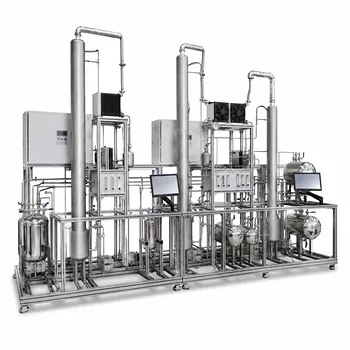
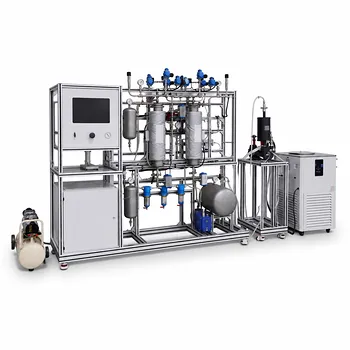
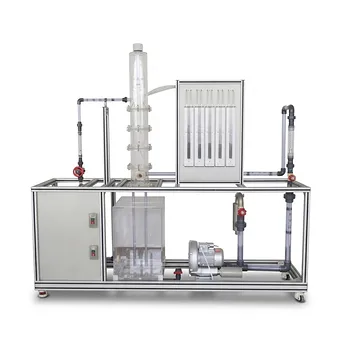
The top of a distillation column is a structural hotspot hiding in plain sight. The placement of heavy auxiliary equipment like overhead condensers directly impacts structural integrity by introducing eccentric bending moments when the equipment's center of gravity drifts from the column’s centerline. This eccentric load subjects the column shell to localized bending and torsional stresses, which can accelerate fatigue, cause weld cracking, or even lead to buckling. The proven design practice in chemical pilot plants eliminates this risk by not mounting heavy condensers directly on the column; instead, they are supported on adjacent structural steel frameworks, keeping the column in a pure, predictable state of compression.
Overhead condensers look like a natural fit atop a column, but direct attachment converts a simple vertical vessel into a cantilever beam. The safest, most reliable pilot plant designs physically decouple heavy auxiliary equipment from the column shell, transferring those loads to an independent support structure. This eliminates dangerous eccentric stresses while preserving net positive suction head (NPSH) for ground-level pumps.
The Unseen Stress: How Eccentric Loads Threaten a Column
Placing a condenser on a column may seem elegant, but gravity is unforgiving. When that weight isn't perfectly centered, it behaves like a lever arm prying at the vessel wall.
The Mechanics of Eccentric Loading
An eccentric load generates a bending moment—calculated as the weight of the equipment multiplied by the horizontal distance from its center of gravity to the column centerline.
Even a modest offset creates significant lever action.
This moment tries to bend the column like a vertical flagpole, superimposing tensile and compressive stresses on the shell.
Local Stresses on the Column Shell
Attaching heavy components directly to the column wall concentrates stress at the connection points.
The shell, designed primarily for internal pressure and axial compression, is now forced to resist bending and torsion.
In dynamic pilot-plant environments, where thermal cycling and vibrations are common, these localized stress risers are prime locations for crack initiation.
The Engineer’s Solution: Structural Decoupling
Rather than fighting physics with thicker metal, smart design isolates the problem entirely. The column stands as a dedicated pressure vessel, and the auxiliaries find support elsewhere.
Independent Support Frameworks
The standard approach places condensers and collecting tanks on separate structural steel frameworks adjacent to the column.
This layout severs the mechanical link that would transmit bending moments into the shell.
The column only carries its own contents and internal components, drastically simplifying the stress analysis and increasing the margin of safety.
Additional Benefits: NPSH and Accessibility
This decoupling isn’t just about structural safety.
Elevating condensers on independent structures still provides the gravity head needed for adequate net positive suction head (NPSH) at ground-level reflux pumps.
It also opens up the top of the column for easier access during pilot-scale modifications, instrumentation changes, and maintenance—a crucial advantage in research environments.
Broader Structural Considerations for Pilot Plant Columns
Ballast from overhead equipment is only one piece of a larger puzzle. Understanding the full load profile reveals why the eccentric moment must be eliminated, not just accommodated.
Beyond Auxiliary Loads: A Holistic Load Checklist
For pilot-scale columns, a complete mechanical design must prove the vessel can handle:
- Internal pressure, dictating minimum wall thickness and head design.
- Wind loads, especially critical for tall columns in outdoor test bays.
- Dead weight of the column structure, internal trays/packing, piping, and maximum liquid hold-up.
- Hydrostatic test loads, where the entire column is temporarily filled with water.
Adding a non-centric condenser load to this mix creates a combined stress state that is far harder to qualify and can demand impractically thick walls at the attachment zone.
Material Selection’s Role in Integrity
While structural decoupling removes the primary bending risk, material choices defend against chemistry.
Carbon steel is cost-effective for recovery systems handling less corrosive streams.
Stainless steel is selected for product purification columns to prevent contamination and resist harsher environments.
However, no alloy can compensate for a fundamentally flawed load path. Even stainless steel will suffer if an eccentric condenser load is allowed to repeatedly flex the shell.
Understanding the Trade-offs
No design decision is without compromise. Decoupling has clear structural benefits, but it’s important to recognize what you’re trading away—and why the choice is almost always justified.
The Allure of a Compact Footprint
Pilot plants are notoriously space-constrained.
A condenser mounted directly on the column’s head uses zero extra floor area, which can be seductive in a cramped lab module.
This perceived simplicity, however, masks a structural debt that accumulates over years of thermal cycles and operational upsets.
When Direct Mounting Might Seem Acceptable
For very small-diameter columns and lightweight total-condenser packages, the eccentric moment may be trivially low.
In these edge cases, a detailed finite element analysis (FEA) might show acceptable local stresses.
Yet for most pilot units processing solvents or operating under reflux conditions, the equipment weight quickly pushes the design into high-risk territory. The safe default remains independent support.
The Hidden Cost of Differential Movement
Placing the condenser on a separate structure introduces the potential for differential thermal expansion between the column and its support frame.
Piping connecting the two must be routed with enough flexibility to absorb this movement without imposing nozzle loads.
This is a manageable piping-stress problem, not a structural integrity threat – a far better engineering challenge to solve than a cracked column shell.
Making the Right Choice for Your Goal
Your path forward depends on what you prioritize most in your pilot plant’s mission: long-term safety, research agility, or absolute minimum footprint.
- If your primary focus is safety and long-term reliability: Always mount heavy overhead condensers and collecting vessels on a separate structural steel frame, ensuring zero eccentric load transfer to the column shell.
- If your primary focus is maximizing lab floor space: Only consider direct mounting after a rigorous FEA stress analysis, and even then, design for worst-case liquid hold-up and ensure the center of gravity is perfectly centered.
- If your primary focus is preserving product purity and operational uptime: Combine the structural decoupling approach with the appropriate material selection (stainless steel for product columns) to protect against both mechanical failure and corrosion.
By treating your distillation column as a pure pressure vessel and giving its auxiliary equipment an independent foundation, you create a pilot plant that is structurally sound, flexibly maintained, and a trustworthy platform for every future experiment.
Summary Table:
| Design Approach | Structural Impact | Key Advantages | Key Disadvantages |
|---|---|---|---|
| Direct Mounting | Eccentric loads, local bending & torsional stress | Compact footprint | Risk of weld cracking & buckling |
| Structural Decoupling | Pure axial compression on column | Eliminates bending moments, improves NPSH & access | Requires piping flexibility for thermal expansion |
Optimize Your Lab with LABPARK's Safe & Reliable Pilot Plants
Designing a chemical engineering lab requires balancing structural integrity with operational efficiency. LABPARK provides state-of-the-art Educational and Vocational Unit Operations Pilot Plants across chemical engineering, bioprocess & biotech, and environmental & water treatment.
Tailored for universities, research institutes, and enterprises, our systems are engineered to eliminate structural risks and ensure long-term reliability.
Ready to elevate your research or training facility? Contact LABPARK today to discuss your custom pilot plant requirements!
Related Products
- Continuous Sieve-Plate Distillation Pilot Plant for Unit Operations Laboratory Education
- Multi-Functional Special Distillation Educational Pilot Plant
- Multi-Modal Distillation Unit Operations Training Pilot Plant
- Continuous Batch Extractive Distillation Educational Pilot Plant
- Dual-Mode Rectification Pilot Plant for Practical Training Unit Operations
People Also Ask
- Why is vacuum operation capability an essential feature for a distillation unit operations pilot plant? Unlock Efficiency
- How to select the right activity coefficient model (Wilson, NRTL, UNIQUAC) for distillation pilot plants?
- What are the primary reflux ratio control strategies? Master Distillation Unit Operations
- How can real-time carbon number prediction improve distillation pilot plants? Optimize control.
- How does catalyst water concentration affect distillation pilot plant design? Key separation train choices.