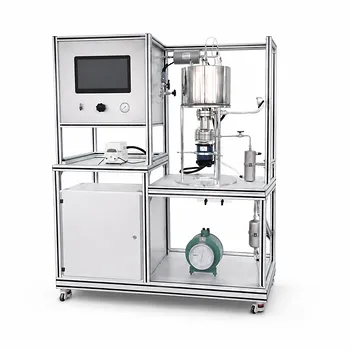
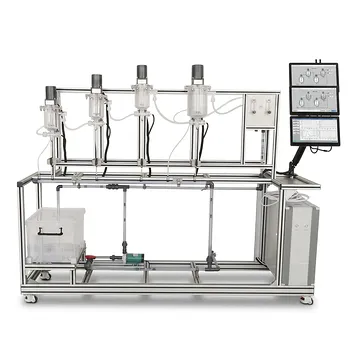
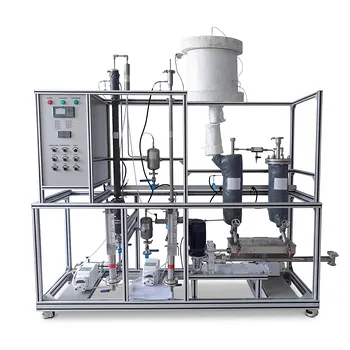
The foundation of superior heat transfer in a microchannel reactor pilot plant is a radical reduction in the distance heat must travel. By interleaving reaction channels directly with dedicated heat-exchange channels, the design slashes the thermal diffusion path to just the thickness of a single wall. This creates near-instantaneous heat removal or addition, enabling chemical engineering researchers to study highly exothermic or endothermic reactions with unprecedented precision and safety.
The interleaved architecture transforms heat transfer from a diffusive bottleneck into an almost instantaneous process. It eliminates the low fin efficiencies of conventional heat exchangers by placing the heat source and sink millimeters apart, allowing pilot plants to achieve isothermal operation, tightly couple reaction steps, and dramatically increase process intensity without the bulk.
The Physics of Heat Transfer at the Microscale
In microchannels, the scaling laws shift the dominant heat-transfer mechanism to pure conduction.
The Dominance of Conduction and the Path Length
At gap sizes below 2 mm, fluid convection in the transverse direction is minimal. Heat transfer relies on molecular conduction, where flux is inversely proportional to distance. Shortening the conduction path is the single most powerful lever for increasing heat-transfer efficiency.
Why Surface Area Alone Isn’t Enough
Conventional reactor designs add high-aspect-ratio fins to boost surface area. However, fin efficiency drops steeply as the fin height increases. A tall fin acts as a thermal resistor—its tip is far cooler or hotter than its base, wasting material. The interleaved design bypasses this limitation entirely by making the entire heat-transfer area an active wall between two flowing fluids, eliminating the need for extended fins.
The Interleaved Design: A Molecular Shortcut
The primary reference’s interleaved architecture is a direct physical answer to the conduction problem. It places a heat-exchange channel immediately adjacent to each reaction channel, creating a sandwich-like multi-layer stack.
How Interleaving Channels Eliminates Thermal Resistance
Each reaction channel shares a thin, diffusion-bonded metal wall with a thermal control channel. The thermal diffusion path becomes the wall thickness (often 0.2–0.5 mm) instead of several centimeters. This geometry enables heat fluxes up to 100 times greater than in traditional shell-and-tube exchangers. Because the wall itself acts as the only thermal barrier, heat moves almost instantaneously, allowing researchers to maintain truly isothermal conditions.
Case Study: Coupling Endothermic and Exothermic Reactions
For endothermic processes like steam reforming, pilot plants can co-locate an exothermic combustion channel in the next layer. The heat of combustion flows directly across the shared wall into the reforming catalyst. This close physical coupling minimizes heat losses to the environment, recovers waste energy with compact recuperators, and reduces the reactor volume by a factor of 10 to 1,000 compared to conventional plants.
Achieving Isothermality in Highly Exothermic Reactions
In temperature-sensitive chemistries like Fischer-Tropsch (FT) synthesis or preferential oxidation (PROX), hotspots destroy selectivity. Interleaved cooling channels remove the heat of reaction as soon as it is generated. For FT synthesis, this enables carbon monoxide conversion above 69% with minimal methane selectivity—a result impossible in slurry or fixed-bed reactors that are limited by heat-transfer bottlenecks.
Understanding the Trade-offs
The interleaved design’s benefits come with engineering challenges that must be managed in a pilot plant environment.
Fabrication Complexity and Cost
The hermetically sealed stacks are typically made by diffusion bonding partially etched metal sheets. This process requires precise alignment, high pressure, and high temperature under vacuum, making the reactors expensive and challenging to customize for quick parameter studies. Any bonding defect can lead to inter-channel leaks and catastrophic failure under thermal cycling.
Flow Distribution and Pressure Drop
Stacking many parallel interleaved channels to scale up throughput requires manifold designs that distribute flow evenly. Malistribution can cause some channels to overheat or underperform. Additionally, while the narrow gaps boost heat transfer, they increase pressure drop. Wave-line or other mixing features may further enhance mass transfer but at the cost of even higher pressure drops and fabrication intricacy.
Thermal Expansion and Material Integrity
The close contact of hot and cold channels means the metal layers experience steep temperature gradients. Mismatched thermal expansion between different materials or within the same stack can induce high mechanical stress. Over many cycles, this may lead to fatigue cracking, especially at the bonded interfaces, requiring advanced stress analysis and material selection.
Scalability Considerations
While stacking plates can scale capacity, maintaining the pristine thermal contact and hermetic seals at larger scales is non-trivial. A single large reactor block cannot be repaired if an internal leak occurs. Scaling instead by “numbering up” many smaller, identical units is often preferred but introduces new challenges in flow distribution and cost, making it a critical design decision for pilot plant operators.
Making the Right Choice for Your Research Goal
Your specific pilot plant objective determines how you leverage the interleaved design.
- If your primary focus is studying fast, highly exothermic kinetics: Use the interleaved architecture to achieve near-isothermal conditions and suppress side reactions, isolating intrinsic kinetic data from heat effects.
- If your primary focus is demonstrating process intensification and energy integration: Exploit the ability to directly couple endothermic and exothermic channels to build a compact, self-heating reforming or synthesis module.
- If your primary focus is scaling up a proven microchannel process: Consider numbering up multiple standard interleaved units rather than enlarging a single block, and invest effort in equalizing manifold pressure drops to avoid flow maldistribution.
- If your primary focus is educational or training purposes: The interleaved geometry provides a tangible, visual demonstration of how reducing thermal path length directly boosts heat transfer, making it an ideal teaching tool for heat and mass transfer principles.
In a microchannel pilot plant, the interleaved channel design does not just incrementally improve heat transfer—it qualitatively changes the thermal landscape, allowing researchers to decouple heat dynamics from reactor scale and unlock process intensities that were simply unattainable before.
Summary Table:
| Feature | Mechanism | Key Benefit |
|---|---|---|
| Shorter Path Length | Reduced thermal barrier (0.2–0.5 mm) | Near-instantaneous heat transfer |
| Direct Coupling | Co-locating endo/exothermic channels | High energy recovery & compact size |
| Isothermal Control | Heat removal directly at the source | High selectivity, eliminated hotspots |
Ready to elevate your chemical engineering research? LABPARK provides state-of-the-art Educational and Vocational Unit Operations Pilot Plants in chemical engineering, bioprocess & biotech, and environmental & water treatment. Designed for universities, research institutes, and enterprises, our systems offer precise thermal control and process intensification to accelerate your innovations. Contact us today to find the perfect pilot plant solution for your lab!
Related Products
- Micro-Scale Gas-Solid Catalytic Reaction Educational Pilot Plant
- Fixed-Bed Chemical Reaction and Gas Dust Tar Removal Unit Operations Pilot Plant
- Internal Circulation Gradient Free Catalytic Reaction Educational Pilot Plant
- Multi-Reactor Educational Pilot Plant for Reaction Engineering Unit Operations
- Fluidized Bed Gas Solid Catalytic Reaction Educational Pilot Plant
People Also Ask
- Fluidized vs. Fixed Bed Reactors: Comparing Heat & Complexity in Pilot Plants
- Why is a multibed configuration necessary for exothermic reactions? Optimize your pilot plant trajectory.
- Why is thermal management a major challenge in methane oxidative coupling? Reactor Solutions for Pilot Plants
- How does the Mears criterion evaluate transport resistance? Key Guide to Intrinsic Kinetics
- How do reactor pilot plants safely study gas-solid reactions? Master kinetics with thermal & flow control.