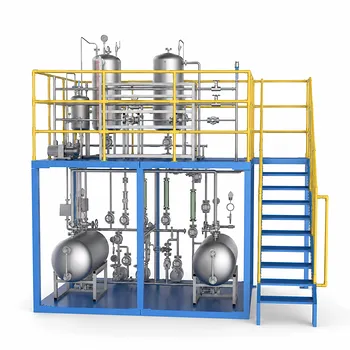
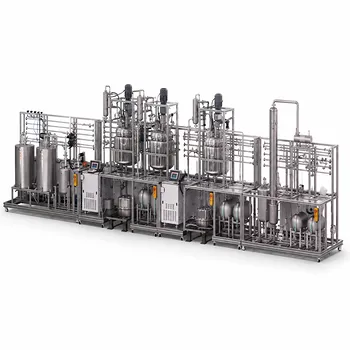
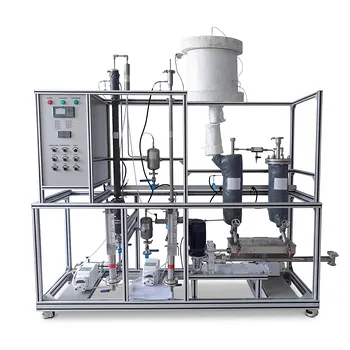
Integrating reaction and downstream purification unit operations doesn’t just shift costs—it transforms them. When designing a pilot plant, the way you couple synthesis and purification determines whether you build a sprawling, energy-hungry facility or a lean, compact system. Downstream steps routinely dominate both capital (capex) and operating (opex) expenditures, often exceeding the cost of the reactor itself. However, a conscious integration strategy—such as achieving higher purity directly in the reactor or merging separations into the reaction vessel—can collapse this cost structure, eliminating entire pieces of equipment and slashing utility consumption.
The integration of reaction and downstream unit operations is the single biggest lever for controlling pilot plant economics. A design that simplifies or removes purification steps by improving reaction performance or physically combining unit ops can drastically reduce both upfront capital and ongoing energy costs, but only if the trade‑offs in flexibility, data quality, and infrastructure demands are carefully managed.
The Economic Lever of Downstream Purification
Downstream steps are not an afterthought—they are often the true cost center of a chemical process. In pilot plants, this reality shapes every decision from equipment sizing to utility requests.
Purification as the Dominant Cost Driver
Conventional processes frequently see distillation, extraction, or crystallization units consuming more capital and energy than the reactor. A pilot plant built with separate, large-scale purification trains mirrors this commercial truth, locking in high equipment expenditure and steam/cooling water demand from day one. Recognizing this dominance makes it clear: if you can alter the purification need, you alter the entire project’s financial profile.
How Reaction Performance Redefines Downstream Needs
A reaction that delivers a purer raw product changes everything downstream. With fewer impurities, a complex multi‑stage distillation might be replaced by a simple extraction or even a single precipitation step. This cascading effect reduces the number of unit operations, shrinks required vessel sizes, and lowers the working capital tied up in solvents and intermediates—all while still giving students and researchers the separation kinetics data they need.
Integration Strategies That Cut Costs
Pilot plant designers have powerful mechanisms to merge reaction and purification, achieving dramatic savings without sacrificing learning outcomes.
Process Intensification via Reactive Distillation
Combining reaction and vapor‑liquid separation into a single column eliminates an entire vessel, its connecting piping, and the associated transfer downtime. For example, a batch reactive distillation column for TAME production requires only 10 trays and a reflux ratio of 10, compared to an 80‑tray conventional column with a reflux ratio of 40. The integrated design also shortens cycle time by about 30%, directly cutting utility consumption and freeing up pilot plant schedule capacity. This one‑to‑one replacement dramatically shrinks both capex and opex while maintaining—or improving—separation data quality.
Advanced Reaction Technologies for Purer Raw Product
Continuous micro‑reaction technology pushes purity higher inside the reactor itself. When the raw product leaves the reactor with fewer by‑products, the downstream task becomes far lighter. A pilot plant can then omit an entire distillation step, substituting a small extraction or precipitation unit. The result is less stainless steel, lower heating/cooling loads, and a simpler control system—all of which directly reduce the fixed capital investment.
Reducing Unit Operations and Footprint
Every eliminated unit operation also removes the supporting structures, instruments, and safety systems that come with it. Fewer vessels mean a smaller pilot plant footprint, lower installation costs, and reduced working capital requirements for spare parts and raw material inventories. For educational institutions, this translates to more experimental capability in constrained laboratory space and fewer utility hookup conflicts.
Understanding the Trade‑offs
Integration is not a magic bullet. The same design choices that shrink costs can introduce new constraints, especially in a research environment where flexibility and data richness are paramount.
Infrastructure and Utility Constraints
Every integrated unit operation still draws power, steam, or cooling water, and these demands must fit within the existing laboratory infrastructure. A reactive distillation column may demand high‑pressure steam that the building cannot supply, while a micro‑reactor system might require specialized electrical connections. Ignoring utility ceilings during design leads to expensive retrofits or unsafe operations, negating any capex savings.
Working Capital Implications
Simpler, integrated processes usually reduce working capital because they require fewer raw material inventories and less product storage. However, a pilot plant running multiple product campaigns may still need up to 15% of fixed capital in working capital (or more for complex, multi‑grade setups). Underestimating this cash reserve can strand a well‑designed pilot plant without the funds to operate continuously, compromising the very data it was built to collect.
Data Fidelity vs. Process Simplification
The purpose of a pilot plant is to generate scale‑up data. Over‑integrating can obscure individual unit operation performance, making it difficult to isolate mass‑transfer coefficients or fouling rates. A design that is too lean may save money now but fail to deliver the predictive models required for a commercial plant, effectively wasting the entire investment. The cost of missing critical data far outweighs any hardware savings.
Making the Right Choice for Your Goal
Your integration strategy should be shaped by the primary purpose of the pilot plant, balancing capital efficiency with the need for actionable learning.
- If your primary focus is minimizing capex and opex for a well‑characterized chemistry: Use micro‑reaction or reactive distillation to collapse multiple unit operations into one, simplifying downstream equipment and utility circuits as much as possible.
- If your primary focus is generating robust scale‑up data for a novel process: Resist the urge to fully integrate. Keep key unit operations as separate, well‑instrumented modules so that individual performance parameters can be measured without confounding effects.
- If your primary focus is fitting a versatile pilot plant into an existing laboratory: Prioritize unit operations with lower utility footprints (e.g., extraction instead of distillation) and match the equipment to available cooling water, steam, and power capacity, even if that means accepting a slightly higher operating cost.
Every dollar saved by intelligent integration is a dollar that can be reinvested into better instrumentation or broader experimental campaigns. The goal is not to build the cheapest plant, but the most informative one at the lowest cost consistent with your data and safety requirements.
Summary Table:
| Integration Strategy | Impact on Capex & Opex | Key Design Trade-off |
|---|---|---|
| Reactive Distillation | Eliminates vessels, cuts cycle times by ~30%, and lowers utility demand. | High utility complexity; potential loss of isolated stage data. |
| Advanced Micro-reactors | Yields purer raw product, replacing complex downstream separation units. | Requires specialized electrical and utility connections. |
| Physical Unit Merging | Reduces piping, footprint, instrumentation, and installation costs. | Can obscure individual unit performance metrics for scale-up. |
Optimize Your Pilot Plant Design with LABPARK
Are you looking to balance budget limits with high-fidelity scale-up data? LABPARK provides state-of-the-art Educational and Vocational Unit Operations Pilot Plants across chemical engineering, bioprocess & biotech, and environmental & water treatment for universities, research institutes, and enterprises.
Let us help you design a space-efficient, cost-effective pilot plant tailored to your exact learning and research objectives. Contact our engineering experts today to discuss your project requirements!
Related Products
- Fixed Bed Gas Solid Catalytic Reaction Educational Pilot Plant
- Multi Pump Fluid Transport Process Piping Unit Operations Training Pilot Plant
- Carbon Dioxide Hydrogen Methanol Synthesis Educational Unit Operations Pilot Plant
- Ethyl Acetate Synthesis Unit Operations Pilot Plant for Practical Training
- Natural Product Extraction Unit Operations Training Pilot Plant
People Also Ask
- How do reactor pilot plants safely study gas-solid reactions? Master kinetics with thermal & flow control.
- How does the Mears criterion evaluate transport resistance? Key Guide to Intrinsic Kinetics
- Fluidized vs. Fixed Bed Reactors: Comparing Heat & Complexity in Pilot Plants
- Why is a multibed configuration necessary for exothermic reactions? Optimize your pilot plant trajectory.
- What are the differences between pseudohomogeneous and heterogeneous models in pilot plants?