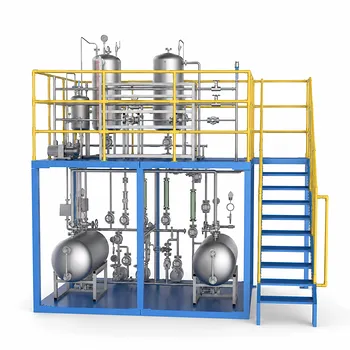
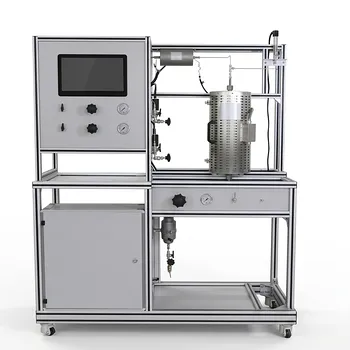
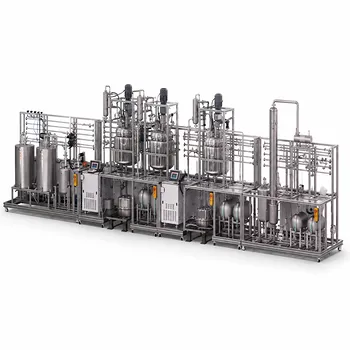
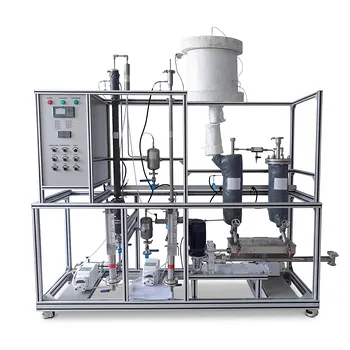
Integrating process simulation software with physical pilot plants fundamentally redefines reactor design training—it’s not just a classroom exercise.
This combination forces students and researchers to confront the non-ideal behaviors that idealized computer models ignore. By feeding real, experimental data back into the digital models, training moves from confirming textbook answers to mastering the art of model calibration, scale-up, and dynamic safety analysis.
Core Takeaway: The true enhancement comes from creating a feedback loop where physical pilot plant data—actual reaction rates, heat transfer coefficients, and mixing inefficiencies—becomes the raw material to calibrate and validate simulation models. This teaches the critical skill of turning an imperfect digital approximation into a trustworthy tool for reactor design, scale-up, and safety management.
The Fundamental Gap Between Theory and Reality
Reactor design cannot rely on simulation alone because commercial process simulators are inherently limited. They excel at mass and energy balances but struggle with the multiscale chaos inside a real reactor.
The Limits of Idealized Reactor Models
Software models often assume perfect mixing, uniform temperatures, and simple kinetic expressions. Reality is messier. Molecular interactions, catalyst deactivation patterns, and fluid dynamic dead zones all create deviations that a standalone simulation will never capture. Without real-world correction, these models can produce dangerously optimistic performance predictions.
Why Pilot Plant Data Is Non-Negotiable
A physical pilot plant generates empirical parameters that no desktop model can invent. Measurement of actual reaction rates, heat transfer coefficients, and mixing efficiency provides the ground truth. Only by confronting these numbers can a student or researcher see exactly where the idealized model breaks down and where it must be tuned.
How the Integration Transforms Reactor Design and Validation Training
The synergy between simulation and physical equipment creates a compressed, risk-free environment for developing real engineering judgment. It turns validation from a theoretical guess into an iterative, data-driven discipline.
Calibrating Models with Real Empirical Data
When you run a reaction in a pilot plant, you obtain temperature profiles, conversion data, and pressure drops that are specific to your equipment. Plugging these measurements back into the simulation software as corrected kinetic constants or heat transfer coefficients turns a generic digital model into a high-fidelity mirror of the actual unit. Training emphasizes that a simulation is only as good as the data fed into it.
Dynamic Behavior and Startup/Shutdown Training
Reactor design isn’t just about steady-state conversion. Dynamic process simulation serves as a virtual twin for studying time-dependent behaviors—startups, shutdowns, and responses to disturbances. Students model the transient concentration and temperature dynamics of a batch reactor first digitally, then observe the physical plant. Comparing the residence time distribution of a non-isothermal CSTR against the simulated ideal allows them to quantify lag times and liquid holdups directly.
Safety and Runaway Scenario Analysis
One of the most powerful training enhancements lies in safety. In a batch reactor, heat generation rates fluctuate dramatically, and insufficient cooling can lead to a temperature overshoot (runaway condition). Pilot plant data combined with dynamic simulation lets students safely practice developing control algorithms that manage rapid heating or cooling. They can test emergency response strategies in the virtual environment before ever touching the physical equipment, building intuition for thermal energy balances that prevent catastrophic failure.
Bridging Steady-State and Transient Operations
A physical pilot plant with sensors gives real-time temperature, pressure, and flow rate streams. When overlaid on a dynamic simulation, these streams teach students to analyze transient responses. They see how a disturbance in feed composition propagates through the system, learning why steady-state assumptions fail during process upsets. This direct comparison bridges the gap between theoretical chemical engineering and practical plant operations.
Sizing and Scale-Up Validation
Scale-up exercises are notoriously dangerous if based purely on textbook correlations. The integrated approach teaches a disciplined method: use pilot plant data to validate the simulation’s prediction of reactor volume, heat exchanger area, and agitation power, then—and only then—extrapolate to a larger scale. This process sizing discipline, grounded in physical evidence, is what transforms a theoretically correct design into a commercially viable one.
Understanding the Trade-offs and Pitfalls
This hybrid methodology is powerful, but it is not automatically effective. Without careful implementation, it can reinforce bad habits rather than build competence.
The Danger of Blindly Trusting “Calibrated” Models
Students may be tempted to assume that once two or three parameters are adjusted, the model is “true.” A model calibrated at one operating point can fail completely under a different set of conditions. Good training must emphasize that validation is a continuous process, not a one-time tweak, and that the model’s applicable range is strictly limited by the data used to fit it.
The Hidden Complexity of Data Interpretation
Raw pilot plant data is noisy. Fouled sensors, heat losses to the environment, and measurement lag can mislead a novice. Without proper instruction in data reconciliation and error analysis, the integration can become an exercise in replicating experimental artifacts rather than revealing true process behaviour. The educational value drops sharply if students never learn to distinguish between a real process deviation and a flawed measurement.
Resource and Safety Constraints
Physical pilot plants are expensive to build and run. The chemicals, maintenance, and supervision required mean that experimental time is always limited. Simulation must therefore do the heavy lifting for repetitive trials and exploratory “what-if” scenarios. Effective training design carefully balances the limited physical runs against extensive pre- and post-experiment simulation work.
How to Apply This to Your Training Program
An effective integration strategy depends on what you want your students or researchers to learn. The focus shifts based on the core educational goal.
- If your primary focus is on fundamentals of model validation: Maximise the number of physical experiments that directly contradict the idealized simulation. Have students iteratively update the model after every run, and grade them on the accuracy of their final, calibrated prediction—not the initial guess.
- If your primary focus is on operational safety and controllability: Use the dynamic simulation to rehearse every startup, shutdown, and emergency procedure. Reserve the physical pilot plant only for the final, supervised demonstration to confirm that the virtual control strategies translate to real hardware.
- If your primary focus is on scale-up methodology: Select a reaction system with well-documented scale-up challenges (e.g., mixing-sensitive selectivity). Force students to make a scale-up decision based solely on their validated simulation, then, if possible, test that decision on a larger rig to close the learning loop.
- If your primary focus is on cost-conscious design: Integrate block-concept process simulation with scheduling tools. Have students simulate entire multi-product campaigns on the digital twin, considering cleaning-in-place interventions and maintenance outages, and compare their optimised plan against the actual throughput of the physical equipment.
Mastering this integration means learning to treat a simulation not as a source of truth, but as a malleable framework that must be bent into shape by physical evidence.
Summary Table:
| Training Area | Simulation Limitation | Pilot Plant Value | Integration Benefit |
|---|---|---|---|
| Model Calibration | Assumes ideal mixing & kinetics | Provides real reaction rates & heat transfer | Creates high-fidelity digital twins |
| Dynamic & Safety | Predicts idealized transient states | Exhibits real temperature overshoots/lags | Enables safe runaway & startup testing |
| Process Scale-up | Relies on theoretical correlations | Offers empirical parameters & constraints | Validates sizing before commercialization |
Elevate Your Chemical Engineering & Process Training with LABPARK
Bridging the gap between software simulation and physical operations is critical for preparing the next generation of engineers. LABPARK designs and manufactures high-quality Educational and Vocational Unit Operations Pilot Plants tailored for universities, research institutes, and enterprises.
Whether your focus is on chemical engineering, bioprocess & biotech, or environmental & water treatment, our pilot plants provide the real-world empirical data needed to validate digital models, analyze dynamic safety scenarios, and master scale-up methodologies.
Ready to enhance your lab's training capabilities? Contact LABPARK today to discuss your custom pilot plant requirements!
Related Products
- Fixed Bed Gas Solid Catalytic Reaction Educational Pilot Plant
- Multi Pump Fluid Transport Process Piping Unit Operations Training Pilot Plant
- Carbon Dioxide Hydrogen Methanol Synthesis Educational Unit Operations Pilot Plant
- Ethyl Acetate Synthesis Unit Operations Pilot Plant for Practical Training
- Natural Product Extraction Unit Operations Training Pilot Plant
People Also Ask
- How do reactor pilot plants safely study gas-solid reactions? Master kinetics with thermal & flow control.
- How does the Mears criterion evaluate transport resistance? Key Guide to Intrinsic Kinetics
- Fluidized vs. Fixed Bed Reactors: Comparing Heat & Complexity in Pilot Plants
- Why is a multibed configuration necessary for exothermic reactions? Optimize your pilot plant trajectory.
- How is the friction factor determined for fixed-bed pilot plants? Select the best pressure drop correlation.