The integration of in-line and on-line process analytics transforms a unit operations pilot plant from a historical data recorder into a real-time discovery engine.
Unlike traditional offline laboratory analysis—where samples are physically removed, transported, and tested with significant delays—direct, integrated sensors deliver a continuous stream of high-fidelity data. This eliminates sample degradation, operator variability, and the inherent time lag, enabling researchers to detect subtle transient events, optimize conditions instantly, and dramatically accelerate the journey from bench to full-scale production.
The true leap is not just faster data, but the elimination of the measurement lag that blinds you to process dynamics. When you can observe critical quality attributes as they form, you shift from retrospective quality control to true in-process control—turning your pilot plant into a precise training ground for robust, scalable manufacturing.
The Fundamental Limitation of Offline Analysis
Offline methods have long been the backbone of process characterization, but they impose severe constraints on what you can learn and how quickly you can adapt.
The Blind Spot Caused by Time Delays
Every manual sample creates a time gap between what is happening inside the equipment and the result you see in the lab.
During a drying, blending, or reaction step, critical parameters can shift in minutes or even seconds.
By the time an offline GC or KF titration delivers a number, that process state is already history—forcing you to infer dynamics from disconnected snapshots rather than observing them directly.
The Unseen Cost of Sample Degradation and Operator Risk
Removing a sample from the process exposes it to ambient conditions. Moisture uptake, temperature changes, or loss of volatile components can compromise sample integrity, yielding data that no longer reflects reality.
Offline methods often require handling hazardous materials, increasing operator exposure and safety risks, particularly during high-temperature drying or toxic reaction steps.
Even the physical location of the sample point can introduce bias, painting an incomplete picture of a heterogeneous unit operation.
How In-line and On-line Analyzers Redefine Pilot Plant Development
Embedding analytical technology directly into the process stream unlocks levels of understanding and speed that offline workflows simply cannot match.
Real-Time Feedback That Captures the True Process Signature
In-line probes (e.g., transmission NIR spectrometers at the discharge of an extruder) and on-line sampling loops (e.g., bypass spectrophotometers) deliver uninterrupted data streams.
This immediacy lets you see the dynamic response of the unit operation to intentional changes. For instance, by monitoring multicomponent composition in real time during an extrusion step, you can fit the response to a First Order Plus Dead Time (FOPDT) model directly from the pilot run.
You instantly learn the system’s dead time and time constant—knowledge that used to require multiple labor-intensive offline campaigns.
Non-Destructive Monitoring of Critical Quality Attributes
Process Analytical Technology (PAT) tools such as near-infrared (NIR) or Raman spectroscopy measure critical quality attributes (CQAs) like blend homogeneity, moisture content, and particle size distribution without ever touching the material.
In a drying unit operation, mass spectrometry of the vent gas, dew point hygrometers, or inline IR spectroscopy provide continuous moisture data. An offline LOD or KF titration, on the other hand, would only give you a post‑mortem value after the cake is already dry.
This continuous insight allows you to define a “processing window” (design space) that accounts for raw material variability, moving quality assurance from the end of the line to the heart of the process.
Accelerating Feasibility Studies and Proof of Concept
Before investing in full‑scale PAT infrastructure, pilot‑scale integrated analyzers deliver a definitive proof of concept.
You are not confined to sterile benchtop simulations with idealized fluids. Instead, you evaluate sensor performance under real flow dynamics, heat transfer limitations, and mixing non‑idealities.
This realistic testing answers the hard questions—will the probe foul, can the spectrometer cope with vibration, does the optical path stay clear—and provides the robustness data needed for confident scale‑up.
Building a Digital Twin with Model‑Based Control
Connecting an NIR or a bypass spectrophotometer directly to the pilot plant’s control system lets you apply calibration curves in real time.
Operators and students alike see reaction yields, concentration trajectories, or drying endpoints update live, reinforcing the principles of closed‑loop control.
This integration is the foundation of a digital twin, where the physical pilot plant and its analytical data feed a dynamic model, enabling model‑based quality control and fault detection that offline checks could never support.
Understanding the Trade-offs and Challenges
Integrated analytics are not a plug‑and‑play magic bullet. A clear‑eyed look at the downsides is essential for successful implementation.
The Complexity of Calibration and Maintenance
In‑line and on‑line analyzers demand robust calibration models built from process‑relevant spectral or analytical data. Developing these models requires expertise and access to representative samples covering the full design space.
Without proper maintenance, fouling of probe windows or drift in sensor electronics can silently erode data quality—a problem that offline lab instruments, used only periodically, often avoid.
Up‑front Capital and Engineering Effort
Process‑grade analyzers must withstand unattended operation, temperature swings, and aggressive chemicals. This translates to higher hardware costs and engineering time for hygienic or hazardous area installations.
Retrofitting an existing pilot plant with PAT may require vessel modifications or new sample conditioning systems, adding project risk if not carefully scoped.
The Risk of Data Overload
A continuous stream of thousands of data points per second can overwhelm a development team not accustomed to managing multivariate, real‑time datasets.
Without a clear data infrastructure and the analytical skills to interpret trends, you risk collecting noise rather than actionable insight.
From Laboratory Simulation to Realistic Process Conditions
A pilot plant is uniquely valuable precisely because it exposes analytical tools to the messy reality of heat transfer, mass transfer, and dynamic flows that static lab setups never replicate.
Lab simulations often assume homogeneous, well‑mixed conditions. In a real pilot‑scale blender or reactor, dead zones, channeling, and varying particle sizes create a much harsher test.
Only by integrating the analyzer directly into that environment do you prove that your measurement strategy is scalable and reliable enough for production.
Making the Right Choice for Your Development Goals
How you adopt in‑line and on‑line analytics depends on what you need your pilot plant to achieve. Start with a clear objective, not with a sensor catalog.
- If your primary focus is accelerating scale‑up timelines: Deploy real‑time PAT sensors on critical unit operations to capture dynamic response data quickly. Use that data to build process models and define your design space without the delays of repeated offline analyses.
- If your priority is teaching modern process control: Integrate bypass spectrophotometers or simple conductivity probes into closed‑loop systems. Let students see how calibration parameters drive automated feedback in real time, bridging the gap between manual lab techniques and industrial automation.
- If you need a rigorous feasibility study for a new analyzer: Resist the temptation of a purely lab‑based demo. Run the exact sensor in your pilot plant under worst‑case flow, mixing, and temperature conditions to generate a bullet‑proof proof of concept.
- If you are balancing a tight budget: Begin with a few targeted on‑line measurements—such as a dew point hygrometer for a dryer or a single NIR probe for blend uniformity. One precise, real‑time data stream often delivers more value than a dozen delayed offline samples.
By placing the analytical right where the process unfolds, you turn your unit operations pilot plant into an engine of real‑time insight, delivering faster, safer, and smarter development—from initial proof of concept straight through to final scale‑up.
Summary Table:
| Feature | In-line / On-line Analytics | Offline Laboratory Analysis |
|---|---|---|
| Data Frequency | Continuous, real-time streams | Delayed, discrete snapshots |
| Sample Integrity | High (measured directly in-process) | Risk of degradation & exposure |
| Process Control | Immediate, closed-loop control | Retrospective quality control |
| Development Speed | Fast (instant feedback on changes) | Slow (waiting for lab results) |
| Setup & Maintenance | Higher initial cost & calibration effort | Lower initial cost, high manual labor |
Modernize Your Laboratory with LABPARK
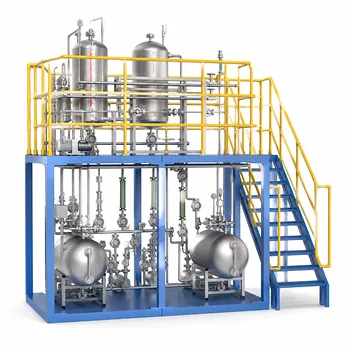
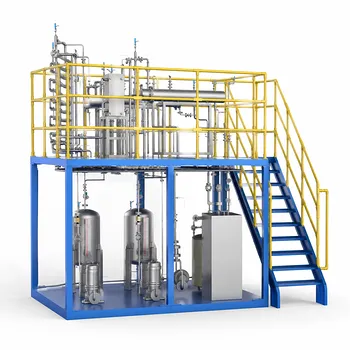
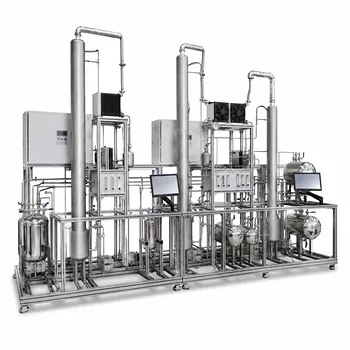
Ready to transition from retrospective testing to real-time process control? LABPARK designs and manufactures premium Educational and Vocational Unit Operations Pilot Plants tailored for universities, research institutes, and enterprises.
Whether your focus is chemical engineering, bioprocess & biotech, or environmental & water treatment, our pilot plants are engineered to integrate advanced process analytics, giving your students and researchers the hands-on experience needed for modern industrial scaling.
Contact our engineering experts today to find the perfect pilot plant solution for your institution.
Related Products
- Multi Pump Fluid Transport Process Piping Unit Operations Training Pilot Plant
- Multi-Functional Drying Educational Unit Operations Pilot Plant
- Natural Product Extraction Unit Operations Training Pilot Plant
- Dual-Mode Rectification Pilot Plant for Practical Training Unit Operations
- Fluid Transport and Piping Dynamics Practical Training Unit Operations Pilot Plant
People Also Ask
- Why distinguish Newtonian & non-Newtonian fluids in pilot plants? Prevent design errors.
- Why is the chemical plant startup schedule crucial? De-risk scale-up with pilot plants.
- When to transition from PID to adaptive control in pilot plants? Key process indicators.
- How do deviations in estimating latent heat impact pilot plant thermal systems? Avoid hardware mis-sizing.
- Why Use PTFE & Hastelloy in Chemical Pilot Plants? Prevent Corrosion & Ensure Safety