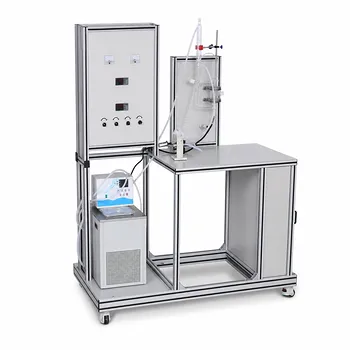
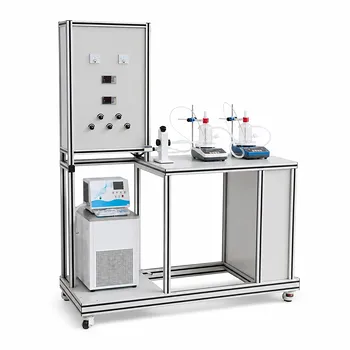
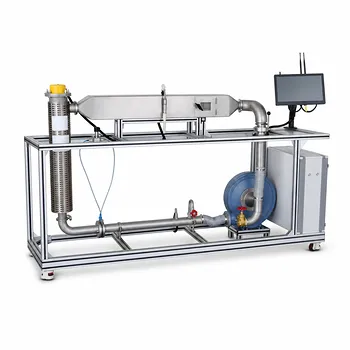
Indirectly determining vapor compositions allows you to compute what’s in the vapor phase mathematically—from just high-precision pressure and liquid composition data. This entirely removes the need to design, install, and troubleshoot a physical vapor sampling system, dramatically reducing the mechanical complexity, cost, and potential for experimental error in VLE laboratory setups.
The central simplification is thermodynamic, not mechanical: by using the binary coexistence equation or Barker’s method under the constraint of the Gibbs-Duhem equation, you transform a difficult direct measurement problem into a straightforward computation. This lets you build an apparatus focused on two highly accurate sensors—pressure and temperature—rather than complex sampling trains, saving time, money, and maintenance headaches without sacrificing data reliability.
The Traditional Challenge of Direct Measurement
Even a well-designed laboratory still struggles with one non-negotiable fact: pulling a physically representative vapor sample is hard. The mechanical complexity that creates isn’t just a nuisance—it becomes a source of systematic error and equipment fragility.
Why Vapor Sampling Is So Error-Prone
A vapor sample is highly sensitive to small gradients in temperature, pressure, and flow. Any cold spot in the sampling line causes partial condensation, shifting the composition of the remaining vapor.
This requires heated transfer lines, precise temperature control, and rapid quenching. Each piece of hardware introduces new joints, seals, and dead volumes—all potential leak points or sites of sample fractionation.
The Domino Effect on Equipment Design
Direct vapor composition measurement forces you to integrate an entire sampling subsystem: a sampling port, often a recirculating loop, a gas chromatograph or mass spectrometer, and calibration standards.
Each additional component multiplies the chances of failure and drives up both capital and labor costs. A VLE still designed this way is not just more expensive to build—it’s harder to validate and slower to operate because every sample must be analyzed and verified in real time.
How Indirect Determination Transforms Equipment Design
Indirect methods flip the problem on its head. They exploit a thermodynamic identity: for a low-pressure binary system, the total pressure and the liquid composition contain all the information needed to calculate vapor compositions if the mixture’s non-ideality can be modeled.
Eliminating Vapor Sampling Hardware Entirely
When you opt for an indirect approach, the vapor sampling port, heated transfer line, and online analyzer become optional. The apparatus can be designed as a simple equilibrium cell with only a pressure transducer, a thermocouple, and a liquid injection or sampling port.
That means fewer flanges, no delicate heated zones, and a dramatically simpler leak-free construction. For educational training, this simplicity is a huge advantage—students spend time on thermodynamic principles, not troubleshooting hardware.
Focusing Instrumentation on What’s Easy to Measure
Pressure and liquid composition can be measured with exceptional accuracy using off-the-shelf components. Modern pressure transducers deliver high resolution with minimal drift, and liquid-phase composition can be determined by refractive index, density, or simple GC analysis of a single-phase sample.
No heroic efforts are needed to preserve a two-phase sample. You simply pull a clean liquid from the equilibrium cell, measure its composition, and the pressure value is already logged. The vapor composition is then deduced mathematically.
Leveraging the Gibbs-Duhem Constraint
Under low pressure, the Gibbs-Duhem equation ties the fugacities of the liquid and vapor phases together. Methods like Barker’s method use this relationship to regress activity coefficient model parameters solely from total pressure–liquid composition data.
Once the model is fit, the vapor mole fraction is computed—not measured. The entire process is thermodynamically consistent and avoids the random errors that come with physical sampling, such as splashing or incomplete vaporization in a sampler.
Understanding the Trade-offs
No method is a silver bullet. Indirect determination makes strong assumptions that you must respect, or you risk creating data that looks precise but is systematically wrong.
The Low-Pressure Assumption
The binary coexistence equation in its simplest form treats the vapor phase as an ideal gas and neglects the Poynting correction. This limits indirect methods to systems well below about 1 atmosphere where vapor-phase non-ideality is negligible.
If your application requires high-pressure VLE data, the approximation breaks down and direct vapor sampling—or more sophisticated equations of state—becomes necessary.
Model Dependence and Error Propagation
Indirect methods are only as good as the activity coefficient model you choose. A poor model fit, especially in highly non-ideal mixtures with azeotropes or strong molecular associations, will propagate errors into the calculated vapor composition.
You must critically evaluate the model residuals. If the model can’t reproduce the pressure–liquid composition curve within experimental uncertainty, the computed vapor compositions will contain systematic bias—exactly what you wanted to avoid.
Sensitivity to Liquid Composition Accuracy
Because the calculation uses the liquid composition as the primary input, any error there is amplified. Investing in a high-accuracy liquid composition analysis system becomes non-negotiable.
This is still a simplification: you’re improving one measurement channel rather than building and maintaining two difficult ones. But it’s a cost that must be accounted for.
Making the Right Choice for Your Goal
The decision between direct and indirect vapor composition determination hinges on your laboratory’s priorities and the chemical systems you study.
- If your primary focus is rapid, cost-effective educational or low-pressure screening: Choose an indirect method. You’ll get a robust, low-maintenance setup that yields reliable data without the complexity of a heated vapor train. The equipment design becomes a straightforward pressure–temperature loop, dramatically reducing training time.
- If your primary focus is high-pressure systems or mixtures with extreme non-ideality: Direct vapor sampling may still be required, but consider whether a static cell with an isothermal analytical method can reduce the sampling error. Indirect methods can still calibrate your process, but validation with a direct measurement is essential.
- If your goal is to bridge pilot-plant operation with thermodynamic precision: Use indirect VLE measurements to quickly generate consistent data that refines your distillation model. This avoids the conservative over-design that comes from less precise, historically sampled data—saving energy and capital in reboilers and condensers.
Ultimately, the power of indirect determination is that it shifts the equipment design philosophy from mechanical complexity to measurement fidelity, yielding a simpler, cheaper, and often more accurate VLE experiment.
Summary Table:
| Feature | Direct Measurement | Indirect Determination |
|---|---|---|
| Hardware Complexity | High (Requires heated transfer lines, loops, & GC/MS) | Low (Simple equilibrium cell, no vapor sampling loop) |
| Primary Measurements | Temperature, pressure, liquid & vapor phases | High-precision pressure and liquid composition |
| Common Error Sources | Partial condensation, sample fractionation, leak points | Model fit limits, liquid analysis inaccuracies |
| Cost & Maintenance | High capital cost, heavy validation workload | Lower cost, robust design, easier maintenance |
Optimize Your VLE and Unit Operations Laboratories with LABPARK
Building reliable, high-precision vapor-liquid equilibrium and chemical engineering setups doesn't have to be complex. LABPARK provides state-of-the-art Educational and Vocational Unit Operations Pilot Plants in chemical engineering, bioprocess & biotech, and environmental & water treatment for universities, research institutes, and enterprises.
Whether you need to simplify lab instrumentation, reduce experimental error, or scale up your process design, we offer robust, low-maintenance pilot solutions tailored to your academic and research goals.
Contact LABPARK today to discover how our pilot plants can enhance your laboratory's efficiency!
Related Products
- Binary System Vapor Liquid Equilibrium Data Determination Educational Unit Operations Pilot Plant
- Ternary Liquid-Liquid Equilibrium Educational Pilot Plant
- Comprehensive Liquid-Liquid Extraction Pilot Plant for Engineering Education
- Circulating Wind Tunnel Drying and Convective Heat Transfer Coefficient Determination Educational Pilot Plant
- Liquid-Liquid Mass Transfer Coefficient Determination Educational Pilot Plant
People Also Ask
- How can pilot plants assist in validating VLE models? Bridge theory and physical reality.
- Why Collect Isothermal vs. Isobaric VLE Data? Key Pilot Unit Advantages
- How Do Equations of State Predict VLE in Pilot Plants? Optimize Your Separation Design
- How do intermolecular forces and molecular kinetic energy govern gas liquefaction and vaporization? Explore VLE pilot plants
- For VLE Experiments: Fugacity vs. Activity Coefficient Method Selection Criteria