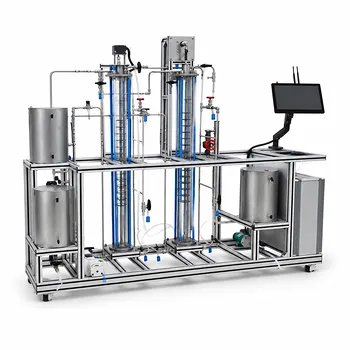
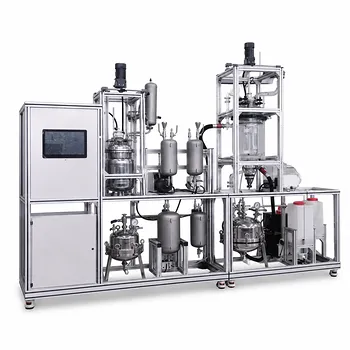
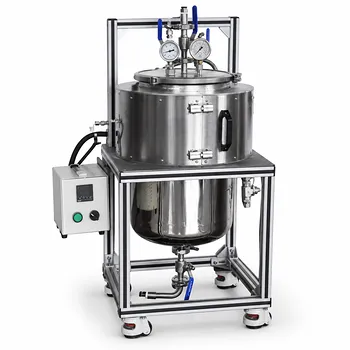
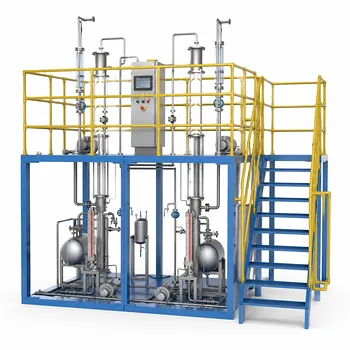
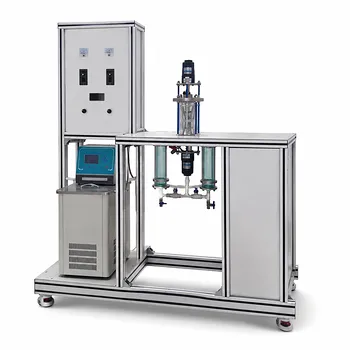
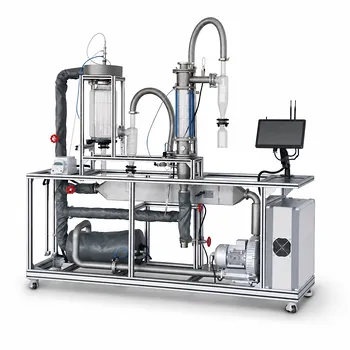
The extraction factor (Am) acts as the central design dial that balances your pilot plant's capital footprint against its operating costs. In a liquid-liquid extraction pilot plant, Am is defined as (Am = K \cdot (S / B)), where (K) is the distribution coefficient, (S) is the solvent mass flow rate, and (B) is the carrier mass flow rate. A higher Am reduces the number of theoretical stages needed to hit a target solute recovery, but it forces a larger solvent flow. That increase directly inflates downstream solvent recovery expenses, creating a trade-off every engineer must navigate during configuration.
The extraction factor forces you to confront a fundamental capital-vs.-operating choice: either invest in more equipment (stages) or accept higher ongoing utility and solvent recovery costs. Smart pilot plant design uses Am to find the specific point where the combined cost of stages and solvent recovery is minimized for a given separation duty.
What the Extraction Factor Actually Represents
The extraction factor is not just a number—it’s a dimensionless group that compares the slope of the equilibrium line to the slope of the operating line in an immiscible system.
For a system where the carrier and solvent are completely immiscible, the operating line on an X-Y diagram has a slope of (B/S). When (Am = K \cdot S/B) is greater than 1, the equilibrium line is steeper than the operating line, making the separation thermodynamically favorable with fewer stages.
How Am Governs the Number of Theoretical Stages
In countercurrent extraction, the number of theoretical stages depends directly on Am. A low Am forces the operating line close to the equilibrium curve, creating many small triangles on the McCabe-Thiele diagram and requiring a tall column or many mixer-settlers in series.
Conversely, a high Am pushes the operating line away from equilibrium, enabling the same solute recovery with dramatically fewer stages. This is why pilot plant experiments often deliberately vary the solvent-to-feed ratio to show students how Am shrinks the equipment size for a fixed separation.
The Direct Link to Solvent Consumption
Raising Am means increasing (S/B). If the carrier flow rate (B) is fixed, a larger Am translates directly to a larger solvent throughput (S). Total solvent consumption and the associated pump sizing, piping, and inventory all rise proportionally.
This has downstream consequences: a pilot plant designed with a high Am will spend more energy recovering that solvent from both extract and raffinate streams, usually through distillation. The cost of utilities (steam, cooling water) and solvent make-up becomes a dominant factor in operating budgets.
How Am Shapes Pilot Plant Configuration
Choosing Am is not an isolated calculation. It ripples through equipment selection, phase separation design, and the analytical toolkit you need on the skid.
Equipment Type and Staging Requirements
The required number of theoretical stages, directly influenced by Am, dictates hardware. A low-Am scenario demanding 10–15 stages often mandates a pulsed column, a rotating disc column, or a battery of mixer-settlers in series. A high-Am design that needs only 2–4 stages can be served by a compact, single mixer-settler or a short packed column.
Pilot plants often incorporate multiple contactor types so the effect of Am on stage count and equipment choice can be observed firsthand. The same separation, executed at different Am values, shifts the preferred equipment from a tall, floor-space-efficient column to a horizontal, stacked mixer-settler system.
Throughput, Settling, and Flooding Limits
A high Am raises the total liquid throughput through your equipment. For extraction columns, this pushes the hydraulic load closer to flooding conditions. If the solvent is too viscous or the density difference is small, the increased flow from a high Am can cause premature flooding or entrainment.
The pilot plant’s settler or phase separation zone must be sized to handle the combined organic and aqueous flows. When Am is large, the residence time available for droplet coalescence decreases, potentially leading to emulsion formation, especially in systems with interfacial tension outside the typical 1–47 × 10⁻³ N/m range.
The Downstream Penalty: Solvent Recovery Economics
Every molecule of solvent you push through to minimize stages must later be removed from the extract and raffinate streams. This is where Am’s influence extends well beyond the extraction skid itself.
Distillation Energy and Solvent Selection
Solvent recovery typically consumes the largest share of utility energy in the process. A high Am means more solvent to vaporize. To keep this penalty manageable, the solvent should have a low latent heat of vaporization and a high relative volatility to the solute and diluent.
Additionally, the solvent must not form azeotropes with feed components. If the solvent becomes the high-flow stream, it should ideally be the more volatile component to minimize the energy spent vaporizing it. Pilot plant configurations frequently evaluate these distillation loads in tandem with the extraction section to teach integrated process economics.
How Selectivity Lowers the Required Am
The selectivity coefficient (β) quantifies how preferentially the solvent dissolves the target solute over the diluent. A solvent with a very high β exhibits a large distribution coefficient for the solute, making (K) larger.
Because (Am = K \cdot S/B), a larger (K) allows you to achieve the same Am with a smaller (S/B). This decouples stage reduction from solvent consumption: you get the benefit of a lower stage count without the full operating cost penalty. In pilot plant design, screening solvents with high selectivity is the most effective way to shift the Am trade-off curve to a more favorable region.
Understanding the Pitfalls of Poor Am Selection
Ignoring the trade-offs embedded in Am leads to pilot plants that either can’t meet performance targets or are uneconomical to run.
Over-Driving the Solvent Ratio
If you choose an excessively high Am to squeeze the stage count down to one or two units, you risk emulsification due to high shear at elevated flow rates, solvent entrainment in the raffinate, and exaggerated solvent inventory costs. The solvent recovery column becomes the bottleneck, often requiring a larger reboiler and condenser than the extraction section itself.
Underestimating Miscibility Complexities
The simple definition of Am with constant (B) and (S) holds perfectly for completely immiscible systems. In partially miscible systems, phase flow rates change from stage to stage. Applying a constant Am without adjusting for changing carrier and solvent flows leads to miscalculated stage numbers and incorrect equipment sizing. Pilot plants must be able to switch between these modeling approaches, using ternary diagrams and lever-rule calculations when miscibility is significant.
Ignoring Physical Property Constraints
A high Am can’t compensate for poor phase separation kinetics. If the solvent’s viscosity is too high or the density difference too low, coalescence slows dramatically. Pilot facilities must then add larger settlers, coalescing internals, or even centrifugal contactors, which erodes the capital savings gained from reducing theoretical stages.
Making the Right Choice for Your Pilot Plant Goal
Your optimal extraction factor depends on what you are trying to achieve with the pilot unit—research insight, teaching trade-offs, or scale-up data.
- If your primary focus is minimizing capital equipment size: Increase Am to the upper limit that your phase system and equipment hydraulics can tolerate, while accepting higher solvent consumption. This is suitable when floor space is tightly constrained or when you need to demonstrate a concept with a compact skid.
- If your primary focus is minimizing operating costs: Select the lowest Am that still yields a manageable number of stages. Combine this with a high-selectivity solvent to keep the stage count reasonable without driving up solvent recovery energy.
- If your primary focus is generating scalable data: Run the pilot plant across a range of Am values to map the full trade-off curve. This allows you to identify the economic minimum where the combined annualized cost of stages and utilities reaches a low point for the full-scale design.
Ultimately, the extraction factor is your single most powerful lever for configuring a liquid-liquid extraction pilot plant. Treat it as a variable to be optimized, not a fixed input, and you will design a unit that teaches, validates, and scales with confidence.
Summary Table:
| Extraction Factor ($Am$) | Theoretical Stages (CapEx) | Solvent Flow & Recovery (OpEx) | Typical Equipment Choice |
|---|---|---|---|
| High ($Am > 1$) | Fewer stages (low column height) | Higher flow rates & energy costs | Compact columns, single mixer-settlers |
| Low ($Am < 1$) | More stages (tall columns/batteries) | Lower flow rates & utility costs | Pulsed/rotating disc columns, mixer-settler series |
Optimize Your Chemical Engineering Lab with LABPARK
Are you looking to configure an efficient liquid-liquid extraction process or upgrade your unit operations laboratory? LABPARK provides state-of-the-art Educational and Vocational Unit Operations Pilot Plants in chemical engineering, bioprocess & biotech, and environmental & water treatment. Designed specifically for universities, research institutes, and enterprises, our pilot plants deliver hands-on learning and precise scale-up data to bridge the gap between classroom theory and industrial practice.
Let our engineering experts help you select the ideal configuration for your research or curriculum needs. Contact LABPARK today to request a quote or consultation!
Related Products
- Comprehensive Liquid-Liquid Extraction Pilot Plant for Engineering Education
- Gallium and Indium Selective Extraction Educational Pilot Plant
- Continuous Sieve-Plate Distillation Pilot Plant for Unit Operations Laboratory Education
- Multi-Reactor Educational Pilot Plant for Reaction Engineering Unit Operations
- Multi-Modal Distillation Unit Operations Training Pilot Plant
People Also Ask
- How do pilot plants differentiate physical vs chemical extraction? Enhance Chemical Engineering Training
- How to Validate BIPs for LLE Pilot Plants? Steps to Align Simulations with Reality
- In a liquid-liquid extraction pilot plant, how is a ternary-phase diagram utilized to determine solvent feed requirements?
- How are ternary phase diagrams and LLE data applied in extraction experiments? Optimize Pilot Plant Scale-up
- How Do Selectivity & Distribution Coefficients Influence LLE Pilot Plant Solvent Choice?