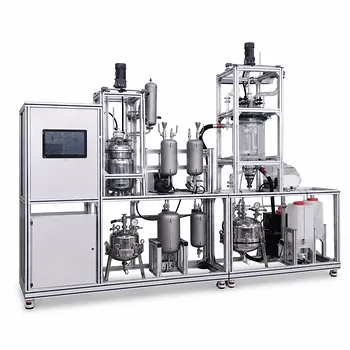
Molecular polarity is the hidden logic that turns a guess into a strategic choice. By teaching students to calculate and interpret molecular dipole moments, educators equip them with a direct, predictive link between a molecule’s structure and its behavior in a pilot-scale extraction column. The net dipole moment—a vector sum of individual bond polarities—instantly reveals whether a solvent will preferentially surround a target solute through strong dipole-dipole or hydrogen-bonding forces, or instead form a clean, immiscible phase boundary with the carrier liquid. This knowledge allows students to deliberately engineer the core of any liquid-liquid extraction: a two-phase system where the solute is selectively pulled across the interface with maximum driving force.
Dipole moment analysis is far more than an academic exercise; it is the fastest, most rational way to pre-screen solvents, anticipate phase behavior, and avoid the costly trial-and-error that can stall a pilot plant. When students master this concept, they stop seeing a list of solvents and start seeing a map of intermolecular forces—allowing them to design separation processes from first principles rather than from recipes.
From Molecular Asymmetry to Macroscopic Separation
The Dipole Moment as a Quantifier of Polarity
A molecule’s net dipole moment is a single number that captures the symmetry of its electron cloud. Symmetrical molecules like carbon dioxide ($\ce{CO2}$) or carbon tetrachloride ($\ce{CCl4}$) have bond dipoles that perfectly cancel, yielding a net moment of zero. Asymmetrical molecules like water ($\ce{H2O}$), with its bent geometry, cannot cancel out—giving it a large permanent dipole.
This is the fundamental screening tool. Before any lab work, a student can look at a molecule’s geometry and instantly classify it as nonpolar (net µ = 0) or polar (net µ > 0). That classification alone predicts the type of intermolecular forces the solvent will use to interact with the feed and the solute.
How Polarity Governs Intermolecular Forces
Net polarity directly dictates the dominant intermolecular force. Nonpolar solvents like carbon tetrachloride interact primarily through weak, transient London dispersion forces. Polar solvents, especially those with hydroxyl ($\ce{-OH}$) or carbonyl ($\ce{>C=O}$) groups, engage in stronger, directional forces: permanent dipole-dipole interactions and, critically, hydrogen bonding.
These forces define solubility. A polar solute, rich in hydrogen-bond donors or acceptors, will be tightly solvated by a polar solvent shell. A nonpolar solute will feel no energetic benefit from a polar environment and will instead prefer a nonpolar solvent that maximizes dispersion contacts. This is the thermodynamic foundation of extraction selectivity.
Applying “Like Dissolves Like” to Create Two Liquid Phases
The rule “like dissolves like” is the student’s engineering lever. To run an extraction, you must select a solvent that is just polar enough to dissolve the target solute yet sufficiently different in polarity from the carrier (often water) to remain immiscible. For example, nonpolar iodine ($\ce{I_2}$) partitions overwhelmingly into a nonpolar solvent like carbon tetrachloride, leaving the polar water phase behind.
In a pilot plant, this principle creates a sharp, stable phase boundary in the column. That boundary is not an accident—it is the direct consequence of the molecular-level mismatch in cohesive energy densities between the two liquids. Students who trace that boundary back to the dipole moment understand exactly why the column is working.
Translating Theory into Pilot Plant Practice
Screening Solvents with Polarity Indices and Hydrogen Bonding
In an educational pilot plant, students move beyond binary polar/nonpolar labels and use polarity indices as quantitative guides. Water (index ~10) is the extreme polar case, using an extensive hydrogen-bonding network to extract highly hydrophilic compounds. Alcohols like methanol, ethanol, and isopropanol share a polarity index around 5.1, making them water-miscible and ideal for biological or polar-nucleic-acid extractions.
Hydrogen bonding capacity becomes a super-screening parameter. A carbonyl-containing solvent like acetone (polarity index 5.1) has no labile hydrogen but a strong acceptor oxygen, giving it a unique versatility to dissolve both polar and nonpolar species. Students learn to complement the single dipole moment with these functional-group indicators to refine their first-pass solvent choices.
Using Molecular Descriptors for Computational Solvent Selection
Modern pilot plant training increasingly connects the workbench to the computer. Using the σ-profile—a surface screening charge density distribution—students can calculate the electrostatic “misfit” energy and hydrogen-bonding energy between a solute and candidate solvent molecules. This computational step allows them to rank solvents before a single milliliter is poured, translating the abstract dipole moment into concrete predictions of extraction efficiency.
This molecular approach reinforces the core message: the dipole moment is the starting point, but the full picture of polarity requires understanding how charge is distributed across a solvent’s entire van der Waals surface. In a teaching column, students can then run the top-ranked solvents and see the computational prediction match the measured mass transfer coefficients.
Beyond Polarity: Additional Criteria for Industrial Solvents
While polarity governs the thermodynamic limit, a successful pilot plant extraction demands more. Students must also evaluate physical and safety properties that the dipole moment alone cannot predict: density and viscosity for rapid phase disengagement, chemical stability to protect equipment from corrosion, and low solubility in the carrier phase to prevent solvent loss. A solvent that is perfect on a polarity scale can fail completely if it forms a stable emulsion or poses an unacceptable flammability risk.
This is where the pilot plant becomes an irreplaceable teacher. Running the extraction with different solvents allows students to quantitatively compare how solvent choice impacts overall mass transfer, phase separation time, and ease of solvent recovery—criteria that no textbook polarity table can fully capture.
Understanding the Limitations and Trade-offs of Polarity-Based Selection
When “Like Dissolves Like” Is Not Enough
The “like dissolves like” heuristic can lead students astray in multi-component feeds or when strong specific interactions, like complexation, dominate. A solvent with the “right” bulk polarity might still fail to selectively extract the target if it preferentially solvates a co-solute or if the activity coefficients deviate strongly from ideal dilution. Students must verify phase diagrams and distribution coefficients experimentally, treating polarity as a hypothesis rather than a guarantee.
The Danger of Oversimplifying with a Single Number
Relying solely on the dipole moment or a tabulated polarity index ignores molecular shape and stereo-electronic effects. Two solvents with identical dipole moments can exhibit vastly different selectivities if one can penetrate the solute’s solvation shell more effectively. For example, branched vs. linear alcohols of similar polarity show different extraction capacities due to steric hindrance. The pilot plant quickly reveals these nuances when students compare performance.
Balancing Extraction Efficiency with Economic and Safety Goals
An ideal extraction solvent from a polarity standpoint might be hazardous, expensive, or energy-intensive to recover. Students face the real-world trade-off: a chlorinated solvent may offer superb selectivity but pose toxicity and waste disposal challenges, while a greener alternative might require a longer column or higher solvent-to-feed ratio. Learning to make this balance—where molecular understanding informs but does not dictate the final decision—is a critical outcome of pilot plant education.
How to Apply This in Your Pilot Plant Projects
Use the following goal-focused strategies to turn dipole moment and polarity knowledge into actionable solvent selection for your unit operations lab.
- If your primary focus is maximizing selectivity for a polar solute: Start with water-miscible, hydrogen-bonding solvents like ethanol or isopropanol, then verify that the carrier phase remains sufficiently immiscible to form a distinct interface.
- If your primary focus is achieving fast, clean phase separation: Favor solvents with a density difference of at least 0.1 g/mL from the carrier and moderate viscosity; use polarity as a secondary filter only after satisfying these physical requirements.
- If your primary focus is safety and ease of recovery: Prioritize low-toxicity, low-boiling solvents such as ethyl acetate or acetone, and confirm that their polarity still provides an acceptable distribution coefficient for your solute.
- If your primary focus is computational pre-screening: Generate σ-profiles for your solute and candidate solvents to quantify electrostatic misfit and hydrogen-bonding energies, then validate the top candidates in the pilot column to calibrate your models.
When you can read a molecule’s geometry and instantly see the phase behavior it will create, you have moved from operating a pilot plant to truly engineering it.
Summary Table:
| Solvent Type | Dominant Force | Extraction Application | Key Consideration |
|---|---|---|---|
| Nonpolar | London Dispersion | Extracting nonpolar solutes | Phase boundary stability |
| Polar Aprotic | Dipole-Dipole | Dissolving both polar & nonpolar species | Safety & solvent recovery |
| Polar Protic | Hydrogen Bonding | Hydrophilic & biomolecule extraction | Water miscibility & density |
Bridge the gap between thermodynamic theory and hands-on engineering. LABPARK provides high-quality Educational and Vocational Unit Operations Pilot Plants in chemical engineering, bioprocess & biotech, and environmental & water treatment for universities, research institutes, and enterprises. Empower your students to master liquid-liquid extraction and process design—contact us today to discover our custom lab solutions!
Related Products
- Comprehensive Liquid-Liquid Extraction Pilot Plant for Engineering Education
- Gallium and Indium Selective Extraction Educational Pilot Plant
- Continuous Sieve-Plate Distillation Pilot Plant for Unit Operations Laboratory Education
- Multi-Reactor Educational Pilot Plant for Reaction Engineering Unit Operations
- Multi-Modal Distillation Unit Operations Training Pilot Plant
People Also Ask
- How do pilot plants differentiate physical vs chemical extraction? Enhance Chemical Engineering Training
- How to Estimate KD for Liquid-Liquid Extraction Pilot Plants Using Henry's Law when Lab Data is Limited
- Why is the plait point a critical limit in liquid-liquid extraction pilot plants? Safe LLE Operation
- How are ternary phase diagrams and LLE data applied in extraction experiments? Optimize Pilot Plant Scale-up
- How to Validate BIPs for LLE Pilot Plants? Steps to Align Simulations with Reality