The Damköhler number is the linchpin that determines whether a reactive distillation pilot plant simply distills a mixture or fundamentally overcomes its thermodynamic limits. In design, it dictates the size of the reactive holdup and catalyst loading. In dynamic simulation, it quantifies the critical balance between chemical kinetics and vapor-liquid mass transfer—allowing the still path to cross distillation boundaries that would trap a non-reactive column. Without a properly tuned Da, your pilot plant becomes an expensive mixer, not a reactor-separator.
Designing or simulating reactive distillation without mastering the Damköhler number is like navigating a maze blindfolded. It measures whether your reaction can outpace product removal. A sufficiently high Da shifts the reactive zone into a regime where continuous stripping drives equilibrium, unlocking high-purity products that no ordinary distillation could achieve.
Understanding the Damköhler Number in Reactive Distillation
The Damköhler number is not a fixed universal parameter—it morphs based on the process you analyze. In reactive distillation pilot plants, its meaning is specific and operational.
The Reactive Still Pot as a Kinetic Reactor
At its core, the batch reactive distillation column is a reaction- separation hybrid. The still pot (or reactive drum) is where liquid-phase reaction and vapor stripping coexist.
The Damköhler number here represents the reaction holdup relative to the convective transport accomplished by vapor removal. It is the ratio of two competing forces: how fast you produce the desired component via chemistry versus how fast you remove the most volatile species via phase equilibrium.
Defining Da for Batch Distillation
In this context, Da is most usefully expressed as the ratio of the characteristic reaction rate to the convective mass transport rate. For a reactive still pot:
Da ~ (reaction rate) / (stripping rate)
A high Da means the reaction occurs quickly compared to the rate at which boil-up removes material. A low Da means distillation outpaces the chemistry, leaving the mixture unconverted.
How Da Enables Distillation Boundary Crossing
This is where the Damköhler number stops being just a nice dimensionless checkpoint and becomes a design imperative.
The Path in Composition Space
In a conventional batch distillation, the liquid composition trajectory is shackled by simple distillation and residue curve boundaries. In a reactive batch distillation, however, the still path can deviate dramatically.
A sufficiently high Da shifts the system into the forward reaction region. The reaction alters the liquid composition as it boils, effectively bending the still path so that it penetrates and crosses azeotropes or distillation boundaries that are insurmountable for non-reactive columns.
Continuous Product Removal as a Driving Force
The mechanism is elegant: continuous removal of a product (often the light-boiling component) via the column shifts the reaction equilibrium. But this only works if the reaction is fast enough to keep up.
The Da quantifies that requirement. If Da is high, the reaction easily replenishes the product being removed, and the still pot composition evolves to complete conversion. If Da is too low, the distillation simply removes the reactant itself before it can react, and you never cross the boundary.
Impact on Dynamic Simulation
Building a trustworthy dynamic simulation of your pilot plant hinges on getting the Damköhler number right.
Da in Material Balance Equations
In differential models for batch rectifiers, strippers, or middle vessel columns, Da appears as the multiplier on the reactive terms in the mole balance. The equation structure is:
(Accumulation) = - (Stripping out) + (Reaction in)
The relative magnitude of the reaction term—scaled by Da—determines whether the simulation predicts boundary crossing. If your simulation's Da is unrealistically low, the model will erroneously show the composition stalling at the boundary. If it's too high, the model may predict an unstable, unrealistically fast reaction path.
Predicting Feasible Operating Regions
By sweeping Da in simulation, you map the feasible region of your process. You can identify the minimum holdup (or catalyst amount) needed for the still path to escape the distillation region. This directly informs pilot plant design: what is the smallest reactive volume that still guarantees high-purity product under varying boil-up rates.
Designing the Pilot Plant with Da in Mind
The Damköhler number translates seamlessly from a simulation knob to a hardware specification.
Sizing the Reactive Holdup
Because Da scales with the liquid holdup in the still pot (or catalyst mass in a fixed-bed column), you can compute the minimum reactive inventory. For a given reaction kinetic constant and target distillate flow rate, this yields a concrete vessel size.
In educational pilot plants, this becomes a teachable scale-up exercise: students vary the still charge volume while holding everything else constant to experimentally verify the Da threshold for boundary crossing.
Selecting Catalyst and Operating Point
Da also guides your choice of catalyst loading and operating temperature. A reaction with slow intrinsic kinetics can still achieve a high Da if you provide sufficient holdup and elevate pressure or temperature within safe limits.
This allows you to back-calculate the combination of feed concentration, flow rate, and catalyst inventory needed to maintain the process in the reaction-dominant regime, rather than the transport-limited regime.
Understanding the Trade-offs
A Damköhler number that is “just right” is powerful, but pushing it to extremes invites a new set of problems.
The Cost of an Overly High Da
An overly large reactive holdup means a bigger, heavier column or a massive still pot with long liquid residence time. This increases capital cost and pressure drop. In a pilot plant, it could also lead to unnecessary thermal degradation of heat-sensitive products, as the liquid remains at boiling temperature for far longer than required.
Sensitivity to Disturbances
In the high-Da regime, the process becomes extremely sensitive to small perturbations. A slight drop in catalyst activity or a momentary increase in distillate withdrawal rate can suddenly pull the composition path back toward a boundary, causing the purity to collapse. A robust design often seeks a Da just slightly above the critical value, not an order of magnitude higher.
Heat Management Complications
Fast reaction in a large liquid holdup might release significant heat exothermically. In a distillation column, this can destabilize vapor-liquid equilibrium, cause flooding, or create hot spots that compromise selectivity. The Da must be weighed alongside the dimensionless heat transfer coefficient to avoid runaway.
Making the Right Choice for Your Pilot Plant Goals
When designing or simulating your reactive distillation pilot plant, align your Damköhler number target with your primary objective.
- If your primary focus is demonstrating distillation boundary crossing in a teaching lab: Size the reactive holdup so Da is approximately 2–5. This guarantees a clear, reproducible composition shift without excessive sensitivity or waste.
- If your primary focus is maximizing reactant conversion at minimum column size: Identify the critical Da from dynamic simulation and add a 20–30% safety margin. This balances performance against capital investment and pressure drop.
- If your primary focus is simulating the real-world scale-up process: Use Da as the scaling invariant. Match the Da from the pilot plant in the commercial design by adjusting residence time and catalyst density, rather than blindly scaling geometry.
- if your primary focus is exploring reaction kinetics under distillation conditions: Run the pilot plant at several carefully chosen Da values by intentionally varying the boil-up rate. The resulting composition profiles will reveal the true rate-limiting step.
The Damköhler number is far more than a dimensionless group—it is the master switch that converts a simple distillation experiment into a unified reaction-separation process capable of defying phase equilibrium limits.
Summary Table:
| Da Regime | Design & Holdup Impact | Simulation Behavior | Operational Risk |
|---|---|---|---|
| Low Da | Distillation outpaces reaction; incomplete conversion | Fails to predict boundary crossing | Reactant escapes unconverted |
| Optimal Da (2–5) | Balanced holdup & kinetics; crosses distillation boundaries | Stable, accurate path prediction | Requires precise flow control |
| High Da | Excessively large holdup; high capital & pressure drop | May predict unstable, rapid reaction path | Thermal degradation & heat runaway |
Scale Up Your Research with LABPARK
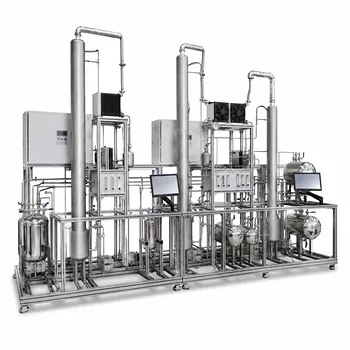
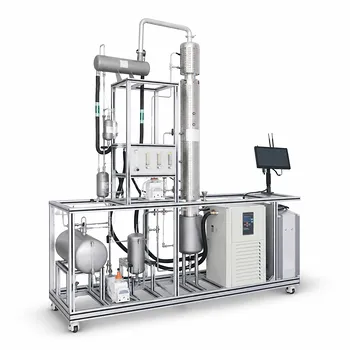
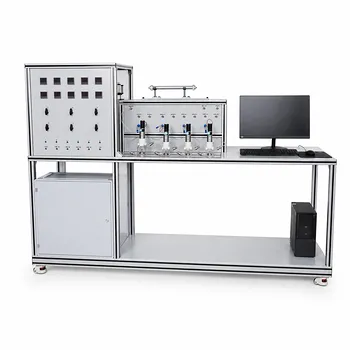
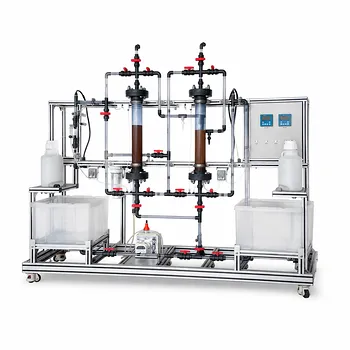
Ready to bring advanced chemical kinetics and separation processes to life? LABPARK designs and manufactures premium Educational and Vocational Unit Operations Pilot Plants in chemical engineering, bioprocess & biotech, and environmental & water treatment. Perfect for universities, research institutes, and enterprises, our systems are engineered to help you master complex parameters like the Damköhler number through hands-on learning and precise process scale-up.
Boost your research capabilities and student engagement—contact us today to discuss your custom pilot plant configuration.
Related Products
- Multi-Functional Special Distillation Educational Pilot Plant
- Continuous Batch Extractive Distillation Educational Pilot Plant
- Electrolyte Distillation Purification and Formulation Educational Pilot Plant
- Green Anhydrous Ethanol Refining Practical Training Pilot Plant
- Green Anhydrous Ethanol Purification Extractive Distillation Unit Operations Training Pilot Plant
People Also Ask
- Why does simple distillation yield higher efficiency than flash distillation? Key thermodynamic differences.
- How to Verify Distillation Boundary Lines & Composition Regions with Pilot Plants
- How Batch vs Continuous Configuration Affects Distillation Pilot Plant Versatility & Footprint
- How does double temperature difference control improve distillation pilot plants? Stabilize purity.
- How to Estimate Distillation Pilot Plant Tray Efficiency? O'Connell's Correlation Guide