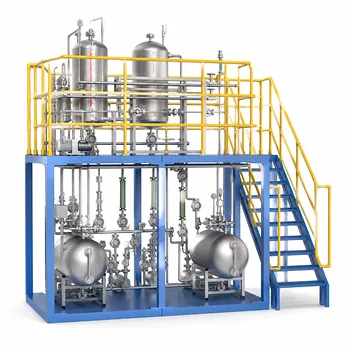
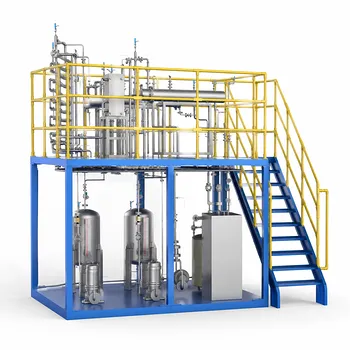
Process fingerprinting transforms training by turning an abstract series of sensor readings into a single, intuitive map of a process’s health. Instead of monitoring isolated variables like temperature or pressure one by one, trainees learn to read the entire “personality” of a batch or reaction in real time. In a unit operations pilot plant, this accelerates the leap from textbook theory to true operational fluency, all while reinforcing critical safety awareness.
Core Takeaway: Process fingerprinting in pilot plants bridges the gap between simple data logging and genuine process understanding. By visualizing the holistic trajectory of a process, it builds the intuition required to anticipate failures and manage complex industrial operations safely—without getting lost in a sea of individual measurements.
Moving Beyond One-Dimensional Monitoring
Traditional training often focuses on keeping single parameters within alarm limits. Process fingerprinting rewires a trainee’s brain to see the bigger picture, which is exactly how real chemical and physical changes behave.
The Limits of Traditional Component Tracking
Monitoring individual components teaches a fragmented view of a process. A tank’s temperature can be perfect while a mixing dead zone creates a critical quality failure. This disconnect leaves trainees unprepared for the interconnected nature of real plant operations.
Embracing the Whole Sample Matrix
Process fingerprinting uses multivariate tools, such as Near-Infrared (NIR) diffuse reflectance spectra, to capture the physical and chemical state of a sample matrix simultaneously. Trainees learn not just if a compound is present, but how particle size, moisture, and chemical identity are evolving together. This removes the impossible task of isolating every variable and replaces it with a reliable, composite health check.
Building an Intuitive Grasp of Process Dynamics
The real power for learning lies in the ability to see motion and direction. Process fingerprinting turns static data into a dynamic trajectory, which is critical for deep, intuitive training.
Visualizing the Process Trajectory in Real Time
Students no longer wait for a single test result to declare an endpoint. They watch a process fingerprint move along a defined path toward a completion zone. This immediate visual feedback—seeing a blending operation converge or a reaction stabilize—cements the concept of process time and kinetic behavior far more effectively than a spreadsheet ever could.
Detecting Abnormal Conditions Without Predefined Limits
One of the hardest things to teach is the detection of “unknown unknowns.” A process fingerprint acts as a pattern-recognition tool. Even if every individual sensor is within its safety range, a multivariate fingerprint can flag that the overall sample matrix is abnormal, teaching trainees to investigate subtle process drifts before they trigger an alarm.
Bridging the Gap Between Training and Industrial Reality
A pilot plant is a safe sandbox, and process fingerprinting makes that sandbox remarkably realistic. It connects controlled training with the high-consequence decision-making needed in production.
Safe Practice for High-Stakes Environments
Vocational pilot plants already provide a controlled platform to learn pressure management, temperature limits, and fluid handling. Integrating process fingerprinting adds a layer of advanced process control mastery without physical risk. Trainees can safely trigger and correct abnormal conditions, seeing immediately how their corrective actions steer the fingerprint back to normal.
From Reactive to Predictive Control Mindset
Rote procedure-following teaches operators to react. Process fingerprinting teaches prediction. By identifying the exact trajectory endpoint for a reaction or blend, students shift from merely watching the clock to actively managing the chemistry and physics, preparing them for modern, efficiency-driven facilities.
Understanding the Trade-offs
While powerful, process fingerprinting is not a magic wand. For effective training, you must address the accompanying challenges to avoid building a false sense of security.
- Instrument Complexity: Trainees can become intimidated by or overly reliant on a “black box.” Without understanding the spectroscopy basics, they might trust a fingerprint blindly rather than developing a critical engineering eye.
- Calibration Demands: A robust fingerprint model requires significant upfront work. If the training program spends all its time wrestling with bad data models, the educational value on process monitoring itself gets lost.
- Not a Replacement for Fundamentals: Seeing a fingerprint deviate does not teach why it deviated. Training must explicitly link the fingerprint pattern back to physical phenomena like poor mixing, side reactions, or sensor fouling, ensuring conceptual depth isn’t sacrificed for a pretty picture.
Making the Right Choice for Your Training Goal
Integrate process fingerprinting deliberately based on what you need your operators to master. A plug-and-play pilot plant sensor can either dazzle or educate; the intent makes the difference.
- If your primary focus is developing intuitive operator instinct: Center your drills around trajectory visualization, where discussions revolve around “why the fingerprint is moving” rather than just hitting a number.
- If your primary focus is teaching early deviation detection: Use fingerprinting in failure-mode simulations, deliberately introducing contamination or stalled mixing so that trainees can see a multivariate drift long before a discrete alarm fires.
- If your primary focus is reinforcing safety through situational awareness: Connect the fingerprint’s holistic view directly to safety consequences, showing how abnormal physical states like unexpected solid formation can predict high-risk equipment failure.
Empowering a trainee to see the entire personality of a process, not just its vital signs, is the most direct path to building the confident, intuitive, and safe operator that industry needs.
Summary Table:
| Feature | Traditional Monitoring | Process Fingerprinting |
|---|---|---|
| Focus | Isolated variables (temp, pressure) | Holistic process trajectory |
| Data View | One-dimensional / alarm limits | Multi-dimensional state matrix |
| Operator Mindset | Reactive (responding to alarms) | Predictive (anticipating drifts) |
| Training Risk | High cognitive load | Intuitive pattern recognition |
Elevate Your Process Training with LABPARK
Are you looking to bridge the gap between theory and industrial reality? LABPARK provides state-of-the-art Educational and Vocational Unit Operations Pilot Plants in chemical engineering, bioprocess & biotech, and environmental & water treatment. We help universities, research institutes, and enterprises train the next generation of intuitive and safe operators with advanced process monitoring capabilities.
Contact LABPARK today to discover how our pilot plants can transform your training programs!
Related Products
- Multi Pump Fluid Transport Process Piping Unit Operations Training Pilot Plant
- Multimodal Absorption and Desorption Pilot Plant for Unit Operations Training
- Three-Tube Heat Transfer Educational Pilot Plant for Unit Operations Training
- Natural Product Extraction Unit Operations Training Pilot Plant
- Dual Mode Heat Transfer Pilot Plant for Unit Operations Training
People Also Ask
- Why distinguish Newtonian & non-Newtonian fluids in pilot plants? Prevent design errors.
- Why is the chemical plant startup schedule crucial? De-risk scale-up with pilot plants.
- When to transition from PID to adaptive control in pilot plants? Key process indicators.
- How do deviations in estimating latent heat impact pilot plant thermal systems? Avoid hardware mis-sizing.
- Why Use PTFE & Hastelloy in Chemical Pilot Plants? Prevent Corrosion & Ensure Safety