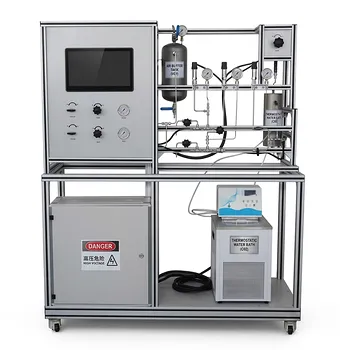
Bond enthalpy is the fundamental predictor of thermal stability in your gas-phase reactor. It directly tells you the energy required to break the chemical bonds in your reactants. This number is not just a theoretical value; it’s the key to setting your operational temperature thresholds, estimating reaction initiation points, and designing the safety systems that prevent catastrophic runaway reactions.
While bond enthalpy provides a crucial first-principles guideline for safe operating windows, relying on it blindly is dangerous. Its primary role is to flag thermal hazards—like the violent decomposition of a weak bond versus the stability of a strong one. However, true operational safety comes from validating these initial estimates with real-world thermodynamic data and rigorous heat balance calculations for your specific process conditions.
Using Bond Enthalpy to Predict Thermal Stability
The core value of bond enthalpy in a pilot plant setting is its ability to rank the thermal stability of your chemical species. It provides a direct, quantitative basis for initial hazard assessment.
The Direct Link Between Bond Strength and Decomposition
A higher bond enthalpy value means a stronger bond. Stronger bonds require more energy—and thus, higher temperatures—to break. This dictates whether a molecule will be a stable feedstock or a potential explosive hazard in your reactor.
For example, consider the dramatic difference between hydrogen fluoride (HF) and fluorine gas (F2). The H-F bond enthalpy is a robust 570 kJ/mol, making it stable even at extreme temperatures around 5000°C. The F-F bond enthalpy is a weak 159 kJ/mol, causing significant decomposition at just 1000°C. This comparison is a powerful teaching tool for understanding inherent material limits.
Defining Initial Safe Operating Windows
Knowing the bond enthalpy of your reactant’s weakest link allows you to estimate an initial "do not exceed" temperature. This isn't your operating set point; it's your first safety boundary.
If your process involves a molecule with a weak bond, you know it is thermally sensitive. Your pilot plant's heating systems and control logic must be designed with this hard limit in mind from the very start. Exceeding this threshold means you are no longer running a controlled reaction—you are initiating wholesale, uncontrolled decomposition.
Guiding Reaction Pathway Selectivity
In complex molecules, the bond with the lowest enthalpy is statistically the most likely to break first. This guides your process design for pyrolysis or cracking experiments.
For instance, if you want to crack a hydrocarbon at a specific location, you must supply enough thermal energy to overcome that specific bond's enthalpy, while ideally staying below the bond enthalpies of other parts of the molecule. This selectivity is the science behind setting critical process parameters like reactor temperature and residence time.
The Critical Limitations of a Theory-First Approach
This is where your expertise as an engineer separates you from a student. Using bond enthalpy as your sole design input is a liability. You must understand and account for its fundamental shortcomings.
The Phase State Assumption
Bond enthalpy calculations are strictly valid only for reactants and products in the gaseous state. This is a non-negotiable limitation.
If any component in your pilot plant reaction is a liquid or solid at the point of calculation—such as liquid water or solid carbon—using standard bond enthalpies will give you a dramatically incorrect estimate. You must integrate phase transition energies, like the heat of vaporization, to correct the calculation. Ignoring this in a pilot-scale heat balance can lead to a massive undersizing of your thermal control system.
Averaged vs. Actual Energy Values
A bond enthalpy is an average value, derived from measuring the same bond in hundreds of different compounds. It is not a precise, experimentally measured value for your specific C-H bond in your specific reactant.
This means your initial temperature estimate is an approximation, not an engineering specification. Relying on it for detailed reactor design is a mistake. For rigorous design and safety calculations, you must transition to using standard enthalpies of formation, which provide exact experimental data for a specific compound’s formation.
Correcting for Non-Standard Conditions
The standard reaction enthalpy (ΔH) is calculated at 25°C and 1 atm. Your pilot plant almost certainly does not operate there. Reaction enthalpy changes with temperature and pressure.
To design your heating or cooling duties accurately, you must calculate the sensible heat required to bring reactants to reaction temperature and the latent heat for any phase changes. Using uncorrected standard data will result in an incorrectly sized furnace, quench system, or heat exchanger, creating an immediate operational failure and a potential safety hazard.
From Molecular Theory to Pilot Plant Safety Protocols
Understanding these principles is what allows you to translate a bond enthalpy value into a concrete, engineered safeguard. Your safety protocols are a physical manifestation of this chemical stability limit.
Designing Pressure Relief Systems
The most immediate consequence of uncontrolled decomposition is a violent, rapid pressure surge. Your bond enthalpy analysis tells you at what temperature this becomes likely.
Your pressure relief system—rupture disks and relief valves—must be sized not just for the normal reaction but for this worst-case decomposition scenario. The set point of these safety devices is a direct operational translation of a bond stability limit.
Setting Hard Limits on Heating Systems
A responsible pilot plant design embeds the thermal stability limit directly into the control system hardware and software. This is a layered defense.
- Interlocks: Hard-wired systems automatically cut off heating power when a critical temperature sensor—placed in the reaction zone—approaches the pre-calculated limit.
- Controller Tuning: The heating ramp rate and PID controller tuning must be aggressive enough to maintain the process set point but gentle enough to never overshoot into the danger zone, especially for reactants with very weak bonds.
Establishing Emergency Shutdown Protocols
When a runaway begins, the first action is often to stop the energy input. For an endothermic cracking reaction that is going out of control, this means a rapid quench.
Knowing the bond enthalpy helps you calculate the "quenching power" needed to drop the temperature below the bond-breaking threshold in milliseconds. Your emergency shutdown logic must be programmed with this understanding to stop energy input, inject a cold inert fluid, or rapidly depressurize the system before a catastrophic failure occurs.
Making the Right Choice for Your Pilot Plant
The ultimate goal is to synthesize theory and practice into a robust operational and safety framework. Your approach should be dictated by your primary objective.
- If your primary focus is initial hazard screening and selecting an experimental pathway: Use bond enthalpy as your guide. Compare the weakest bonds in your candidate reactants to quickly rank thermal stability and predict the most likely decomposition routes. This is a fast, powerful filtering tool.
- If your primary focus is the detailed engineering design of a reactor and its safety systems: Abandon bond enthalpies as a final design input. Your calculations for vessel thickness, relief valve capacity, and heat exchanger duty must be based on experimental standard enthalpies of formation, rigorously corrected for your actual operating temperature and pressure.
- If your primary focus is teaching the fundamental "why" of a safety limit: Use the bond enthalpy concept as your primary narrative. The visual comparison between a weak bond (low temperature failure) and a strong bond (high temperature stability) connects a core chemical principle directly to the tangible language of operational risk.
A deep respect for the chemical bond is the foundational layer of safety in any high-temperature operation. Your role is to interpret that molecular-scale energy into the macro-scale safeguards that protect your team and your equipment.
Summary Table:
| Application / Limit | Description | Safety & Design Action |
|---|---|---|
| Predicting Stability | Identifies the weakest bonds to estimate initial thermal limits. | Defines maximum operating temperatures. |
| Process Selectivity | Guides temperature settings to target specific bond cleavage. | Determines reactor set points & residence time. |
| Safety Systems | Sets baseline for worst-case thermal runaway scenarios. | Determines relief valve sizing & quench rates. |
| Design Limitations | Average values and gas-phase assumptions introduce errors. | Require correction using enthalpies of formation. |
Optimize Your Pilot Plant Operations with LABPARK
Designing safe and efficient high-temperature reaction systems requires a seamless transition from molecular theory to practical engineering.
LABPARK provides state-of-the-art Educational and Vocational Unit Operations Pilot Plants in chemical engineering, bioprocess & biotech, and environmental & water treatment for universities, research institutes, and enterprises. Our systems are engineered with advanced safety interlocks, precise control systems, and robust relief mechanisms to ensure safe hands-on learning and research.
Ready to elevate your lab's safety and research capabilities? Contact LABPARK today to find the perfect pilot plant solution for your institution!
Related Products
- Gas Phase Mixing and Residence Time Distribution Determination Educational Unit Operations Pilot Plant
- Fixed-Bed Chemical Reaction and Gas Dust Tar Removal Unit Operations Pilot Plant
- Fixed Bed Gas Solid Catalytic Reaction Educational Pilot Plant
- Fluidized Bed Gas Solid Catalytic Reaction Educational Pilot Plant
- Carbon Dioxide Hydrogen Methanol Synthesis Educational Unit Operations Pilot Plant
People Also Ask
- How do gas-phase pilot plants demonstrate limiting reactants, reaction extent, and yield? Measure stoichiometry in action
- Why do gas-flow unit operations pilot plants require an expansion factor? Achieve Precise Flow Calculations
- How does the molar mass of a gas influence its diffusion rate? Optimize Pilot Plant Design
- Why can volumetric percentage be directly equated to mole percentage in gas-phase pilot plant unit operations? A Practical Guide
- Why Open vs. Closed Boundaries Matter in RTD Pilot Plant Experiments