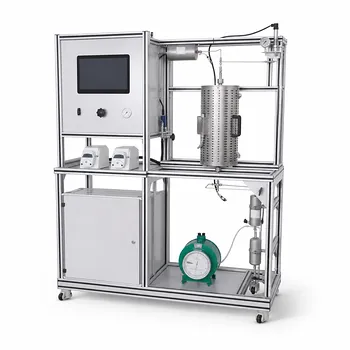
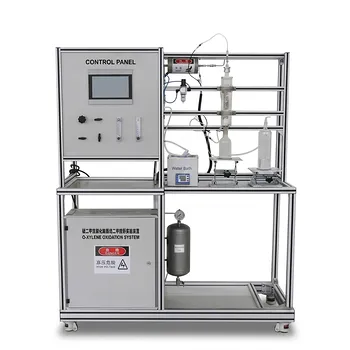
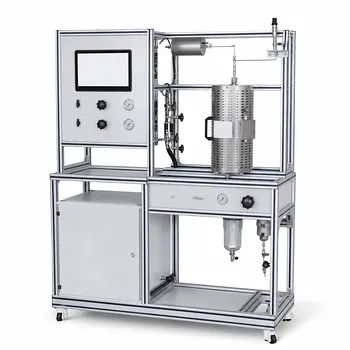
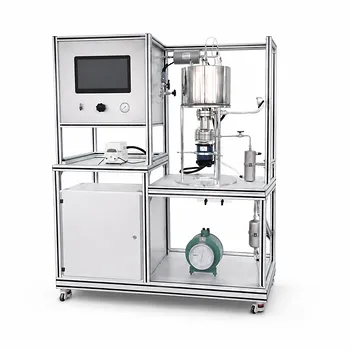
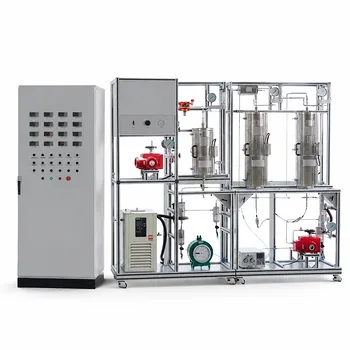
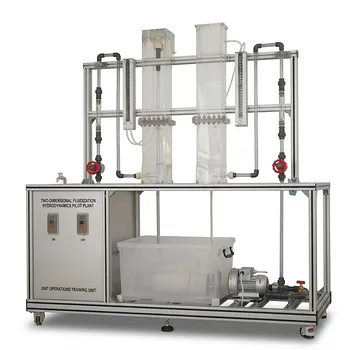
The single most critical difference between a fixed-bed and a fluidized-bed reactor pilot plant is heat transfer—and that choice cascades directly into catalyst longevity and performance. In a fixed-bed pilot plant, highly exothermic reactions can create localized hot spots that permanently deactivate the catalyst, while a fluidized-bed design virtually eliminates these thermal gradients through vigorous particle mixing and delivers heat transfer coefficients an order of magnitude higher. However, the fluidized bed introduces a new set of catalyst challenges: mechanical attrition, backmixing, and more complex scale-up.
For gas-solid catalytic unit operations, the reactor selection in your pilot plant is a direct trade-off between thermal uniformity and mechanical simplicity. A fixed-bed offers plug-flow behavior and minimal catalyst wear but struggles with hot spots. A fluidized-bed provides near-isothermal conditions and easy catalyst handling at the cost of attrition risk and complex fluid dynamics. The right choice depends on how the specific heat of reaction and catalyst cost dictate your priority.
How Reactor Type Shapes Heat Transfer Performance
The primary function of a pilot plant is to mirror the transport phenomena of a full-scale unit. In gas-solid catalytic systems, heat management is often the bottleneck that determines whether a reaction can be run safely and profitably.
The Thermal Challenge in Fixed-Bed Pilot Plants
Fixed-bed reactors can be designed as adiabatic beds (with interstage quenching) or as multi-tubular heat-exchanger systems. Both configurations operate close to plug flow, which simplifies kinetic modeling. However, the solid catalyst particles create a relatively stagnant thermal environment.
In highly exothermic reactions, this poor radial heat transfer creates localized hot spots. Once a hot spot forms, the reaction rate accelerates in that zone, releasing even more heat. This positive feedback can lead to irreversible catalyst sintering, loss of active surface area, and in extreme cases, thermal runaway.
Even the most advanced multi-tubular fixed-bed designs demand a heat exchange area roughly ten times larger than a fluidized bed for the same duty. Despite this, they cannot fully suppress the axial and radial temperature gradients that distort kinetic data and shorten catalyst life.
Fluidized-Bed Pilot Plants: Near-Isothermal Conditions
When the gas velocity lifts and suspends the catalyst powder, the bed behaves like a boiling liquid. The violent, chaotic motion of particles guarantees excellent solid-solid and solid-gas heat transfer. A fluidized-bed pilot plant typically achieves heat transfer coefficients around 200 W/(m²·°C), far exceeding any fixed-bed configuration.
This intense mixing delivers a single, overriding advantage: a highly uniform bed temperature. Hot spots are physically impossible because any overheated particle is instantly swept into the bulk. For reactions like acrylonitrile synthesis or phthalic anhydride production, this near-isothermal behavior is not just a convenience—it’s a safety and selectivity necessity.
The price of this uniformity is particle size. Fluidized beds require fine catalysts, typically under 300 μm, to achieve proper fluidization. This directly impacts catalyst handling and performance in the next section.
The Impact on Catalyst Performance and Regeneration
Heat transfer dictates catalyst longevity, but reactor choice also shapes how the catalyst behaves mechanically and kinetically.
Attrition and Mechanical Durability
In a fixed-bed pilot plant, catalyst particles sit stationary. Attrition is negligible, and even mechanically weak extrudates or pellets can be tested for months without degradation. Catalyst deactivation comes purely from chemical poisoning, fouling, or thermal sintering—not from wear.
A fluidized bed is fundamentally different. The constant particle-to-particle and particle-to-wall collisions cause surface abrasion and fracture. This attrition generates catalyst fines that are entrained in the gas stream, requiring cyclones or filters to recover them. When studying expensive noble-metal catalysts, this loss can render a pilot study economically nonviable. Consequently, fluidized-bed pilot plants demand high-attrition-resistant catalysts, often specially formulated microspheres.
Reaction Selectivity and Backmixing
Heat transfer uniformity protects selectivity in exothermic reactions, but the fluidized bed’s mixing pattern introduces a counteracting factor. Fixed beds behave close to ideal plug flow, which maximizes per-pass conversion and minimizes side reactions for positive-order kinetics.
Fluidized beds suffer from significant backmixing. Gas can bypass the catalyst in large bubbles, and solids can circulate, creating a broad residence time distribution. This non-ideal flow can degrade selectivity if the desired product can undergo secondary reactions. Researchers must weigh the selectivity gain from isothermal operation against the selectivity loss from backmixing—a classic pilot-plant trade-off that teaches core chemical engineering principles.
Handling, Regeneration, and Operational Flexibility
Fixed-bed catalyst loading and unloading is labor-intensive. In a pilot plant setting, a change of catalyst often means a lengthy shutdown. In contrast, a fluidized bed permits continuous catalyst addition and withdrawal while the plant is online. This makes it uniquely suited for studying processes like fluid catalytic cracking, where coke-deactivated catalyst is continuously circulated to a regenerator.
The stable pressure drop across a fluidized bed, regardless of gas velocity changes, also simplifies control. The fine particles pack loosely, and the ΔP remains approximately equal to the bed weight per area once fluidized. This is an often-overlooked operational advantage when running extended pilot campaigns.
Understanding the Trade-offs: A Balanced View
Every advantage brings a corresponding limitation. The following pitfalls deserve specific attention when selecting a reactor for your gas-solid pilot plant.
When Fixed-Bed Simplicity Becomes a Liability
A fixed bed’s mechanical simplicity can mask severe data quality issues. If your reaction is moderately or strongly exothermic, the measured kinetics will be corrupted by the true temperature profile. Modeling a reaction with hidden hot-spot temperatures leads to scale-up failures. Moreover, catalyst regeneration in place is often impossible, requiring a complete cooldown and reload.
The Hidden Costs of Fluidized-Bed Uniformity
Isothermal operation solves the hot-spot problem but introduces a different kind of complexity. The fluidization regime is sensitive to particle size distribution and gas flow. You must invest in robust gas-solid separation equipment and accept that catalyst attrition data will be a permanent part of your experimental results. You are also trading plug-flow kinetic clarity for a reactor that requires more sophisticated modeling approaches (e.g., two-phase or CFD models) to interpret the data correctly.
Making the Right Choice for Your Pilot Plant Goal
The decision hinges on which limitation you can afford to manage, given the thermal character of your specific reaction.
After a brief introductory sentence, use a bulleted list to provide specific recommendations based on different user goals.
- If your primary focus is studying a highly exothermic reaction with a narrow operating temperature window: Choose a fluidized-bed pilot plant. Its isothermal bed eliminates hot spots, protects the catalyst from thermal sintering, and gives you true kinetic data free from runaway temperature gradients.
- If your primary focus is tracking catalyst deactivation by attrition or studying continuous regeneration loops: A fluidized-bed pilot plant is essential. It allows online catalyst addition and withdrawal, directly mirroring industrial FCC or regenerator operations, and reveals attrition behavior early.
- If your primary focus is maximizing kinetic modeling accuracy with minimal backmixing and the reaction is only mildly exothermic: A fixed-bed pilot plant is the better tool. Its plug-flow profile simplifies parameter estimation, and the absence of particle wear ensures you are measuring intrinsic deactivation, not mechanical losses.
- If your primary focus is testing expensive, mechanically fragile catalysts where loss is unacceptable: Start with a fixed-bed reactor. The minimal attrition guarantees that every gram of catalyst remains in the bed, and you can isolate chemical deactivation without wasting precious material.
Ultimately, the pilot plant’s job is to illuminate the interaction between heat, kinetics, and catalyst integrity before you scale up. Matching the reactor fluid dynamics to your thermal demands turns a complex unit operation into a clear, repeatable experiment.
Summary Table:
| Feature | Fixed-Bed Reactor | Fluidized-Bed Reactor |
|---|---|---|
| Heat Transfer | Poor radial transfer; prone to hot spots | Excellent; near-isothermal conditions |
| Flow Pattern | Near-ideal plug flow | High backmixing & bubble bypassing |
| Catalyst Attrition | Negligible; stationary bed | High; requires abrasion-resistant catalyst |
| Operation & Regen | Batch loading; requires shutdown to change | Continuous online addition and withdrawal |
Scale Up Your Chemical Engineering Lab with LABPARK
Choosing the right reactor configuration is critical for teaching and research. LABPARK provides premium Educational and Vocational Unit Operations Pilot Plants in chemical engineering, bioprocess & biotech, and environmental & water treatment for universities, research institutes, and enterprises.
Whether you need to demonstrate complex heat transfer phenomena or study catalyst longevity, our systems are built to deliver precise, real-world data. Contact us today to find the perfect pilot plant solution for your lab!
Related Products
- Fixed-Bed Chemical Reaction and Gas Dust Tar Removal Unit Operations Pilot Plant
- Fixed Bed Gas Solid Catalytic Reaction Educational Pilot Plant
- Multi-Reactor Educational Pilot Plant for Reaction Engineering Unit Operations
- Ethylbenzene Dehydrogenation Educational Unit Operations Pilot Plant
- Educational Unit Operations Pilot Plant for Intraparticle Diffusion Effective Factor Measurement
People Also Ask
- When to transition from PID to adaptive control in pilot plants? Key process indicators.
- How do deviations in estimating latent heat impact pilot plant thermal systems? Avoid hardware mis-sizing.
- Why Compare Predicted and Experimental Excess Enthalpy? Key to Accurate Pilot Plant Scale-up
- How to study gasification in pilot plants? Compare exit gas composition & efficiency
- Why Use PTFE & Hastelloy in Chemical Pilot Plants? Prevent Corrosion & Ensure Safety