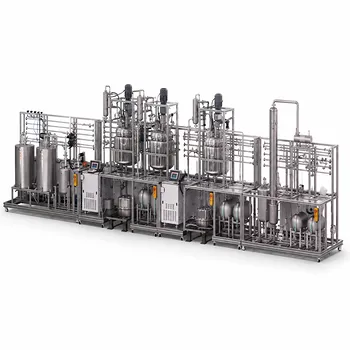
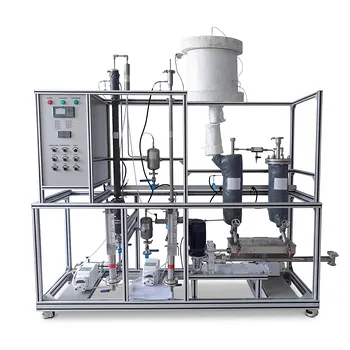
Temperature reshapes the energy landscape of a gas. As you increase the temperature, the Maxwell-Boltzmann distribution of molecular speeds broadens and its peak shifts to the right, meaning a greater proportion of molecules now move fast enough to overcome the activation energy barrier. This microscopic shift is the direct physical reason that reaction rates accelerate with temperature—and in a chemical engineering pilot plant, students can manipulate temperature to see these molecular-level changes manifest as measurable changes in reaction rate, equilibrium yield, and product distribution.
The core insight is that temperature does more than just “heat things up.” It redistributes the kinetic energy of gas molecules according to the Maxwell-Boltzmann law, increasing the population of high-energy molecules. Teaching this concept inside a pilot plant transforms an abstract statistical distribution into a tangible, data-rich experience where students connect particle physics to the Arrhenius equation and the industrial-scale trade-offs between kinetics and thermodynamics.
The Maxwell-Boltzmann Distribution: A Molecular Speed Map
The primary reference tells us that at any fixed temperature, gas molecules move at random speeds, and their velocities are not all equal. Instead, they follow a characteristic asymmetric curve: the Maxwell-Boltzmann distribution.
The Shape of the Distribution
Most molecules cluster around a most probable speed, but the curve has a long “tail” extending to higher speeds.
This tail, although sparsely populated, holds the key to understanding chemical reactivity.
The Temperature Effect in Detail
When you raise the temperature:
- The peak of the distribution (the most probable speed) moves to a higher velocity.
- The entire curve flattens and widens, so the fraction of molecules in the high‑speed tail increases dramatically.
Even a modest temperature rise can double or triple the number of molecules that exceed a given activation energy threshold, which is the microscopic engine behind the exponential rate increases described by the Arrhenius equation.
Why the Distribution Shift Drives Reaction Kinetics
Reaction kinetics is not about average molecules—it’s about the energetic few.
Energy Thresholds and Collision Efficiency
For a bimolecular gas reaction to happen, colliding molecules must possess a combined kinetic energy above the activation energy.
The Maxwell-Boltzmann distribution shows that as temperature climbs, many more molecules satisfy this condition, and collisions that were previously “soft” become effective.
From Microscopic Speeds to Macroscopic Rate Constants
The Arrhenius equation captures this mathematically, but the physics behind the exponential term is rooted in the fraction of molecules in the high-energy tail.
Educational pilot plants make this abstract relationship concrete: students can measure reaction rates at different temperatures, calculate activation energies, and directly link their data to the shifting molecular speed distribution.
Connecting Molecular Speeds to Macroscopic Observations in Pilot Plants
This is where the primary reference’s pedagogical value shines: unit operations pilot plants turn molecular theory into visible, controllable experiments.
Kinetics-Driven Experiments in Jacketed Reactors
In a jacketed batch reactor or continuous stirred-tank reactor (CSTR), students can maintain precise set points and watch conversion climb as temperature increases.
With real‑time monitoring, they see that a higher temperature shortens the time to reach a given conversion—exactly what the shifted speed distribution predicts.
Visualizing the “Tail” Through Rate Measurements
By computing rate constants at multiple temperatures and plotting an Arrhenius graph, students infer the fraction of molecules crossing the activation barrier.
The pilot plant thus serves as a macroscopic “microscope” for molecular behavior.
From Kinetics to Thermodynamics: The Temperature Trade-off
Temperature doesn’t only accelerate reactions—it also repositions the chemical equilibrium.
When Faster Isn’t Better: The Equilibrium Limit
For exothermic reversible reactions, the equilibrium constant decreases with rising temperature (van’t Hoff equation).
This creates a performance conflict: higher temperature delivers faster kinetics but can shrink the maximum possible conversion.
Pilot Plant Demonstrations of the Trade-off
Using a reactor pilot plant, students can run the same exothermic reaction at two temperatures and observe that while the initial rate is higher at the hotter condition, the final conversion may be lower than at a cooler temperature.
This directly illustrates why industrial reactors often use temperature profiles or staged cooling—to balance molecular energy distribution shifts against thermodynamic constraints.
Educational Pilot Plants as a Bridge Between Theory and Practice
The supplementary references reinforce that pilot plants are unparalleled teaching tools because they allow students to manipulate the very variables that control molecular behavior.
From Gasification to Gas Absorption: The Temperature Thread
- In a gasification pilot plant, higher temperature favors endothermic steam‑gasification reactions, shifting the product gas toward more CO and H₂—again a consequence of more molecules achieving the necessary energy.
- In gas absorption, raising the solvent temperature reduces solubility (Henry’s law), a thermodynamics concept that students can quantify by measuring concentration changes at different heat exchanger settings.
All these examples trace back to the same fundamental idea: temperature redistributes molecular energy, and pilot plants let you measure the outcome.
Kinetics and Thermodynamics in a Single Unit
A well‑designed experiment can combine a kinetics run (measuring rate constants) with an equilibrium run (measuring final conversion versus temperature).
Students then graph both the Arrhenius barrier and the van’t Hoff equilibrium, seeing how the Maxwell-Boltzmann tail feeds the former while thermodynamics caps the latter.
Understanding the Trade-offs: Kinetics vs. Equilibrium
Teaching this topic without addressing the inherent trade-offs would be incomplete.
The Activation Energy Sweet Spot
High activation energy reactions benefit enormously from a temperature hike because the tail population grows exponentially.
But if the reaction is strongly exothermic, the same temperature may push equilibrium back toward reactants, eroding the yield gain.
Avoiding Thermal Runaway
Raising temperature to boost high‑energy molecule counts also increases heat generation rate.
Without adequate cooling, an exothermic reaction can self‑accelerate into a thermal runaway—a critical safety lesson that pilot plants can demonstrate under controlled conditions.
Pressure as a Co‑Variable
For gas‑phase systems, pressure alters the distribution’s density but not its shape.
However, combining pressure and temperature control in a pilot plant lets students explore how both affect collision frequency and equilibrium, clarifying that temperature acts on the energy distribution while pressure acts on molecular proximity.
Making the Right Choice for Your Teaching Goal
When designing an experiment or curriculum module around molecular speed distributions and pilot plants, align your operational choices with your learning objective.
- If your primary focus is teaching the link between molecular theory and reaction kinetics: Use a simple irreversible gas‑phase reaction in a jacketed batch reactor. Have students measure rates at multiple temperatures and plot the Arrhenius curve, explicitly connecting the slope to the fraction of molecules exceeding the activation energy.
- If your primary focus is illustrating the kinetic‑thermodynamic trade-off: Choose a reversible exothermic reaction (like esterification) and run experiments at three temperatures. Have students calculate both rate constants and equilibrium conversions, then discuss why the highest temperature gave the fastest initial rate but the lowest final yield.
- If your primary focus is demonstrating diffusion and mass transfer: Incorporate a gas absorption or membrane unit. Vary the operating temperature and measure diffusion coefficients or Henry’s constants, showing how increased molecular speed enhances mass flux even as solubility drops.
- If your primary focus is safety and scale‑up awareness: Simulate a thermal runaway scenario safely by reducing cooling capacity while monitoring temperature and pressure. Link the accelerating rate to the exponential increase in high‑energy molecules, reinforcing why industrial reactors demand precise thermal management.
Temperature’s ability to reshape the molecular speed distribution is the quiet engine behind nearly every kinetic and thermodynamic phenomenon you can observe in a pilot plant. By turning that engine into a hands‑on, data‑driven investigation, you transform a statistical curve into a profound teaching moment that stays with students long after they leave the lab.
Summary Table:
| Metric/Concept | Microscopic Behavior (Gas Molecules) | Macroscopic Observation in Pilot Plants |
|---|---|---|
| Kinetics (Arrhenius) | Speed distribution flattens; more molecules exceed activation energy. | Faster reaction rates and higher conversion in jacketed CSTRs. |
| Equilibrium (van't Hoff) | Exothermic reactions shift back toward reactants. | Lower final equilibrium yield at higher temperatures. |
| Absorption (Henry's Law) | Increased molecular motion reduces gas solubility. | Decreased gas absorption efficiency at higher solvent temperatures. |
Elevate Your Chemical Engineering Curriculum with LABPARK
Bridge the gap between molecular theory and industrial practice. LABPARK provides state-of-the-art Educational and Vocational Unit Operations Pilot Plants in chemical engineering, bioprocess & biotech, and environmental & water treatment for universities, research institutes, and enterprises.
Our advanced pilot plants enable students to visualize complex kinetics, thermodynamics, and mass transfer phenomena in real time.
Ready to enhance your lab's training capabilities? Contact LABPARK today to discuss your custom project requirements!
Related Products
- Fixed Bed Gas Solid Catalytic Reaction Educational Pilot Plant
- Multi Pump Fluid Transport Process Piping Unit Operations Training Pilot Plant
- Carbon Dioxide Hydrogen Methanol Synthesis Educational Unit Operations Pilot Plant
- Ethyl Acetate Synthesis Unit Operations Pilot Plant for Practical Training
- Natural Product Extraction Unit Operations Training Pilot Plant
People Also Ask
- How do reactor pilot plants safely study gas-solid reactions? Master kinetics with thermal & flow control.
- How does the Mears criterion evaluate transport resistance? Key Guide to Intrinsic Kinetics
- Fluidized vs. Fixed Bed Reactors: Comparing Heat & Complexity in Pilot Plants
- Why is a multibed configuration necessary for exothermic reactions? Optimize your pilot plant trajectory.
- How is the friction factor determined for fixed-bed pilot plants? Select the best pressure drop correlation.