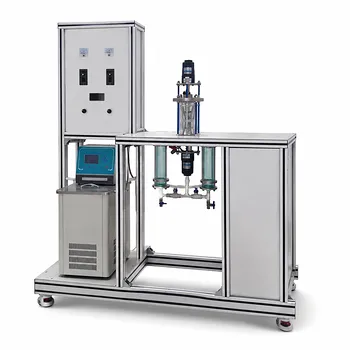
If your leaching reaction absorbs heat, turning up the temperature is like pressing the accelerator on product formation. For any endothermic leaching process (where the enthalpy change ΔH is positive), raising the temperature drives the chemical equilibrium to favor the products—meaning higher yields of your extracted solute. This thermodynamic shift is calculated using the Van 't Hoff equation, which quantifies how the equilibrium constant K changes with temperature. In a solid-liquid extraction pilot plant, you first use this equation to predict the theoretical extraction ceiling, then validate it by adjusting the integrated heating system and measuring actual concentrations.
The equilibrium of an endothermic leaching reaction (ΔH > 0) always moves toward products as you increase temperature, a relationship precisely described by the Van 't Hoff equation. In pilot-scale solid-liquid extractors, this principle allows you to boost yield by applying heat, but you must stay within limits imposed by solvent boiling points, thermal degradation of the solute, and the interplay with mass-transfer kinetics. Precise temperature control transforms a theoretical calculation into a reliable, optimized extraction process.
The Thermodynamic Driver: Why Temperature Shifts the Balance
Leaching is governed by the same thermodynamic laws as any reversible chemical reaction. Understanding the “why” behind the shift sets the stage for putting the math to work.
Le Chatelier’s Principle and Endothermic Leaching
An endothermic leaching reaction can be written as: Solid + Solute + Heat ⇌ Dissolved Product.
According to Le Chatelier’s principle, if you add heat (raise the temperature), the system will try to consume that extra energy by favoring the forward, endothermic direction.
This directly translates to a higher concentration of the target compound in the liquid extract phase at equilibrium.
The Van ’t Hoff Equation: Calculating the Equilibrium Shift
The quantitative link between temperature and equilibrium is the Van ’t Hoff equation.
For a specific temperature change from T₁ to T₂, the corresponding change in the equilibrium constant K is given by:
[ \ln\left(\frac{K_{T2}}{K_{T1}}\right) = \frac{\Delta H}{R} \left(\frac{1}{T_1} - \frac{1}{T_2}\right) ]
Here, ΔH is the molar enthalpy of the leaching reaction (must be positive for an endothermic process), R is the universal gas constant (8.314 J/mol·K), and temperatures are in Kelvin.
Because ΔH > 0, the right‑hand side becomes positive when T₂ > T₁, proving that K always increases with temperature. This means you can predict the equilibrium constant—and thus the maximum possible extraction yield—at any operating temperature, provided you know K at one reference temperature and the reaction’s heat of reaction.
A Practical Calculation Example
Suppose a laboratory‑scale measurement gives K₁ = 50 at T₁ = 298 K (25°C), and the leaching reaction has ΔH = +25 kJ/mol.
You plan to run the pilot extractor at T₂ = 333 K (60°C). Plugging the numbers into the Van ’t Hoff equation:
[ \ln\left(\frac{K_{333}}{50}\right) = \frac{25000}{8.314} \left(\frac{1}{298} - \frac{1}{333}\right) ]
The calculation yields a value of K₂ ≈ 145—a near three‑fold increase in the thermodynamic driving force.
This tells you that operating at the higher temperature could theoretically deliver a much higher solute loading in the extract phase, provided other constraints don’t intervene.
Pilot‑Scale Equipment: Applying Thermodynamics in the Real World
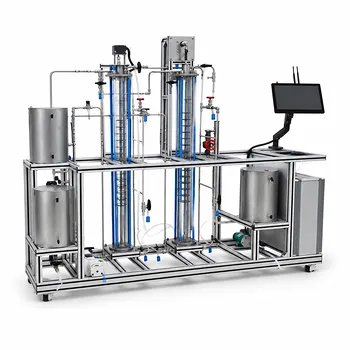
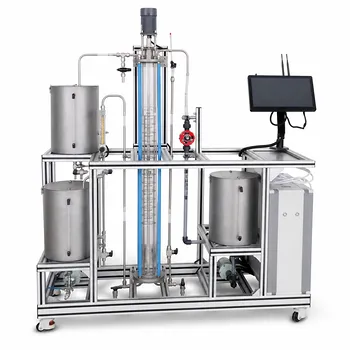
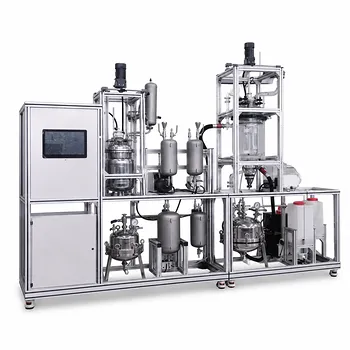
Modern solid-liquid extraction pilot plants are built precisely to translate such calculations into controlled experiments and process development.
Integrated Heating and Precision Control
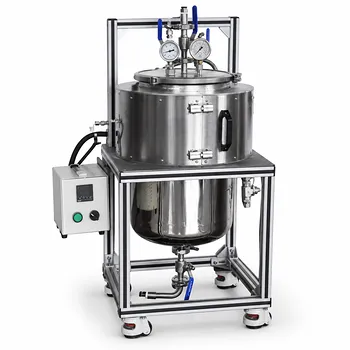
Most pilot‑scale extractors—such as continuous counter‑current leaching columns, Soxhlet‑type units, or mixed‑settler trains—feature jacketed vessels, external heat exchangers, or oil‑bath heating systems.
These allow you to hold the extraction temperature steady within ±1°C, a level of control that is essential for reproducing the equilibrium conditions modeled by the Van ’t Hoff equation.
Validating Theory with Experimental Data
In an educational or R&D pilot plant, the typical workflow is:
- Calculate the expected K at the chosen temperature using the Van ’t Hoff equation.
- Run the extraction, sample the liquid phase, and measure the solute concentration.
- Compare the measured yield to the thermodynamic ceiling.
Any persistent gap signals that mass‑transfer limitations or side reactions are dominating, pointing you toward further optimization of particle size, agitation, or residence time.
Understanding the Trade‑offs
Heat is a powerful lever, but increasing temperature in a solid‑liquid pilot extraction is not a free lunch. A purely thermodynamic viewpoint must be balanced against practical constraints.
Solvent Loss and Thermal Degradation
Excessive temperatures can push the solvent near or beyond its boiling point, leading to vapor losses that change the solvent‑to‑feed ratio and may create safety hazards.
Even below the boiling point, elevated temperatures can trigger the formation of unwanted contaminants or cause irreversible degradation of thermolabile active compounds. For example, many natural product extractions (such as alkaloids or bio‑active phytochemicals) see a rapid decline in purity above 50–60°C, negating the yield gains from a higher K.
Kinetics vs. Equilibrium: You Can’t Rush Perfection
A higher temperature also increases the rate constant (k) via the Arrhenius equation, speeding up the approach to equilibrium.
However, a faster reaction rate can’t overcome the thermodynamic limit set by K. If the new equilibrium constant is high but your extraction equipment has a fixed residence time, you may not reach that limit. Conversely, if you push to a temperature where K is very large, the system becomes almost irreversible, and you risk running into solid‑phase depletion or unwanted side‑reactions before the solvent even leaves the extractor.
Mass‑Transfer Caveats
Temperature influences not just reaction thermodynamics but also the physical transport steps.
Higher temperatures generally reduce solvent viscosity and increase the solute’s diffusivity, improving penetration into solid pores and shortening the diffusion path. This interacts with equilibrium: a solute that dissolves more quickly will also reach equilibrium sooner.
However, if particles are large and diffusion‑limited, a higher equilibrium K may deliver only a fraction of its theoretical benefit unless you also optimize particle size reduction and agitation.
Making the Right Choice for Your Pilot‑Scale Leaching Process
Your desired outcome determines how aggressively you should use temperature to shift the equilibrium.
- If your primary focus is maximum equilibrium yield: Raise the temperature as high as the solvent’s thermal stability and the solute’s integrity allow, using the Van ’t Hoff equation to predict the yield ceiling. Validate with a short‑duration run to ensure degradation is negligible.
- If your primary focus is product purity (heat‑sensitive compounds): Keep the temperature in the lower end of the safe range, even if K is lower. Compensate with smaller particle sizes, longer residence time, or a staged counter‑current setup to approach equilibrium more fully.
- If your primary focus is energy efficiency and solvent recovery: Select a temperature just below the solvent’s boiling point to maximize solubility while minimizing vapor losses. Use a condenser on any open vessel to recycle evaporated solvent, and monitor for any drop in selectivity that could increase downstream purification costs.
- If your primary focus is scale‑up validation: First demonstrate that the measured equilibrium constants follow the Van ’t Hoff trend in the pilot unit. Then, systematically vary temperature to build a response surface that includes both thermodynamic yield and practical extraction rate, giving you a robust model for the commercial plant design.
Mastering the temperature‑equilibrium relationship in your pilot‑scale solid‑liquid extraction means moving from a simple “heat it up” instinct to a precise, calculated operation—turning a theoretical equation into predictable, high‑quality results.
Summary Table:
| Parameter / Factor | Thermodynamic Effect | Practical Pilot-Scale Considerations |
|---|---|---|
| Equilibrium Constant (K) | Increases with temperature (Van 't Hoff Eq.) | Higher theoretical yield of target solute |
| Reaction Kinetics (k) | Speeds up rate of extraction (Arrhenius) | Shorter residence time to reach equilibrium |
| Solvent Properties | Decreases viscosity, increases diffusivity | Improved mass-transfer rate, but risk of solvent boiling |
| Solute Stability | No thermodynamic change | Risk of thermal degradation of heat-sensitive compounds |
Optimize your extraction processes with precision. LABPARK provides premium Educational and Vocational Unit Operations Pilot Plants in chemical engineering, bioprocess & biotech, and environmental & water treatment for universities, research institutes, and enterprises. Contact us today to find the perfect pilot-scale solution for your research and training needs!
Related Products
- Hot Filtration Educational Unit Operations Pilot Plant Laboratory System
- Comprehensive Liquid-Liquid Extraction Pilot Plant for Engineering Education
- Educational Rotary Disc Liquid-Liquid Extraction Pilot Plant
- Gallium and Indium Selective Extraction Educational Pilot Plant
- Gas-Solid Heterogeneous Separation Demonstration Educational Unit Operations Pilot Plant
People Also Ask
- How to Determine Specific Cake (r) & Filter Medium (Rm) Resistance Using Filtration Pilot Plant Data
- How can researchers identify and resolve filter medium blinding? Optimize Your Pilot Plant Runs
- How to select solid-liquid separation equipment for pilot plants? A Step-by-Step Guide
- Why Demo Constant-Rate to Constant-Pressure Filtration on a Pilot Plant? Key Practical Insights
- How do Buchner funnels & leaf filters differ in filtration scale-up? Key Differences Explained