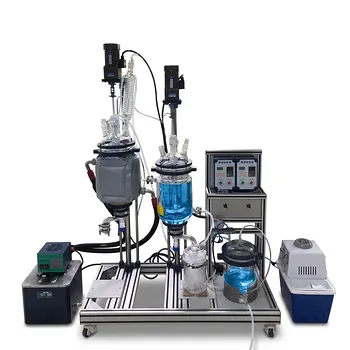
Your solvent choice is the crystallization control knob. By carefully selecting the reaction medium, you can steer the formation of a target conformational polymorph in a pilot‑plant crystallization unit. The solvent directly shifts the equilibrium population of flexible molecular conformers in solution, and because crystal nucleation is fed by the most abundant conformer, the polymorphic outcome is decided long before the first crystal appears. In practice, switching from an aqueous environment to an organic solvent such as methanol or acetonitrile can completely alter which form you isolate.
The central insight: Solvent molecules stabilize specific solute conformations through hydrogen‑bonding, dipole‑dipole, and dispersion interactions. The conformer that achieves the highest population in the saturated solution becomes the dominant building block for nucleation, so the solvent effectively pre‑programs which conformational polymorph will grow. Mastering this relationship is what transforms solvent selection from a routine decision into a precise tool for polymorph engineering.
The Molecular Mechanism: Conformer Population Control
Why Conformational Polymorphs Depend on Solution Chemistry
Conformational polymorphs are different crystal structures of the same molecule, arising solely from alternative molecular shapes. In solution, a flexible molecule rapidly interconverts between these shapes. The solvent environment does not alter the molecule’s covalent bonds; instead, it tips the energetic balance between conformers by offering different stabilizing interactions. A conformer that forms strong hydrogen bonds with a protic solvent, for example, will be over‑represented relative to a less‑favored shape.
This shift in population is the root cause of polymorph selectivity. The nucleation of a particular crystal form is a probabilistic event that depends heavily on the concentration of the correct building block. If the solvent doubles the fraction of conformer A in the saturated solution, the probability of nucleating the polymorph built from A rises dramatically. The effect is so powerful that a modest solvent change can completely switch the crystallization product.
The Thermodynamic Foundation of Solvent Selection
Thermodynamics dictates which conformer persists. The free‑energy difference between two conformers in solution is a function of solute‑solvent interactions. Polar protic solvents (water, methanol) stabilize conformers that expose hydrogen‑bond donors or acceptors. Polar aprotic solvents (acetone, acetonitrile) favor conformers with exposed dipole moments but shield hydrogen‑bond donors. Non‑polar solvents (hexane) leave the molecule to fold into shapes that maximize internal interactions and minimize exposed polar groups.
In a pilot‑plant setting, the saturated solution is the playground where this equilibrium establishes itself. The solvent not only influences the conformer ratio but also the overall solubility, which in turn affects supersaturation—the engine of crystallization. Therefore, the “ideal” solvent for a conformational polymorph is one that creates a high population of the target conformer while maintaining a solubility window that permits practical cooling or antisolvent operation.
How Pilot‑Plant Operators Can Exploit This Principle
For a given compound, operators can run a rapid solvent screen to map out which solvent classes favour which polymorph. When the goal is the thermodynamically stable form, the solvent system is chosen to maximize the population of the low‑energy conformer that builds that crystal. When a metastable form is desired—perhaps for its higher solubility or unique dissolution profile—the solvent is deliberately selected to over‑stabilize a higher‑energy conformer, trapping it kinetically as it nucleates.
This approach turns crystallization into a design activity. Instead of hoping for a particular polymorph, engineers can redirect the process by changing the solvent composition, often without altering the equipment line‑up.
Translating Theory to Pilot‑Plant Unit Operations
Solvent Screening for Polymorph Discovery
A robust screening protocol uses a diverse solvent set: polar protic, polar aprotic, and non‑polar solvents. Each category interrogates a different set of solute‑solvent interactions and reveals which conformer is stabilized under which conditions. The goal is to observe whether a new polymorph appears as the solvent environment changes.
During screening, solubility must remain high enough to enable meaningful crystallization. If a solvent stabilizes the target conformer but dissolves only trace amounts, the population advantage cannot translate into sufficient mass for nucleation. Thus, the practical screen often blends solvents to balance conformer selectivity and solubility, thereby using the conformer‑population principle while maintaining operable process windows.
Using Co‑Solvents to Accelerate Metastable‑to‑Stable Transitions
A powerful application of conformer control is the use of a co‑solvent to trigger a solvent‑mediated phase transformation. For example, adding just 10 wt% methanol to a slurry of a metastable alpha‑form can shrink the induction period for conversion to the stable beta‑form from hours to minutes. The co‑solvent does this by altering the conformer distribution of the dissolved solute—increasing the population of the conformation that feeds the stable crystal—without dramatically shifting the bulk solubility.
This shortcut is invaluable in pilot‑scale manufacturing. It allows a process to start with the metastable form (which may nucleate more readily) and then rapidly convert it to the stable form once crystallization is underway, eliminating the risk of unwanted phase changes during downstream storage or handling.
Understanding the Trade‑offs of Solvent‑Driven Polymorph Control
The Solubility–Selectivity Conundrum
The solvent that best stabilizes your target conformer may not be the one that gives you a practical solubility curve. A highly selective but poor solvent forces you to work at extreme dilutions, reducing yield and increasing energy costs for evaporation. Compromise is frequent: you might blend a strong conformer‑selective solvent with a second component that lifts solubility to a workable level, accepting a mild decrease in selectivity as the price for process viability.
Kinetic Traps and Process Robustness
A solvent chosen to kinetically trap a metastable polymorph may create a form that is stable only under tightly controlled conditions. Slight fluctuations in temperature, impurity levels, or mixing can push the system across the nucleation barrier of the stable form, causing a catastrophic polymorphic shift mid‑campaign. When targeting metastable forms, the operating window must be defined with narrow tolerances, and seeding strategies become nearly mandatory to maintain phase purity.
Downstream Processing and Solvent Recovery
Solvent selection reaches beyond the crystallizer. Residual solvent trapped in the crystal lattice or on the surface must be removed, and the chosen solvent’s boiling point, toxicity, and recovery cost all matter. A solvent that yields perfect polymorph control but requires complex distillation or creates hazardous waste is often rejected at pilot scale. The decision must balance crystallographic precision with the economic and safety realities of the plant.
Making the Right Choice for Your Pilot Plant Objective
Your solvent strategy should map directly to your process goal. Use the following guidelines to align solvent selection with what matters most in your operation.
- If your primary focus is isolating the thermodynamically stable polymorph: Select the solvent that gives the highest population of the lowest‑energy conformer, even if a co‑solvent is needed to reach practical solubility. This minimizes the risk of transformation during processing.
- If your primary focus is crystallizing a metastable form for study: Choose a polar protic or aprotic solvent that over‑stabilizes the desired high‑energy conformer. Expect to operate with tight temperature and mixing control, and plan for a dedicated seed train to lock in the metastable phase.
- If your primary focus is accelerating a polymorphic transformation: Introduce a co‑solvent (like methanol) that rebalances the conformer population toward the stable form without dissolving the solid excessively. This shortens the induction time and ensures complete conversion in a reasonable batch cycle.
- If your primary focus is scaling up a crystallization process: Screen solvent blends for the best compromise between conformer selectivity and solubility, then validate that the chosen system performs consistently across vessel sizes. Remember that mixing and heat‑transfer variations at scale can shift the kinetic balance, so build in a margin of selectivity to absorb those fluctuations.
By treating solvent selection as a molecular‑level design tool rather than an afterthought, you gain the power to consistently produce the exact conformational polymorph your process demands.
Summary Table:
| Solvent Class | Solute-Solvent Interaction | Operational Impact on Crystallization |
|---|---|---|
| Polar Protic (Water, Methanol) | Stabilizes exposed hydrogen-bond donors/acceptors | Directs thermodynamic stability; accelerates phase transformation |
| Polar Aprotic (Acetone, Acetonitrile) | Favors exposed dipole moments; shields hydrogen donors | Kinetically traps specific metastable polymorphs |
| Non-Polar (Hexane) | Encourages internal solute folding to minimize polar exposure | Selects conformers maximizing intramolecular interactions |
Master Crystallization Control with LABPARK Pilot Plants
Translating solvent-driven crystallization control from the laboratory to scalable production requires precise control over process parameters. LABPARK designs and delivers premium Educational and Vocational Unit Operations Pilot Plants in chemical engineering, bioprocess & biotech, and environmental & water treatment.
We empower universities, research institutes, and enterprises to train the next generation of engineers and optimize complex processes like polymorph crystallization with industrial-grade reliability.
Ready to elevate your research or educational facility? Contact LABPARK today to find the ideal pilot plant solution for your unit operations.
Related Products
- Multi Functional Membrane Crystallization Educational Unit Operations Pilot Plant
- Potassium Salt Thermal Dissolution and Crystallization Separation Educational Unit Operations Pilot Plant
- Continuous Sieve-Plate Distillation Pilot Plant for Unit Operations Laboratory Education
- Two-Dimensional Fluidization Hydrodynamics Educational Pilot Plant for Unit Operations Training
- Multi-Modal Distillation Unit Operations Training Pilot Plant
People Also Ask
- Why is precise temperature control critical in crystallization pilot plants? Key to Scale-Up Success
- Control Crystallization Pilot Plant Secondary Nucleation: 4 Key Adjustments
- What key factors should be considered when configuring a crystallization unit operations pilot plant?
- How Crystal vs Amorphous Solids Guide Crystallization Pilot Plant Objectives
- What are the benefits of integrating online PAT tools like ATR-FTIR into crystallization unit operations pilot plants?