Secondary nucleation is the dominant source of new crystal nuclei in a stirred pilot plant, and it fundamentally dictates your product quality. It is not a mere nuisance but the primary kinetic mechanism you must control. Specifically, it is contact nucleation—the microscopic fracturing of existing crystals as they collide with the impeller, vessel walls, and each other—that generates a surge of fine particles, leading to a wider, often bimodal, crystal size distribution and downstream processing nightmares.
The core challenge of scaling up a stirred crystallizer is that the mixing energy required for good suspension inherently fuels secondary nucleation. Mastering this pilot-scale operation isn't about eliminating collisions, but about engineering them to balance growth and nucleation, directly linking your impeller choice and agitation profile to the filterability and purity of your final product.
The Mechanical Heart of the Problem
Defining Contact Nucleation in the Pilot Plant
The term "secondary nucleation" in your stirred vessel is almost entirely mechanical. It relies on a parent crystal that is already present. The primary reference source identifies the key culprits as crystal-impeller collisions and crystal-wall collisions. This process is a function of collision energy and crystal size. Larger crystals have greater mass and present more contact area, making them more susceptible to fracturing upon high-energy impact.
The Direct Link to Product Quality
The result of excessive contact nucleation is a rapid population of undesired fine crystals. A cloud of fines creates an operational death spiral by providing enormous surface area that consumes supersaturation, starving the larger crystals you want to grow. This is why you see a wider particle size distribution. You end up with a product that is both dusty from the fines and undersized from the starved larger particles, as the primary reference confirms.
From a Particle Cloud to a Process Failure
Monitoring the Warning Signs in Real-Time
Your pilot plant isn't just a smaller factory; it's an instrument. The supplementary references highlight that you can detect harmful secondary nucleation by tracking the rate of desupersaturation. A sudden, sharp drop in solute concentration immediately following an increase in agitation speed is a telltale sign of a nucleation event. You can also visually validate this by observing crystal morphology. The presence of fractured, irregular shards instead of well-formed facets indicates mechanical damage from violent collisions.
The Downstream Catastrophe You're Creating
A poor crystal size distribution formed in the reactor is an expensive gift to your filtration team. The supplementary data provides precise evidence: spontaneous nucleation creates fine, needle-like crystals with a high specific cake resistance (e.g., 6.9 x 10^10 m/kg). This compacted, impermeable cake leads to long filtration cycles and wet product. In contrast, controlled growth produces thicker, rod-like crystals that slash that resistance down to 9.0 x 10^9 m/kg, enabling a dramatic increase in filtrate flux. The pilot plant’s mixing regime directly dictates these downstream economics.
Understanding the Trade-offs
The Sacrificial Balancing Act
You cannot just turn the agitator down to zero. An effective crystallization pilot plant must suspend solids for heat transfer and bulk crystal growth. The trade-off is sharp: high agitation ensures a uniform temperature and keeps crystals off the vessel floor, but the high tip speed creates high-energy collisions and rampant nucleation. As the supplementary materials suggest, a common solution is switching from a standard stainless steel impeller to a softer material like PTFE (Teflon) . This reduces the hardness mismatch and the impact energy transmitted during a collision, lowering contact nucleation while still allowing high RPMs for suspension.
The Metastable Zone
The term "cooling rate" is often discussed, but the real underlying variable is supersaturation. If your cooling profile is too aggressive, even for a short period, you generate a peak of supersaturation that massively increases the rate of contact nucleation. The existing crystals cannot grow fast enough to consume it. This pushes you out of the metastable zone—the safe operating window where growth dominates. The primary reference notes that pilot plants are essential for defining this boundary before moving from lab to production.
The Pivotal Moment for Scale-Up
Why Bigger Vessels are Different
A pilot plant's true value is exposing scale-up pitfalls before you commit to a 10,000-liter reactor. When you scale up, you change the shear profile and mixing time. A corner or a "dead zone" in a large industrial vessel will scale much faster than the high-shear zone near the impeller. The supplementary references warn that if your scale-up strategy keeps tip speed constant to maintain nucleation rate, you might fail to suspend the solids. If you match suspension power per volume, you might shatter the crystals. The pilot plant allows you to verify the finite difference models for cooling profiles by experimentally testing them, ensuring your calculated trajectory matches reality.
Control Measures to Adopt
You are not helpless against fines. The supplementary references arm you with a specific control toolkit to implement on the pilot plant: First, establish a fines destruction loop. This continuous method dissolves the most reactive, smallest particles without heating the main batch. Second, pre-heat and filter your feed solution. This eliminates foreign particles, decoupling primary nucleation (which could spark uncontrolled secondary nucleation) from your controlled seeding strategy.
Making the Right Choice for Your Goal
To manage secondary nucleation, you must align your operating philosophy with your endgame. The pilot plant is the place to make these deliberate choices before they become industrial mistakes.
- If your primary focus is achieving a specific narrow Crystal Size Distribution (CSD): Implement a precisely programmed cooling curve and monitor real-time desupersaturation to ensure the system never leaves the metastable growth-dominated zone.
- If your primary focus is ensuring fast filtration and minimal downstream cycle time: Prioritize mitigating contact nucleation by using a PTFE impeller or lowering tip speed, and seed the batch to promote the growth of the low-aspect-ratio crystals that build a permeable filter cake.
- If your primary focus is generating a scalable design for an industrial vessel: Systematically vary agitation speed and impeller design (material, shape) while measuring the resulting crystal morphology and CSD to build a predictive model for collision energy and nucleation rate, rather than relying on a single geometric constant.
The stirred crystallization pilot plant is your reality check where the chaotic force of contact nucleation is physically observed, measured, and ultimately, engineered into a predictable, profitable solid product.
Summary Table:
| Key Factor | Process Impact & Challenges | Target Control Strategy |
|---|---|---|
| Contact Nucleation | Generates excess fines, broadens CSD, and degrades product quality. | Switch to PTFE impellers; install a fines destruction loop. |
| Agitation Speed | High speed causes crystal collisions; low speed leads to settling. | Balance RPM; use pilot tests to verify shear/mixing profiles. |
| Cooling & Supersaturation | Rapid cooling triggers sudden nucleation, bypassing growth. | Follow precise cooling curves; track real-time desupersaturation. |
| Filtration Resistance | Needle-like fines increase cake resistance to 6.9 x 10^10 m/kg. | Seed the batch to yield rod-like crystals (9.0 x 10^9 m/kg). |
Optimize Your Crystallization & Scale-Up Processes with LABPARK
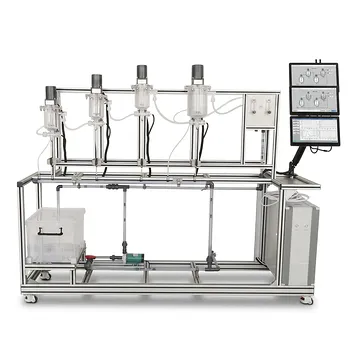
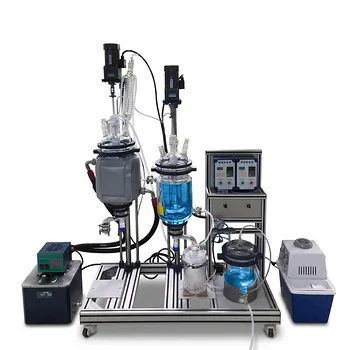
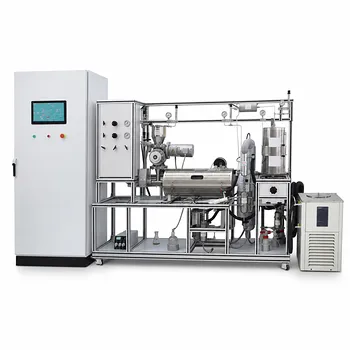
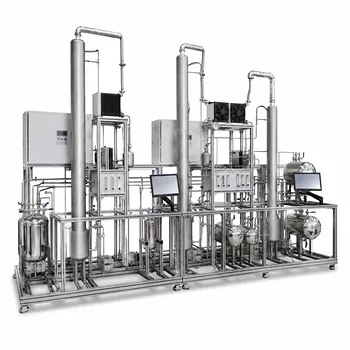
Controlling secondary nucleation and mastering crystallization kinetics requires reliable, scalable equipment. LABPARK provides premium Educational and Vocational Unit Operations Pilot Plants in chemical engineering, bioprocess & biotech, and environmental & water treatment for universities, research institutes, and enterprises.
Our pilot plants are designed to help you bridge the gap between lab-scale discovery and industrial production, enabling precise control over mixing, cooling, and particle size distribution.
Partner with LABPARK to enhance your research and training capabilities:
- Academic & Research Institutions: Deliver hands-on, industry-grade training in unit operations.
- Enterprises: Validate scale-up models and optimize downstream filtration economics.
Ready to elevate your lab's performance? Contact our technical team today to find the ideal pilot plant solution!
Related Products
- Multi-Stage Stirred Tanks in Series Residence Time Distribution and Mixing Performance Determination Educational Pilot Plant
- Multi Functional Membrane Crystallization Educational Unit Operations Pilot Plant
- Multi-Reactor Educational Pilot Plant for Reaction Engineering Unit Operations
- Potassium Salt Thermal Dissolution and Crystallization Separation Educational Unit Operations Pilot Plant
- Multi Functional Catalytic Reaction and Reactor Evaluation Educational Unit Operations Pilot Plant
People Also Ask
- How does MRF model impeller rotation in CFD? Key Boundary Conditions Explained
- How can a CSTR pilot plant demonstrate reactor staging? Visualize volume savings.
- How does steady-state multiplicity affect the operation and safety of exothermic reactions within a CSTR pilot plant? - Guide
- What parameters to monitor transitioning from Batch to CSTR? Master Pilot Plant Setup
- Why is temperature regulation via a cooling jacket a critical feature in CSTR pilot plants used for laboratory training?