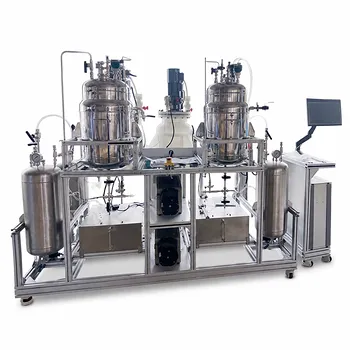
Simulation is the safe, digital rehearsal for a physical pilot plant. Manipulating the reflux ratio and product flow rates in a column simulation mirrors the exact same control levers you turn on a real distillation unit. It reveals how those adjustments influence separation purity, energy consumption, and hydraulic limits before a single drop of liquid enters the column.
The reflux ratio and product flow rates are the primary variables governing separation in both simulation and reality. Changing them in a rigorous model allows you to predict utility demands, avoid column flooding, and balance purity against production rate—turning virtual experiments into safe, efficient pilot-plant operations.
How Simulation Mirrors Real Pilot‑Plant Operation
The Digital Twin of Separation Control
In a physical distillation column, you adjust the reflux ratio by modulating a control valve to split the condensed liquid between distillate product and liquid returned to the column. Setting product flow rates does the same via the distillate and bottoms withdrawal streams. A simulation replicates these actions directly: fixing a reflux ratio or a product rate in the model imposes the same mass and energy balances that govern the real plant.
Both environments respond with identical cause‑and‑effect chains. Increase the reflux ratio, and internal liquid and vapor flows rise. The composition profile shifts, and purity improves—at a measurable cost in reboiler steam and condenser cooling water.
Predicting Utility Demands and Column Constraints
A pilot plant’s reboiler and condenser have fixed capacities. In a simulation, you can instantly see how a chosen reflux ratio translates into duty (kW) and coolant flow. This lets you plan your utility supply and avoid the real‑world surprise of exceeding heating or cooling limits. You can also spot the onset of flooding and weeping long before the real column’s pressure drop alarms.
Why Reflux Ratio Is the Master Control Variable
Purity vs. Production Rate
Increasing reflux ratio sends more purified liquid back down the column, boosting mass transfer. The immediate benefit is higher distillate purity. But that benefit comes at two costs:
- Higher energy input – the reboiler must vaporize more liquid, and the condenser must remove that extra heat.
- Lower net product withdrawal – more liquid returning means less is collected as product per minute.
A simulation quantifies this trade‑off for your specific mixture and column geometry, so you can decide what purity is worth the utility spend.
Internal Loads and Flooding, Predicted on Screen
Higher reflux ratios increase both liquid and vapor traffic inside the column. When the total flow exceeds the column’s hydraulic capacity, flooding occurs. The supplementary references remind us that a pilot plant’s physical tray or packing limits constrain how far you can push reflux. A simulation can plot the column’s operating point against its flood curve, allowing you to dial back before the real packing chokes and product quality collapses.
The Role of Product Flow Rates in Material Balance Control
Closing the Mass Balance
Product flow rates are not just about how much you collect; they enforce the overall material balance: ( F \cdot x_F = D \cdot x_D + B \cdot x_B )
If you set a distillate rate (( D )) too high, the top composition (( x_D )) must drop because you are removing more of the mixture with less enrichment per unit mass. A simulation makes this relationship visual and immediate—just as you’d see it happen on a real pilot plant’s concentration readings.
Coupling Product Flow with Reflux
In practice, reflux ratio and product flows are interdependent. Changing the distillate rate while holding reflux ratio constant requires adjustments to heat input; otherwise, you disturb the column’s hydraulic equilibrium. A simulation enforces these couplings exactly as the physical process does, preventing you from defining an impossible operating point that would violate energy or mass balances.
Understanding the Trade‑offs and Common Pitfalls
A simulation is only useful if you respect the constraints it reveals. The primary reference shows that adjusting these specifications lets you optimize yield and thermal efficiency; the supplementary material highlights the risks.
The Capital‑Energy Trade‑off
Operating at a very high reflux ratio reduces the number of theoretical stages needed for a given purity—great for a short, fixed‑height pilot column. But the optimum economic reflux is typically only 1.1 to 1.5 times the minimum reflux ratio (( R_m )). Below that range, you risk failing to meet purity targets because the column runs out of stages. Above it, energy costs climb faster than purity gains, and you may hit flooding.
When Simulation Meets a Real Column
A simulation cannot replace physical insight, but it prepares you. In a real pilot plant, students often trace temperature profiles and pressure drops as they adjust reflux. The same simulation you ran beforehand gives you the expected profile; any deviation indicates tray weeping, fouling, or instrument error.
Making the Right Choice for Your Simulation or Pilot Run
Use the same decision logic in the simulation that you would on the physical plant. Your goal determines how you set reflux ratio and product flows.
- If your primary focus is validating a design model: Run the simulation at several reflux ratios (from ( R_m ) to flooding) and, if possible, replicate the exact settings on the pilot plant to compare stage efficiencies and HETP values.
- If your primary focus is maximizing product yield per hour: Choose the highest distillate rate that still meets purity specs. In the simulation, back‑calculate the required reflux ratio and check it against the column’s flood limits before attempting it.
- If your primary focus is achieving the highest purity on a fixed column: Operate at a higher reflux ratio (say 1.5–2.0 × ( R_m )), verify in the simulation that the internal flows stay below flooding, and monitor the reboiler duty to ensure utilities are in range.
- If your primary focus is minimizing energy cost while staying within spec: Find the lowest reflux ratio at which the simulation still meets purity, ideally just above ( R_m ). Then test that setpoint on the pilot plant, watching for any sensitivity to feed disturbances that could push you below spec.
Ultimately, refining reflux ratio and product flow rates in a simulation gives you a crystal‑clear map of your pilot plant’s behavior before you commit to a single drop of steam—turning each real‑world experimental run into a well‑informed, safe, and data‑rich investigation.
Summary Table:
| Control Lever | Action in Simulation | Impact on Physical Pilot Plant |
|---|---|---|
| Reflux Ratio | Changes internal liquid/vapor traffic models | Dictates product purity, energy usage, and physical flooding limits |
| Product Flow Rates | Numerically balances mass equations ($F \cdot x_F = D \cdot x_D + B \cdot x_B$) | Changes real-world concentration profiles and physical stream draw-off rates |
| Utility/Duty Limits | Calculates heat load (kW) for reboiler/condenser | Prevents overloading physical heaters and cooling water capacities |
Bridge the Gap Between Simulation and Practical Engineering
Transitioning from digital models to hands-on operations requires reliable, real-world hardware. LABPARK provides state-of-the-art Educational and Vocational Unit Operations Pilot Plants in chemical engineering, bioprocess & biotech, and environmental & water treatment.
Designed specifically for universities, research institutes, and enterprises, our pilot plant systems allow students and researchers to safely test simulation parameters—like reflux ratios and flow rates—on industry-grade equipment.
Equip your lab with the tools to validate theory with practice. Contact LABPARK today to explore our custom pilot plant solutions!
Related Products
- Continuous Sieve-Plate Distillation Pilot Plant for Unit Operations Laboratory Education
- Multi-Functional Special Distillation Educational Pilot Plant
- Continuous Batch Extractive Distillation Educational Pilot Plant
- Multi-Modal Distillation Unit Operations Training Pilot Plant
- Electrolyte Distillation Purification and Formulation Educational Pilot Plant
People Also Ask
- How can real-time carbon number prediction improve distillation pilot plants? Optimize control.
- How does catalyst water concentration affect distillation pilot plant design? Key separation train choices.
- How to select the right activity coefficient model (Wilson, NRTL, UNIQUAC) for distillation pilot plants?
- Why is vacuum operation capability an essential feature for a distillation unit operations pilot plant? Unlock Efficiency
- What are the primary reflux ratio control strategies? Master Distillation Unit Operations