MAS doesn't just sharpen fuzzy peaks—it unlocks the atomic-level blueprint of a solid catalyst while it’s still in its working state.
By spinning a solid catalyst sample at a precise 54.74° angle relative to the magnetic field, Magic Angle Spinning mechanically averages the anisotropic nuclear interactions that otherwise render solid-state NMR spectra broad and featureless. This yields high-resolution spectra that let pilot plant engineers quantify framework composition (like Si/Al ratios), track structural degradation during continuous runs, and even measure the active metal dispersion on supported catalysts.
The true value of MAS NMR in catalytic reactor pilot plants lies not in merely making spectra look better, but in turning solid-state NMR into a quantitative, diagnostic tool that answers the question "Is my catalyst still what I designed it to be?" under real process conditions. Without MAS, the chemical information trapped in those broad lines remains invisible.
Why Solid Catalysts Defy Standard NMR
The Hidden Information in Broad Lines
A solid catalyst like a zeolite or a supported metal is a rigid lattice.
In solution, rapid molecular tumbling naturally averages out orientation‑dependent nuclear interactions. In a solid, that tumbling stops.
As a result, direct dipole-dipole couplings between nearby spins and the chemical shift anisotropy (CSA)—the dependence of the chemical shift on the orientation of the molecule relative to the magnetic field—produce broad, overlapping resonance lines. Instead of sharp peaks that carry distinct chemical identity, you get a hump that conceals everything underneath.
What You Lose Without High Resolution
When every unique atomic environment contributes a broad blob to the spectrum, you cannot resolve the individual signals needed to answer practical questions.
You cannot count the number of silicon atoms sitting in distinct crystallographic T‑sites. You cannot distinguish a Brønsted acid site from a silanol nest.
For a pilot plant operator, this means you cannot quantitatively confirm whether a fresh catalyst lot matches its specification, or whether a spent sample has lost crucial framework aluminum after a hundred hours on stream.
How Magic Angle Spinning Solves the Core Problem
The Magic Angle — 54.74° Explained
Both the dipole-dipole interaction and the CSA contain a geometric term that scales with (3 cos²θ − 1), where θ is the angle between the principal axis of the interaction and the external magnetic field.
When the sample is spun exactly at 54.74° (the "magic" angle where 3 cos²θ − 1 equals zero), that term vanishes.
The static, secular parts of these interactions are averaged to zero, provided the spinning speed is fast enough to outrun the broadening they cause.
Mechanically Averaging Out the Blur
Think of each crystallite orientation contributing a slightly different resonance frequency, like many slightly out‑of‑tune violins.
Rapid spinning at the magic angle rotates every crystallite through all possible orientations, so each nucleus experiences an averaged environment.
The resulting high‑resolution MAS spectrum collapses the broad CSA‑dominated profile into a set of narrow, well‑separated lines. The chemical shift now reflects a true isotropic value—a clean fingerprint of the local electronic environment, free of the orientation‑dependent smearing.
The Dramatic Improvement in Spectral Resolution
With MAS, signals that were once buried under an envelope spanning tens of kilohertz now appear as peaks only a fraction of a ppm wide.
This jump in resolution is the lever that enables quantitative solid‑state NMR in pilot plant work.
You can now assign peaks to specific framework positions, measure relative peak areas to determine occupancies, and follow subtle changes in the spectrum as the catalyst evolves under reaction conditions.
Practical Insights for Catalytic Pilot Plants
Decoding Zeolite Framework Architecture
For zeolites—the workhorses of acid‑catalyzed refining and petrochemical units—MAS NMR on ^29Si and ^27Al nuclei is indispensable.
The chemical shift of each ^29Si resonance reports on the identity of its four nearest‑neighbor tetrahedral atoms (Si or Al), allowing a direct, non‑destructive measurement of the Si/Al ratio and the distribution of aluminum atoms through the framework.
With this information, you can verify that a ZSM‑5 catalyst actually contains the intended density of acid sites, before it ever touches feedstock.
Monitoring Structural Integrity During Continuous Runs
Pilot plant campaigns often span hundreds of hours, exposing catalysts to steam, temperature excursions, and feed contaminants.
^27Al MAS NMR can distinguish tetrahedral framework aluminum (active) from octahedral extra‑framework aluminum (often a sign of dealumination and permanent deactivation).
By collecting ex‑situ MAS spectra on spent samples taken at intervals, you build a time‑resolved picture of catalyst stability. A gradual loss of framework Al intensity is an early warning that your reactor’s acid function is dying, long before a drop in conversion forces a shutdown.
Bridging to Supported Metal Catalysts
MAS is equally critical for supported metal catalysts, where active site accessibility matters.
Consider platinum on alumina: ^195Pt NMR can directly probe the metallic state because the Knight shift—a large chemical shift caused by conduction electrons—shifts the resonance of metallic platinum particles far from that of diamagnetic Pt²⁺ species.
However, only high‑resolution MAS spectra can cleanly separate the Knight‑shifted peak from other overlapping signals. By analyzing the peak shape as a function of platinum dispersion (the fraction of Pt atoms at the particle surface), you get a direct measurement of the exposed metal fraction. For a pilot plant, this turns NMR into a batch‑quality check and a way to detect active site poisoning or sintering during an extended run.
Understanding the Trade‑offs
The Spinning Sideband Dilemma
When the spinning speed is slower than the static linewidth of the CSA, copies of the true isotropic peak appear at integer multiples of the spinning frequency.
These spinning sidebands can overlap with genuine resonances and confound quantification.
The solution—faster spinning or special pulse sequences—often requires a trade‑off between probe cost and sample volume. For some nuclei with enormous CSA (like ^195Pt), you may accept a lower spinning speed and identify sidebands through a simple speed‑change experiment.
Operational Challenges in a Pilot Plant Context
MAS is not a direct in‑line technique; samples must be packed into a rotor and spun at several kilohertz.
Frictional heating at high speeds can alter the sample temperature, potentially masking or mimicking subtle structural changes.
Additionally, not all pilot‑plant staff have deep NMR expertise, so extracting quantitative site populations demands careful calibration with known standards. MAS gives you a window, but interpreting what you see still requires chemical engineering knowledge, not just spectrometer skills.
When the Technique Reaches Its Limits
Amorphous phases or highly paramagnetic samples (such as spent catalysts with accumulated metals) can broaden lines beyond what even fast MAS can fully average.
For very small metal particles with low metal loading, the NMR signal may simply be too weak to provide reliable dispersion numbers within a practical measurement time.
In such cases, MAS NMR becomes a complementary tool rather than a standalone answer, best paired with particle‑size techniques like TEM or CO chemisorption.
Making the Right Choice for Your Reactor Analysis
Your specific question dictates how you deploy MAS NMR in a pilot plant.
- If your primary focus is zeolite framework characterization: Use ^29Si and ^27Al MAS NMR to measure the Si/Al ratio, confirm aluminum‑site distribution, and verify the acid‑site density before loading the reactor. This provides a baseline fingerprint that you can compare against any post‑run sample.
- If your primary focus is monitoring catalyst degradation during continuous runs: Plan scheduled ex‑situ MAS NMR analysis of catalyst charges withdrawn at different times on stream. Track framework Al loss by ^27Al MAS NMR; a drop in tetrahedral Al intensity is a direct metric of dealumination and irreversible deactivation.
- If your primary focus is quantifying metal dispersion for supported catalysts: Implement ^195Pt MAS NMR (or the appropriate nucleus) with Knight‑shift analysis to directly measure the exposed metal fraction. This is especially powerful for correlating active‑site loss with observed activity decline, without relying on indirect gas‑phase titrations.
MAS NMR does not replace process data—it makes the catalyst itself a data source that tells you what is happening at the atomic scale. Used strategically, it transforms pilot plant runs from black‑box testing into a diagnostic loop that guides scale‑up with confidence.
Summary Table:
| Catalyst Analysis Challenge | MAS NMR Solution | Pilot Plant Benefit |
|---|---|---|
| Line Broadening (CSA & dipolar coupling) | Mechanical spinning at 54.74° to average anisotropic interactions | Yields high-resolution, quantifiable spectra |
| Zeolite Framework Degradation | ^27Al and ^29Si isotropic chemical shift tracking | Detects dealumination & acid-site loss before shutdown |
| Supported Metal Sintering | ^195Pt Knight shift analysis | Quantifies surface metal dispersion & active site poisoning |
Scale Up Your Catalytic Research with LABPARK
To translate atomic-level insights into reliable industrial processes, you need robust physical testing systems. LABPARK provides state-of-the-art Educational and Vocational Unit Operations Pilot Plants in chemical engineering, bioprocess & biotech, and environmental & water treatment for universities, research institutes, and enterprises. We empower you to test catalyst stability, study reactor kinetics, and train engineers on industry-grade equipment.
Ready to optimize your reactor testing? Contact LABPARK today to discuss your pilot plant requirements!
Related Products
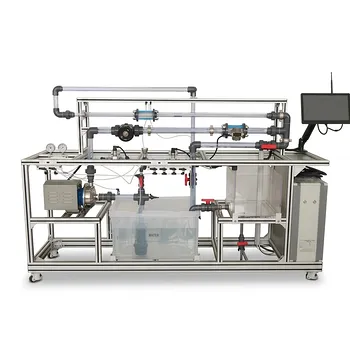
- Centrifugal Pump Performance and Orifice Flowmeter Calibration Educational Pilot Plant
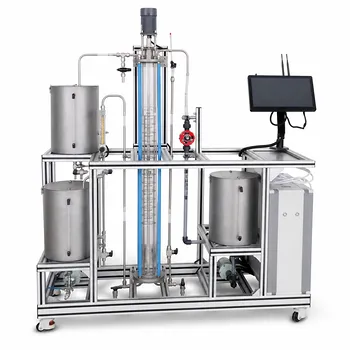
- Educational Rotary Disc Liquid-Liquid Extraction Pilot Plant
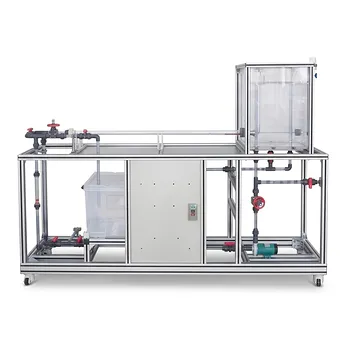
- Fluid Reynolds Number Demonstration Educational Unit Operations Pilot Plant
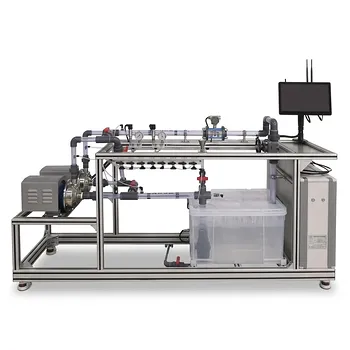
- Centrifugal Pump Performance Determination Educational Unit Operations Pilot Plant
- Rising and Falling Film Evaporation Educational Unit Operations Pilot Plant
People Also Ask
- What features should instructors look for in pump & flowmeter pilot plants? Key Selection Guide
- Why start a centrifugal pump with a closed outlet valve? Protect your pilot plant motors.
- How to update chemometric calibration models in pilot plants? Best practices for process engineers.
- How can cavitation and slurry erosion be studied and mitigated using fluid transport and centrifugal pump pilot plants?
- How do pilot plants demonstrate siphon pressure variations? Visualizing Bernoulli's Energy Balance