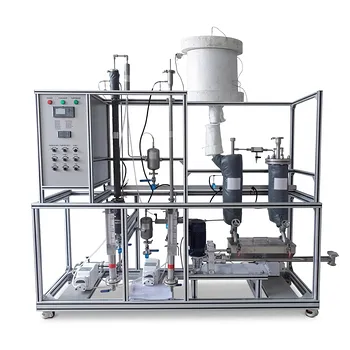
Temperature accelerates reactions because it increases the fraction of molecular collisions that can overcome the activation-energy barrier. In collision theory, the reaction rate depends on how often molecules collide, whether they have the correct orientation, and whether their collision energy is at least equal to the activation energy (E_a). This temperature dependence is represented by the Arrhenius equation, (k = A\exp(-E_a/RT)), and is demonstrated in pilot-plant training by measuring reaction rates at controlled temperatures and comparing the results with the predicted kinetic model.
The key idea is that temperature does more than increase molecular motion: it changes the fraction of collisions energetic enough to produce reaction. Pilot plants make this visible by linking controlled reactor temperature, measured concentration changes, calculated rate constants, and practical decisions about reactor operation and safety.
How Collision Theory Explains Temperature Dependence
Molecules must collide effectively
A reaction does not occur every time reactant molecules meet. The molecules must collide with sufficient energy and an appropriate orientation for bonds to break and form.
For a simplified bimolecular reaction,
[ A+B\rightarrow C+D ]
the reaction rate may be written as:
[ -r_A=kC_AC_B ]
Here, (C_A) and (C_B) are reactant concentrations, while (k) is the temperature-dependent rate constant.
Activation energy creates a threshold
The activation energy, (E_a), is the minimum energy required for reactants to reach the activated transition state. Only collisions with energy equal to or greater than this threshold can produce reaction.
At a given temperature, molecules have a distribution of kinetic energies rather than one common energy. Increasing temperature shifts this distribution so that a larger fraction of molecules can cross the activation barrier.
The Arrhenius equation describes the effect
The rate constant is commonly modeled as:
[ k=A\exp\left(-\frac{E_a}{RT}\right) ]
In this expression:
- (k) is the reaction-rate constant.
- (A) is the pre-exponential or frequency factor.
- (E_a) is the activation energy.
- (R) is the gas constant.
- (T) is absolute temperature in kelvin.
The exponential term represents the strong temperature dependence of the fraction of sufficiently energetic molecules.
The factor (A) represents collision-related behavior, including the frequency of encounters and, in practical kinetic models, the likelihood that collisions have a suitable orientation. The increase in collision frequency with temperature contributes to the overall effect, but the exponential activation-energy term is usually the dominant source of sensitivity.
How Pilot Plants Demonstrate the Principle
Students operate at several controlled temperatures
A training pilot plant can use a jacketed batch reactor or a continuous stirred-tank reactor with controlled heating and cooling. The same reaction is operated at several temperatures while other important variables—such as feed composition, concentration, mixing, and residence time—are kept as consistent as possible.
This isolates temperature as the principal operating variable affecting the observed rate.
Concentration changes reveal reaction rate
Students measure reactant or product concentrations using an appropriate analytical method. In a batch reactor, they may track concentration with time; in a continuous reactor, they may compare inlet and outlet concentrations after the system approaches steady operation.
The measured data are used to calculate the reaction rate and determine the rate constant (k) for each temperature.
For a bimolecular reaction, the working model may be:
[ -r_A=A\exp\left(-\frac{E_a}{RT}\right)C_AC_B ]
This connects the molecular explanation directly to the reactor-scale material balance.
An Arrhenius plot tests the model
Taking natural logarithms of the Arrhenius equation gives:
[ \ln k=\ln A-\frac{E_a}{R}\left(\frac{1}{T}\right) ]
Plotting (\ln k) against (1/T) should produce an approximately straight line when the selected kinetic model is appropriate.
The slope can be used to estimate the experimental activation energy:
[ E_a=-R(\text{slope}) ]
The intercept provides an estimate of the frequency factor (A).
Reactor performance makes the result tangible
Students can observe that increasing temperature generally increases conversion at a fixed residence time, provided the reaction is not limited by equilibrium, transport, or another process constraint.
They can then examine how the same kinetics affect reactor volume, residence time, heating demand, cooling duty, and control strategy during scale-up.
What Pilot-Plant Training Teaches Beyond the Equation
Temperature control is a design requirement
A reactor temperature is not simply a number selected to maximize rate. The pilot plant demonstrates the need for heating and cooling systems that can remove or supply heat at the required rate.
This is especially important for exothermic reactions, where an increase in temperature can accelerate the reaction and generate heat even more rapidly.
Thermal runaway must be considered
For a sufficiently exothermic reaction, poor temperature control can create a positive feedback loop: temperature rises, the rate increases, heat generation rises, and the temperature rises further.
Pilot-plant exercises therefore connect kinetic measurements with alarms, cooling capacity, emergency procedures, and operating limits. The goal is not only to achieve high conversion but to understand how safely the reactor can reach it.
Kinetics and equilibrium are different
Collision theory explains how temperature affects the rate of reaction. It does not by itself determine the final equilibrium composition of a reversible reaction.
For reversible exothermic reactions, higher temperature may increase the initial rate while reducing the equilibrium conversion. Training should therefore distinguish between operating conditions that produce rapid reaction and those that produce the desired final conversion.
Energy balances complete the picture
Pilot-plant operation also requires an energy balance. The heat released or absorbed by reaction, together with sensible heating and cooling effects, determines the required jacket or heat-exchanger duty.
The standard heat of reaction can vary with temperature because species heat capacities vary. This matters when designing temperature-control equipment across a broad operating range, although it is separate from the Arrhenius explanation of kinetic acceleration.
Understanding the Trade-offs
Higher temperature is not always better
A higher temperature usually increases (k), but it may exceed equipment limits, damage a catalyst, increase side reactions, or create unacceptable safety risks.
For irreversible reactions, the principal restriction may be materials, catalyst stability, or heat removal. For reversible reactions, equilibrium may impose an additional limit.
Experimental data are not automatically ideal
Measured rates can be affected by mixing, heat-transfer resistance, mass-transfer limitations, sampling delays, concentration errors, and temperature gradients.
If these effects are significant, the apparent activation energy may not represent the intrinsic molecular reaction barrier. Pilot training should therefore include checks that the reactor is well mixed and that the measured temperature represents the reacting fluid.
Arrhenius behavior has a range of validity
The Arrhenius equation is a useful model over a defined temperature range, but a straight-line Arrhenius plot is not guaranteed over all conditions.
Changes in reaction mechanism, catalyst behavior, phase, or transport regime can produce deviations. Such deviations are useful diagnostic evidence rather than errors to be ignored.
Temperature effects on rate and heat must be separated
Increasing temperature can accelerate reaction while also changing heating or cooling requirements. A successful operating policy must evaluate both the kinetic benefit and the thermal consequence.
This is why pilot plants are valuable: they expose the interaction between reaction kinetics, equipment response, control systems, and operating safety.
How to Apply This to Your Training Program
A well-designed exercise should move from controlled measurement to kinetic interpretation and then to reactor-operation decisions.
- If your primary focus is understanding collision theory: Run the same reaction at several controlled temperatures and relate the measured rate constants to the Arrhenius equation and activation-energy barrier.
- If your primary focus is estimating kinetic parameters: Determine (k) at each temperature, plot (\ln k) against (1/T), and use the slope and intercept to estimate (E_a) and (A).
- If your primary focus is reactor design: Use the temperature-dependent rate law in material balances to assess conversion, residence time, and reactor-volume requirements.
- If your primary focus is process safety: Compare the temperature-driven rate increase with available heating and cooling capacity, especially for exothermic reactions.
- If your primary focus is scale-up: Check whether mixing, heat transfer, and temperature uniformity remain comparable before treating pilot-plant kinetics as intrinsic reaction data.
By combining molecular theory with controlled reactor measurements, pilot-plant training turns temperature dependence from an equation into an observable and manageable engineering principle.
Summary Table:
| Key concept | Pilot-plant demonstration | Engineering insight |
|---|---|---|
| Collision theory | Operate a reactor at controlled temperatures | Only effective, high-energy collisions produce reactions |
| Arrhenius equation | Calculate rate constants at each temperature | Estimate activation energy and frequency factor |
| Reactor performance | Compare concentration, conversion, and residence time | Link kinetics to reactor sizing and operation |
| Energy balance | Measure heating and cooling requirements | Match reaction heat with thermal-control capacity |
| Process safety | Evaluate exothermic reactions and runaway risks | Set operating limits, alarms, and emergency procedures |
| Data quality | Check mixing, heat transfer, and temperature uniformity | Distinguish intrinsic kinetics from transport limitations |
Equip your students, researchers, and process teams with practical reaction-kinetics experience. LABPARK provides Educational and Vocational Unit Operations Pilot Plants for chemical engineering, bioprocess and biotech, and environmental and water-treatment training. Our systems help universities, research institutes, and enterprises measure temperature-dependent reaction rates, estimate Arrhenius parameters, evaluate reactor performance, and connect kinetics with heat transfer, process control, scale-up, and safety. Contact LABPARK to discuss a pilot-plant configuration aligned with your teaching, research, or industrial training requirements.
Related Products
- Fixed Bed Gas Solid Catalytic Reaction Educational Pilot Plant
- Multi Pump Fluid Transport Process Piping Unit Operations Training Pilot Plant
- Carbon Dioxide Hydrogen Methanol Synthesis Educational Unit Operations Pilot Plant
- Ethyl Acetate Synthesis Unit Operations Pilot Plant for Practical Training
- Natural Product Extraction Unit Operations Training Pilot Plant
People Also Ask
- Fixed-Bed vs. Fluidized-Bed Reactor: How to Choose the Right Pilot Plant for Gas-Solid Catalytic Reactions
- How to determine catalyst pore radius & porosity? Optimize your chemical engineering pilot plant.
- What reactor configurations study gas-solid reactions? Guide to key types and applications.
- How does identifying the rate-limiting step optimize reaction conditions? Pilot Plant Guide
- How do reactor pilot plants safely study gas-solid reactions? Master kinetics with thermal & flow control.